Alan Dershowitz has a famous name, a long resume, and no shortage of ways to answer his critics. Yet his loss at the Supreme Court exposes a problem that reaches far beyond one retired law professor.
On Monday, the court declined to revive his $300 million defamation suit against a major cable network over coverage of his remarks during President Donald Trump’s 2020 Senate impeachment trial. Lower courts found he failed to clear the “actual malice” standard from New York Times Co. v. Sullivan.
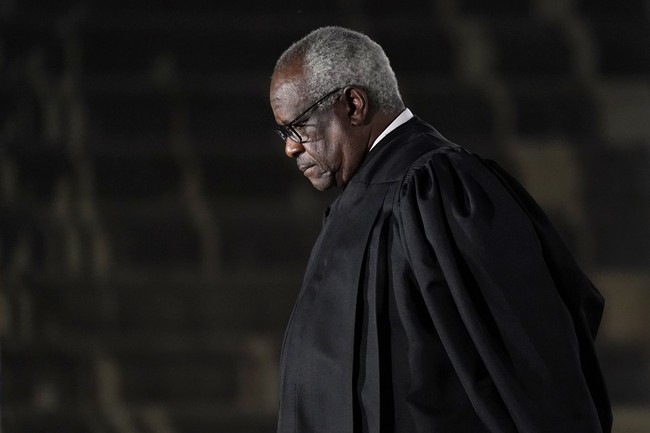
Associate Justice Clarence Thomas, joined by Neil Gorsuch, didn’t want to let the case pass; Thomas wrote that the actual-malice rule for public figures has no real tie to the Constitution’s text, history, or structure. From Newser:
It’s at least the third time since 2019 that Thomas has pushed for the court to reexamine the decision, which he argues got things backward. The ruling makes it harder for public figures to sue, but the “founding generation believed that, if anything, public figures had stronger claims for damages when they were defamed,” he wrote in his dissent. In its brief order, the majority declined to hear Dershowitz’s appeal, leaving intact lower-court decisions tossing his $300 million suit, per USA Today.
In his suit against CNN, Dershowitz said the outlet misrepresented his defense of Donald Trump during the first impeachment trial by airing incomplete snippets of his arguments. The upshot, he argued, was that CNN gave its viewers the incorrect impression that he believed presidents could bribe or extort people with impunity. Lower-court judges found Dershowitz hadn’t shown “actual malice,” the bar set in the 1964 case. Dershowitz complained that the standard “has devolved into near-absolute immunity for media defendants, even when they profoundly misrepresent verifiable public statements.”
He also argued that America’s founding generation saw public figures as having stronger claims for damages when someone defamed them, not weaker ones.
Sullivan came from 1964, when the court held that public officials must prove a defamatory falsehood was made with knowledge that it was false or with reckless disregard for the truth. The rule later grew to cover public figures; its original purpose had force. The country didn’t need local officials using libel suits as clubs against critics during the civil rights era.
There is real wisdom in protecting rough political speech: America shouldn’t hand governors, prosecutors, mayors, presidents, celebrities, and billionaires a legal billy club for every ugly sentence.
Still, the Sullivan rule has hardened into a shield for people and institutions that can repeat distortions, flatten context, and then tell courts the victim can never prove what was inside the speaker’s head.
Dershowitz claimed the network edited his impeachment-trial remarks in a way that made him sound as though he believed a president could do anything if reelection served the public interest.
The Eleventh Circuit noted that the network later gave him two on-air interviews to explain his position. The court still held that his evidence didn’t show actual malice, so the case failed.
So yes, Dershowitz lost under existing law, and Thomas is aiming at the foundation beneath that loss. His target is the old idea that reputational ruin is part of the price of entering public life.
A false charge moves faster than the correction; a clever edit travels farther than a transcript. A “public figure” may have a microphone, but often not as loud as the institution that framed him.
America has spent years watching people get smeared first and examined later. School board parents become “extremists.” Small-town officials become cartoon villains. A doctor, pastor, police officer, coach, or local candidate can get shoved into public debate and then told the legal hill is too steep to climb.
The bully doesn’t always carry brass knuckles; sometimes it has producers, lawyers, and a chyron.
The First Amendment isn’t a hall pass for a lie. It protects speech, but it does not bless calculated damage because someone dressed it in constitutional language. Thomas isn’t arguing that every bruised ego deserves a payday. He’s asking whether the court built a barrier the Constitution never required, then watched that barrier become a fortress around falsehoods.
Thomas put the problem in terms so blunt they sound less like a legal footnote than a challenge to the Court itself: “The actual malice standard for public figures bears no relation to the text, history, or structure of the Constitution. Instead, the founding generation believed that, if anything, public figures had stronger claims for damages when they were defamed.”
The majority declined to take the fight, resulting in an intact Sullivan, Dershowitz empty-handed, and Thomas one more for writing for a future case. He’s pressed the issue several times since 2019. Gorsuch has now shown enough concern to join him.
Two votes don’t change the law, but they do tell us the argument is still alive.
Media defendants will call that dangerous; they should worry more about the danger of a country where public life attracts people eager to destroy names with little fear of consequence.
Free speech needs room to breathe, and reputation deserves room to survive.
If you value independent conservative writing that still believes facts, accountability, and plain speech matter, now is a good time to join PJ Media VIP. Use promo code FIGHT for a 60% discount and help keep columns like this coming.