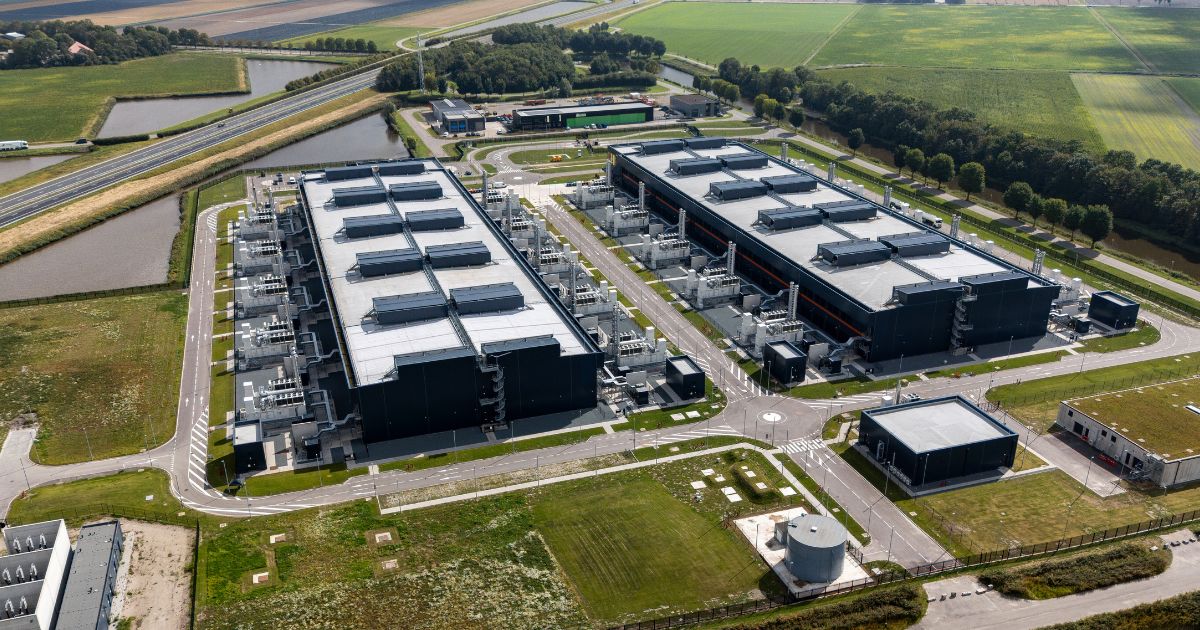
Politicians have found a slogan for the data center boom. Let the servers come, but make them “100% renewable.”
Wisconsin’s Democratic candidate for governor, David Crowley, put it in his platform. Similar language is turning up wherever a campus is proposed.
But which “100% renewable” do they mean?
There are two. In one, the servers physically run on wind and sun every hour. In the other, a data center draws whatever the grid is producing at 2 a.m. and buys enough renewable contracts and credits to match its consumption on paper over a year.
The second is an accounting ledger. The first is physics. They do not cost the same.
Wisconsin is a measuring stick. The Paris Solar-Battery Park in Kenosha County sits near Microsoft’s Mount Pleasant campus: about 500,000 panels on roughly 1,500 acres, 200 megawatts of solar, and the state’s first large battery, 110 megawatts for about four hours, or 440 megawatt-hours. The project ran about $575 million.
Microsoft says phase one of Mount Pleasant needs about 450 megawatts around the clock. That is 3.9 million megawatt-hours a year.
Start with the ledger. In Wisconsin, solar produces about 18 percent of its rated capacity over a year, so Paris generates about 315,000 megawatt-hours annually. Matching one hall on paper takes 12 to 13 Paris-sized projects: roughly 2,500 megawatts, 6.5 million panels, 19,000 acres, about 30 square miles.
Built as complete Paris plants, on the order of $7 billion. That is the cheap version of the promise. The servers still run on the grid at night.
Now the physics. Paris’s battery holds 440 megawatt-hours. The data center uses 450 every hour. A mid-January night in Wisconsin is about 15 hours of darkness, roughly 6,700 megawatt-hours, or about 15 Paris-sized batteries, before a cloudy day.
Five gray days need about 54,000 megawatt-hours, more than 120 of those batteries. Add a winter-sized solar fleet to refill them and, at current battery costs, about 25 Paris plants, 12 million panels, 60 square miles, tens of billions for one firm-powered hall is the right order of magnitude, before transmission, charging losses, and battery replacement.
For comparison, a new combined-cycle gas plant of that size is on the order of $1 billion. The Three Mile Island nuclear restart is $1.6 billion for 835 megawatts. Both run at night.
The companies building AI already know this. Microsoft announced it had matched 100 percent of its electricity with renewables annually. Its 2030 goal is now hourly carbon-free power.
Note the words: carbon-free, not renewable. Carbon-free includes nuclear, which is why Microsoft signed a 20-year deal for Three Mile Island, Meta contracted for the Clinton plant in Illinois, and Amazon put money into new reactors. Firm power is what runs the servers and the rest of the grid we depend on.
This is not an argument against solar. It is an argument against writing a slogan before understanding and defining it. It helps to have some concept of the real-world costs, which are many times the cost of natural gas.
Crowley’s platform backs nuclear because “reliable, carbon-free baseload power is essential to a grid that works for families and businesses.” Nuclear is carbon-free, not renewable. His data center rule appears to exclude the resource he says the grid needs and takes a decade or longer to build. Data centers need power right away, not a decade from now.
Gas turbines are backlogged. Data centers go up in two years. Candidates requiring “100% renewable” data centers are making one of two promises. If they mean the ledger, they should say so. If they mean all-the-time electricity from renewables, they should show voters the land, the batteries, and the bill.
This also applies to the grid we all use. Show us the costs.
Crowley is right that data centers should not shove grid costs onto households. Wisconsin regulators already require large customers to pay for the generation built for them. Pay your own way is policy.
“Wind doesn’t cost us. Sunlight doesn’t cost us” is a slogan. Fuel is free. Capacity in January is not.
Renewable certificates can balance a ledger. They cannot balance the grid.
AI works nights, weekends, and January. Energy policy has to work then, too, but for all of us, not just data centers.
The views expressed in this opinion article are those of their author and are not necessarily either shared or endorsed by the owners of this website. If you are interested in contributing an Op-Ed to The Western Journal, you can learn about our submission guidelines and process here.
Advertise with The Western Journal and reach millions of highly engaged readers, while supporting our work. Advertise Today.