In 2023, the Supreme Court told universities that race could no longer be used as a direct advantage or disadvantage in admissions. Three years later, the Justice Department says the UCLA School of Law kept race inside the process anyway, not through a checkbox, but through essays, diversity statements, recruiting events, and what the DOJ describes as a two-tiered system.
From the Department of Justice:
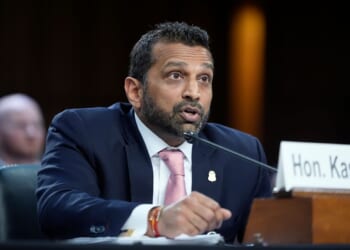
“Like many of its peer institutions, UCLA Law School runs a two-tiered admissions system whose academic bar for acceptance shifts up or down depending on the color of your skin,” said Assistant Attorney General Harmeet K. Dhillon of the Justice Department’s Civil Rights Division. “The use of race as a thumb on the scale that helps or disadvantages any student is illegal. The Department will continue to enforce equal treatment under the law everywhere — including in our nation’s law schools.”
The findings cover UCLA Law’s 2023, 2024, and 2025 entering classes. Assistant Attorney General Harmeet Dhillon said the school’s academic bar moved depending on an applicant’s race, with white and Asian applicants held to a different standard from black and Hispanic applicants.
The numbers are difficult to wave away. The DOJ says black applicants in 2025 had about seven times the admission odds of otherwise equivalent white applicants, while Hispanic applicants had about twice the odds. The median LSAT score for admitted black students was 168, compared with 172 for admitted white students, and 168 was also the median score for white and Asian applicants who were rejected.
The DOJ says the pattern didn’t disappear after the Supreme Court ruling. Its seven-year review found the racial effects persisted through 2025, and in 2024 and 2025 combined, half of admitted black applicants had LSAT scores at or below 90% of admitted white applicants.
UCLA Law’s own admission policy says it places “substantial weight” on grades and standardized test scores while also considering achievements, work experience, public service, leadership, hardship, and other lawful factors. Holistic admissions are legal, while using race as a hidden thumb on the scale isn’t, and the DOJ says the evidence shows that is what happened.
From UCLA Law:
In evaluating each applicant, UCLA Law places substantial weight on traditional measures of academic ability, namely grades and standardized test scores, specifically Law School Admission Test (LSAT) scores and Graduate Records Exam (GRE) scores.
We also recognize that other factors and attributes contribute greatly to a person’s ability to succeed as a law student and lawyer, including economic, physical or other challenges that have been overcome; scholarly achievements such as graduate study, awards and publications; the rigor of the undergraduate educational program undertaken; and letters of recommendation.
The most revealing piece may be an email sent before the Supreme Court issued its decision. The DOJ says Assistant Dean of Admissions Robert Schwartz told a prospective applicant that any change in the law that the Supreme Court announced “wouldn’t change anything at UCLA Law.”
After the ruling, the DOJ says staff members at a diversity admissions event explained how applicants could reveal themselves through essay responses and diversity statements.
The Supreme Court left universities some room to consider an applicant’s individual experiences, including hardships tied to race. Chief Justice John Roberts also made clear that schools couldn’t use personal essays as a back door to recreate the race-based admissions systems the Court had just struck down. An applicant may explain how adversity shaped character, but the school still has to evaluate the individual rather than award a racial preference.
The DOJ’s conclusion is serious, but it’s still an administrative finding, not a court judgment. UCLA Law rejects the accusation, says it complies with federal and California law, and describes its admissions process as comprehensive and merit-based. The school says it is confident in the process, and notes that California’s Proposition 209 already bars public universities from considering race in admissions.
From UCLA Law:
UCLA School of Law is committed to making admissions decisions in compliance with all applicable laws, including the California Constitution and Proposition 209, federal statutes, and the U.S. Constitution. Students are admitted through a comprehensive, merit-based review process that considers each applicant’s achievements and experiences. We are confident in our process.
UCLA’s denial deserves to be plainly stated, but the Justice Department now has seven years of application data, internal communications, and admissions materials behind its findings. The DOJ says the discrimination is ongoing, and is seeking a voluntary agreement to change the school’s practices. If negotiations fail, the department says it will file suit.
From the DOJ:
“Like many of its peer institutions, UCLA Law School runs a two-tiered admissions system whose academic bar for acceptance shifts up or down depending on the color of your skin,” said Assistant Attorney General Harmeet K. Dhillon of the Justice Department’s Civil Rights Division. “The use of race as a thumb on the scale that helps or disadvantages any student is illegal. The Department will continue to enforce equal treatment under the law everywhere — including in our nation’s law schools.”
The larger issue reaches beyond UCLA. The Supreme Court didn’t tell universities to stop using one particular form and then continue racial preferences through softer language, coded prompts, or applicant coaching. It told them race couldn’t be used as the reason one applicant gets an advantage over another.
If the DOJ’s findings survive scrutiny, UCLA Law didn’t misunderstand the ruling. Its own admissions official had already said a change in Supreme Court law would change nothing. Three years later, the federal government is saying the numbers, the documents, and the process show that race still mattered.
A Supreme Court ruling means very little if powerful institutions simply find another route around it. PJ Media keeps digging into the documents, numbers, and government findings behind stories like this one.