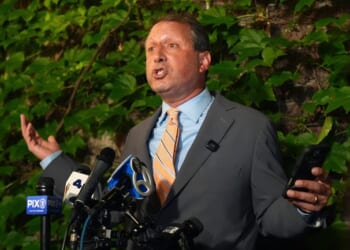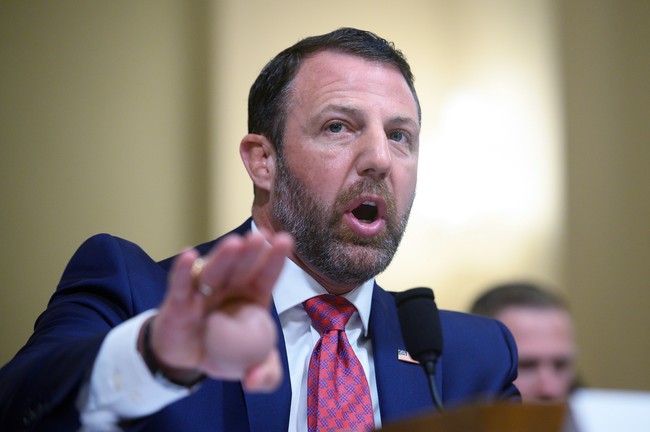
Secretary of Homeland Security Markwayne Mullin didn’t deny the rot inside Mexico, saying cartel money reaches “some very high-ranking places” and calling the corruption frustrating.
NewsNation Senior Border and Immigration Correspondent Ali Bradley asked, “The cartels are obviously at the helm of the movement of everyone at the border. The DEA has said that the Mexican government and the cartels are one in the same. Do you echo that sentiment, and how do you crack down on them if they’re working together?”
Mullin answered, “Well, we do know there’s corruption with inside — especially with our border communities, with the cartels. They’re very wealthy. We constantly have that issue with them paying off our southern friends in some very high-ranking places. And it’s frustrating to us. But we have a good partnership with President Sheinbaum and her administration. We work with them every single day. Our cooperation gets better at understanding their sovereignty needs, but understanding the criminal activity that flows north to south and south to north. And, as a partnership, we can defeat these terrorist organizations. They’re not just terrorizing Mexico, they’re also terrorizing our cities and states, too. And our goal is to defeat these terrorist cartels every single day. And so, the better we can work and partner together, the better we can go after these terrorist organizations.”
He also defended the daily partnership between the United States and Mexican President Claudia Sheinbaum’s administration.
Mullin is right to do both.
DEA Administrator Terrance Cole used harder language in July. He described a deadly connection between cartel networks and the Mexican government, then said they were “one in the same.”
From the DEA:
I’m proud of treatment and recovery communities, including people like Kathy Strain of the Partnership to End Addiction who joined the organizations after personal family tragedy motivated her to support others. Because of other people like Kathy, you remind this nation, it’s important to be involved. I am proud that together we are seeing signs of work that are making an impact. You see we’re here to strengthen those partnerships that will help end it.
Our goal this week is to improve the blueprint communities can take home, replicate and scale. Protecting Americans requires enforcement, education, prevention, treatment, recovery, and community action working together. This is how we save lives. This is how we build a Fentanyl Free America. At the DEA, enforcement is our foundation. We bring the full wave of this agency to the fight against the cartels, against the facilitators, the distributors, the money launderers, the chemical supply, and every individual that profits from poisoning American citizens. This includes the deadly connection between cartel networks and the Mexican Government. They are one in the same. And at DEA, they are our number one priority.
[Since the beginning of this Administration], DEA has seized over 568 million potential lethal doses of fentanyl. This is partly why this summit matters. Being here together, we send a clear message to the American people, to Washington, and to the cartels that the safety and health of our American people are not for sale. We tell our children they are worth fighting for. We tell families who have lost loved ones that their grief is not forget. We tell people struggling with substance use that their lives matter. We tell the cartels and every individual who profits from this poison that America, our Americans, are united. America is watching, and America is fighting back. We’re not simply here to talk about the fentanyl crisis, we are here to call for action. I want to wrap with the following. I know I’m over and I’m sorry. But this past Saturday, we concluded our Fentanyl Free America enforcement operations. It’s the fourth event in the last year, and in six weeks, we seized close to four million fentanyl pills in the United States, and 1,158 kilograms of fentanyl powder. Every seizure represents poison that will never reach a child, a college student, a veteran, a parent, or a neighbor. Every arrest disrupts networks. Every prosecution brings justice and sends a message. Every partnership makes us stronger. Thank you to President Donald J. Trump, and the Department of Justice that is led by the Attorney General Todd Blanche. DEA is attacking this crisis from every possible angle.
Although his statement was sweeping, the danger behind it is real. Cartels don’t survive for generations through gunmen and smugglers alone; they buy protection, intimidate public servants, corrupt police, and turn government offices into shields.
Federal prosecutors charged then-Sinaloa Gov. Rubén Rocha and nine other current or former Mexican officials in April with helping the Sinaloa Cartel move massive quantities of drugs into the United States.
The case reaches a senator, a mayor, prosecutors, police commanders, and security officials. The charges allege political support, bribes, leaked intelligence, protection for drug shipments, and cartel violence allowed to proceed without consequences.
Mexico has seen such betrayal before. Genaro García Luna, who served as Mexico’s public security secretary from 2006 to 2012, was convicted in 2023 of taking millions of dollars from the Sinaloa Cartel while holding one of the nation’s most powerful law enforcement posts.
Corruption at that level gives criminal organizations more than influence; it gives them time, territory, and access to the state’s machinery.
The cartels have also spread far beyond narcotics. A major July sanctions action targeted over 50 people and companies linked to the Jalisco New Generation Cartel. The network stretched across several Mexican states and included money laundering, fuel theft, smuggling, fraud, front companies, and bribery.
Mexican financial intelligence officials helped coordinate the action, proof that honest cooperation still exists inside a compromised system.
Sheinbaum rejected Cole’s accusation and called it political. Her response was predictable; no president can accept a blanket claim that her entire government is identical to organized crime.
Reuters, July 15, 2026:
In her daily press conference, Sheinbaum said the remarks seemed “a very unfortunate statement.” “It seems more like a political statement than one backed by evidence,” she added.
Sheinbaum said the DEA should focus its efforts on combating drug trafficking, distribution, and money laundering within the United States, which she described as the world’s largest market for illicit drugs.
On Tuesday, the Mexican government issued a formal statement rejecting Cole’s remarks, calling them inconsistent with the results of its anti-cartel efforts. The statement reiterated Mexico’s willingness to cooperate with Washington, provided such collaboration respects Mexican sovereignty.
The spat comes amid worsening relations between the U.S. and Mexico, with a U.S. indictment of Sinaloa Governor Ruben Rocha in April triggering a strong rebuke from Sheinbaum’s government which has said there is not enough evidence to execute a warrant for his arrest.
She also carries the burden of proving which side holds the greater power.
Speeches about sovereignty won’t settle the question. Arrests, prosecutions, extraditions, clean police forces, and protected witnesses will.
President Donald Trump’s administration can tighten the border, freeze cartel assets, prosecute traffickers, and disrupt the flow of weapons and money.
American pressure alone can’t reclaim Mexican towns, police departments, courts, and state governments.
That’s work Mexico needs to do, and its leaders must be strong enough to survive the threats and honest enough to refuse the money.
Mullin understands the hard reality; Washington must work with Sheinbaum without pretending corruption is small, rare, or safely contained. Partnership requires pressure, evidence, shared operations, and consequences for officials who serve the cartels.
Mexico’s culture, history, and people are greater than the criminals terrorizing them. The country’s future depends on whether its government proves the same thing through action.
Cartels thrive when corruption goes unanswered and powerful institutions look away. PJ Media keeps digging into the people, policies, and consequences behind the headlines. Join PJ Media VIP today and take 60% off with promo code FIGHT.