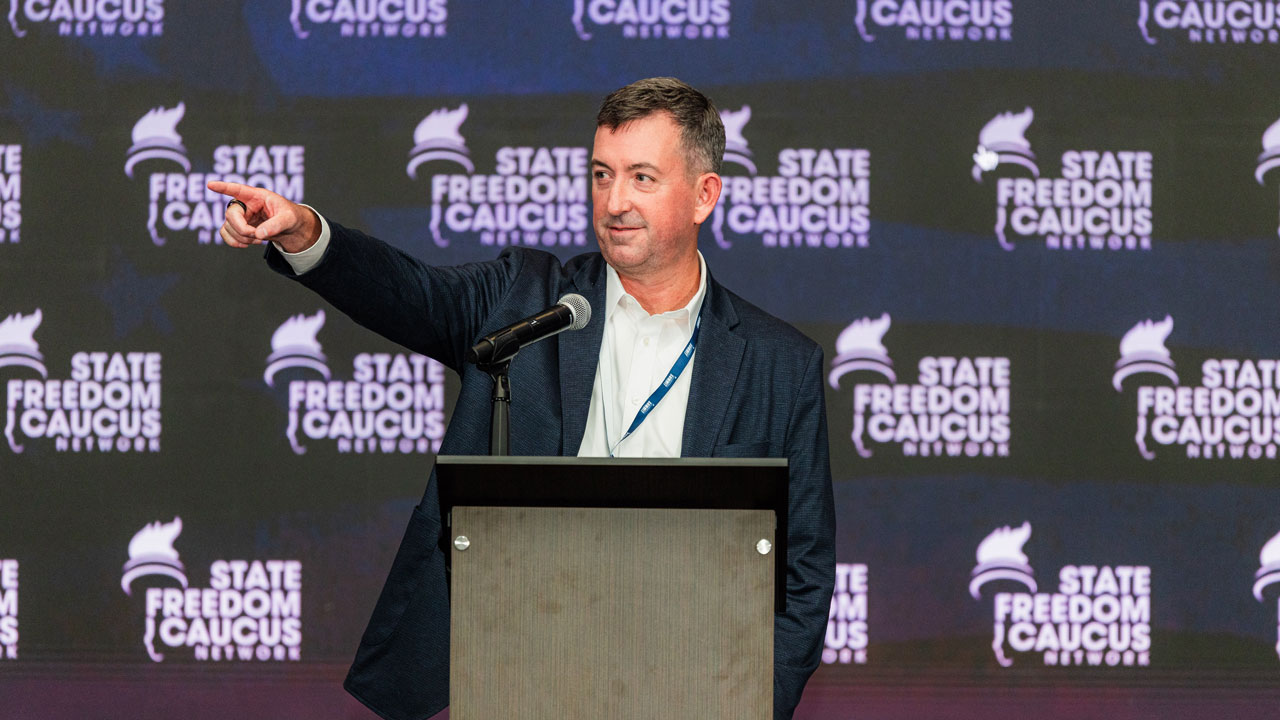
The State Freedom Caucus Network was founded to advance conservative legislation at state capitals across the country. Now, the group’s biggest obstacle isn’t Democrats—it’s so-called Republicans who don’t govern like it once they take office.
The State Freedom Caucus Network is a group of conservative state lawmakers determined to cut spending, secure American elections, and push state legislatures further to the right. Now the group, founded out of Congress’ House Freedom Caucus, works on everything from the 2030 census to removing Flock cameras and opposing government subsidies for data centers.
“The biggest challenge is combating Republicans that are not conservative in the state legislature,” State Freedom Caucus Network President Andrew Roth told the Daily Signal.
“Democrats in red states who want to run for office know they can’t get elected with a ‘D’ after their name, so they put an ‘R’ after their name, get elected, and then vote like Democrats,” he continued. “This isn’t a problem just in one or two states. It’s a problem in all 50 states. It’s especially a problem in red states.”
Roth said the goal of the network is to “set up state freedom caucuses in the state capitals and succeed at the state level.” The group currently has 180 members across 15 states, and many of those members plan to run for higher office.
This year, the network has its first opportunity to bring state freedom caucus members to Congress. Two State Freedom Caucus Network alums, Chuck Gray, secretary of state of Wyoming, and Blake Miguez, a Louisiana state senator, are running for Congress.
The group also has the opportunity in Arizona to have a former State Freedom Caucus Network member, U.S. Rep. Andy Biggs, R-Ariz., run the state as governor with a large freedom caucus supporting him in the state Legislature. Roth says that together they can “DOGE the entire state up and down” and pass conservative reforms.
The job of these conservative lawmakers, according to Roth, is not only to vote conservatively but also to “be loud about what’s happening in their state capital.”
“Each state is different, and each state freedom caucus has their own list of priorities. But the one thing that is constant among all of them is the budget,” Roth said. “Unlike Congress, states have the ability and the capacity to cut spending, if only they have the political will, and so our freedom caucuses lead on that.”
Thanks to the Missouri Freedom Caucus, the Legislature cut its budget by nearly $4 billion. Now, it’s lower than it was two years ago. “That’s squarely because of the Missouri Freedom Caucus,” Roth said.
Similarly, Wyoming’s and South Dakota’s budgets are as flat as they were two years ago. “Imagine if Congress had that sort of fiscal discipline,” Roth said.
He pointed to redistricting being a fight they take on all fronts. The State Freedom Caucus Network went on the offensive to get Missouri redistricted and fought in Maryland to prevent redistricting efforts there.
Roth also highlighted the State Freedom Caucus Network’s opposition to Flock cameras, saying, “Our members hate them.” He added that the West Virginia Freedom Caucus is backing a Fourth Amendment Restoration Act to restrict their use in the Mountain State.
Looking forward, he noted that big data center fights are coming next year. “[State incentives are] corporate welfare for tech companies that have billions and billions of dollars in cash. They don’t need tax dollars,” Roth said.
The Impact of the 2030 Census
Seemingly, the most important policy action on Roth’s mind is the 2030 census.
“I don’t think that people recognize the importance of it,” he told the Daily Signal.
The State Freedom Caucus Network is working to appoint a census director with a political mandate to require the 2030 census to have a question on citizenship. “We’re basically taking the SAVE Act template,” he said. The group recently sent a letter to President Donald Trump urging him to appoint a director to be confirmed by the Senate as soon as possible.
“The 2030 census is going to be a national conversation, and if we have fair, accurate census data that only counts citizens, then the Republican Party could be 260 seats [in Congress],” Roth said.
“The removal of the citizenship question from the household census form has empowered the noncitizen population count to deform congressional apportionment and state and federal redistricting,” the letter reads.
Roth’s Vision for the Conservative Network
Roth also shared his goals for growing the network of conservative freedom caucuses. He explained that the network receives an influx of requests from potential candidates hoping to join their state-affiliated caucus right before primary season, “because people want to be able to say they’re on freedom caucus before they go out and campaign.”
Already, the organization is in expansion mode, Roth says.
“I want to expand into states like Indiana, Arkansas, North Dakota, and Tennessee,” he said. “I want to take another shot at Maine. I think Maine has got a lot of potential. I think there’s a lot of conservatives up there. And we’re not afraid to go into blue states, obviously.”