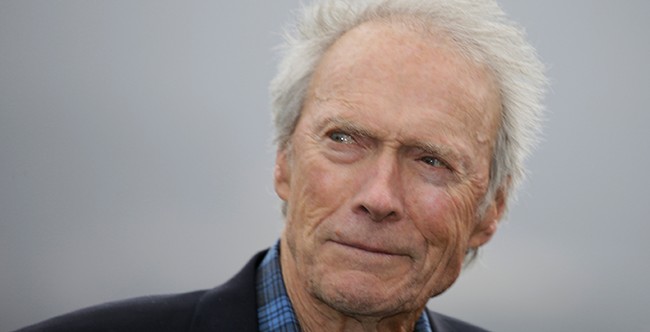
Of course we’re inviting Clint Eastwood to the Anti-Communist Film Festival. Eastwood, 96, is an American icon. He represents classic American values — the kind of values that people now call right-wing when, in fact, it’s the culture, not people like Clint, who have shifted. Clint represents a lot of us who get called radical because we don’t want high taxes or boys in girls’ bathrooms. We don’t vote for Marxists.
This political phenomenon is explored in the recent book Clint: The Man and the Movies — A Comprehensive Biography of Hollywood’s Most Iconic Actor-Director by Shawn Levy.
Eastwood was born in 1930 in San Francisco. A troublemaker as a kid who was held back in school, he was noticed by a talent scout in 1954 and landed a role on the TV series Rawhide. In 1963, Eastwood was cast in A Fistful of Dollars (1964), filmed in Spain by director Sergio Leone. The film was a hit and led to other westerns: For a Few Dollars More, The Outlaw Josey Wales, Hang ‘Em High. Eastwood went on to become the face of the Dirty Harry movies. He won Oscars for Best Director and Best Picture for 1992’s Unforgiven.
This is all known to most movie fans, but where the book Clint is most compelling is in analyzing Eastwood’s politics. Eastwood has always been a small-government guy who wants people to be left alone, whether it is running a business or living their personal lives. He’s more libertarian than conservative.
What happened, Levy argues, is that Eastwood stood firm to his pro-freedom positions as American culture shifted around him in the 1960s and 1970s. Eastwood did not cause the rise in crime in the 1970s, but his character of policeman Harry Callahan expressed the frustration of regular people seeing communities destroyed — in 2026, Harry might work for ICE. Eastwood also depicted the media as biased and reckless — this, as Levy notes, “when Donald Trump was still a businessman in New York.”
“He was still a man who felt entitled to define his own time and liberty when it came to sexual relationships and life partnerships,” Levy writes of Eastwood in the 1970s and 1980s. “ And he was still a political Libertarian, voting Republican in accord with his views on economic and defense issues but holding laissez-faire attitudes toward matters like abortion, gay rights, and legalized marijuana and even repeatedly speaking out in favor of stricter regulation of handgun ownership. None of that had changed since the early 1960s. But as he stood stock still, things around him had shifted in a way that made it seem as though he had moved. There had been a time, not very long before, when you could walk into college dorm rooms and see posters of him in his poncho and beard stubble alongside images of Jimi Hendrix and Che Guevara—icons of rebellion and resistance. But as the ʼ80s dawned, he seemed like a standard-bearer for what had become known, in an increasingly common phrase, as ‘traditional values.’ The center of American culture had shifted to the right.”
In his 1980 film Bronco Billy, Eastwood celebrated the regular working people who had been part of his film crews for decades. “Bronco Billy looked like a statement when, really, it was a movie about dreams and wishes—an effort to evoke the starry-eyed social-commentary comedies by Frank Capra and Preston Sturges,” Levy notes. “The sitcom-ish plot wasn’t what attracted Clint to it. It was the vibe: communitarian, optimistic, starry-eyed, even slightly goofy. In gathering a ragtag team of circus performers, and playing shows in small towns in the inland Northwest, and conveying lessons of hard work and decency and milk-drinking to kids, Bronco Billy was an old-timey cornball, yes, but he was also an emblem of the values with which Clint had been raised and which, in large part, he still believed.”
Eastwood described it this way: “I wanted to say something about everybody being able to participate. America is the maddest idea in the world, put together by madmen. So, here comes this tent. I suppose other people see America as a collage of crazies. Well, maybe we are kind of hard to fathom.”
There have also been missteps. In 2019’s Richard Jewell, Eastwood missed an opportunity to depict a reporter as tortured by her decision to defame an innocent man. Journalist Kathy Scruggs pointed at innocent security guard Richard Jewell as the guilty part in an Atlanta bombing. Levy convincingly argues that Eastwood shows her as a monster, when in reality Scruggs was tormented by her false reporting — a show of conscience rare in the media in 2025. “She was never at peace or at rest with this story,” Mike Kiss, one of her editors, once said. “It haunted her until her last breath. It crushed her like a junebug on the sidewalk.”
Consider yourself a VIP for the festival, Clint.
Editor’s Note: The Democrat Party has been infected by socialism, and it’s spreading FAST. Democrats are claiming there’s nothing to worry about, but we know the truth.
Help us continue to shine a light on the socialist takeover by joining HotAir VIP. Use promo code FIGHT to get 60% off your VIP membership.