We are pleased to present this guest essay from Matthew Hoy, political analyst and author of the new book, “Fact-Checking Frauds: How Fact-Checkers Distract, Deceive, and Distort Our Politics,” from which this essay has been adapted exclusively to Hot Air readers. We present guest essays on occasion to further debate and discourse on important topics. As always, the opinions expressed by the guest author do not necessarily represent those of Hot Air or Townhall Media.
The artificial intelligence revolution is here, and it’s being used by fact-checkers to stifle and silence conservative and contrarian points of view from spreading in the public square.
When City Journal’s John Tierney decided to write about the effects of Covid mask mandates for children and teens and the emerging scientific research back in April 2021, he never suspected that he’d find himself in a weird “Twilight Zone” where fact-checkers, AI, and censorship intersected.
Tierney’s original article, “Much to Forgive,” characterized mask mandates for children as “all pain and no gain.” Citing studies from various European countries with robust public health data and tracking, Tierney demonstrated that not only was mask-wearing detrimental to children’s health and education, but that they were also extremely unlikely to suffer serious medical problems if they caught the virus, and they generally didn’t spread the virus to those around them.
Needless to say, this was not a popular opinion among the public health czars in the United States, or a variety of power-hungry politicians in many blue states. It took little time for pushback to occur.
Shortly after publication, sharing Tierney’s article on Facebook would see the article tagged with “Partly False Information. Checked by independent fact-checkers.” This standard phrasing would turn out to be mostly false itself; it wasn’t checked by multiple fact-checkers, but a single one. And that single fact-checker didn’t actually check Tierney’s article, but one by a completely different author and publication.
The fact-checker in question, Science Feedback, part of Meta’s since-abandoned (in the U.S.) program using International Fact Checking Network (IFCN)-approved signatories, was the sole fact-checker to not come from a journalistic background. When it comes to science, you might think that maybe it’s better for scientists to fact-check science-related news. You’d be wrong; Science Feedback is manned by activists, who just happen to hold science degrees.
Three months before Tierney’s article was published, Science Feedback did a fact-check on an article touting a preprint of a German study on mask-wearing in children by the website GreenMedInfo. Though they don’t acknowledge it, it’s unlikely that anyone at Science Feedback actually read Tierney’s article before it got slapped with Facebook’s warning label.
Who read it? Perhaps it’s more appropriate to ask what read it? It appears the answer is likely Meta’s AI. Just a few months before Tierney’s article appeared, Facebook parent company Meta was touting its new AI technology called SimSearchNet++, which could detect memes and images with identical text, but with substituted images, crops, or other font and graphical changes. If their AI could accomplish this in late 2020, then a similar AI crawling its IFCN-approved partners’ fact-checks and articles posted to Facebook could connect links, sources, and references buried deep within both and make connections.
And that’s likely what happened. When you clicked on the Facebook-provided link to Science Feedback’s fact-check of Tierney’s article, it took you to a page featuring the fact-check of the GreenMedInfo article. There was no mention on their site of Tierney’s article or any of the other studies he cited. Meta’s AI made the connection; it’s unclear if any human at any point along the line—whether at Meta or at Science Feedback—made an independent decision to connect the two.
None of that stopped Science Feedback from defending its labeling of the article. City Journal and Tierney encountered a Kafkaesque denial of a wealth of supporting evidence for the case they made, reminiscent of the tobacco industry’s attack on early studies linking smoking and lung cancer.
Tierney’s article wasn’t the only one to be hit by this Meta AI-Science Feedback axis of censorship.
John Stossel, the Emmy Award-winning consumer reporter who worked for ABC News and Fox News over his long career, had one of his videos, “Government Fueled Fires,” also hit with the “false information” tag by Facebook and Science Feedback.
Stossel’s video, released in September 2020, blamed the wildfires then raging across many western states on a combination of climate change and poor forest management, but mostly poor forest management. Like in Tierney’s case, following the Facebook label back to Science Feedback didn’t result in an analysis of Stossel’s video, but to a fact-check of the claim: “Forest Fires are caused by poor management. Not by climate change.” The source for that quote is listed as “Facebook” and “Facebook users,” not John Stossel.
Which is both good and bad. It’s good that they don’t attribute that quote to Stossel. That quote doesn’t appear in Stossel’s video. Stossel doesn’t say it. Stossel’s main source in the video, Michael Shellenberger, author of “Apocalypse Never: Why Environmental Alarmism Hurts Us All,” doesn’t say it. It isn’t said in any of the various news clips interspersed throughout the video. But that’s also a problem. How can you credibly use a quote that doesn’t appear in the source material to fact-check and censor a news report?
It’s something that’s a serious breach for a journalist. Apparently not so much for activist fact-checkers.
In fact, using a variety of search engines to find that exact quote turns up only Science Feedback’s own site; it appears to have never appeared anywhere else on the Web. (Science Feedback doesn’t typically link directly to the claims they check—apparently an attempt to prevent their spread.)
The fact-check itself isn’t even original reporting in response to Stossel’s video. The fact-check was posted online a couple of weeks before Stossel’s video appeared and is a repost of wildfire-specific checks of a larger fact-check published months earlier on a Shellenberger article entitled “On Behalf Of Environmentalists, I Apologize For The Climate Scare.”
The application of “similar” fact-checks to entirely new claims by entirely new people is something that only Science Feedback does with the help of Meta’s AI.
When Stossel challenged Science Feedback’s labeling of his video, he filed an appeal with them (an almost universally futile move for most fact-checkers), which they ignored. Stossel then went on to interview two of Science Feedback’s experts listed on the fact-check they applied to his video—which neither of them had watched before Stossel contacted them.
In interviews with Stossel, the two reviewers, Stefan Doerr, a professor at Swansea University, and Zeke Hausfather of The Breakthrough Institute, both appeared to disagree with applying the fact-check of anonymous Facebook to Stossel’s video. That is, until Stossel told Science Feedback that he’d talked to them and what they’d said. Then, suddenly, it was as if the climate mafia had decided to turn the screws on its unwittingly conciliatory bagmen.
Then, Hausfather and Doerr return to the hardline party consensus that raging forest fires are caused by climate change…and only climate change… lest the proles start getting the wrong ideas.
When a connection is made between an article, video, meme, or post on Facebook and an IFCN-approved fact-check, it results in the warning label and, according to Meta’s own numbers, an up to 95% reduction in the number of people who saw the article on Facebook. Facebook’s policy also means that it’s not just these articles and videos that are throttled, but anything from those sources also suffers.
It’s unclear what concrete effects that meant for the distribution of Tierney’s City Journal article. For Stossel, being tagged a serial misinformer meant that his monthly income from Facebook dropped by approximately 45%. He said he now gets most of his income from YouTube.
However, something has changed at Facebook. Neither Stossel’s video nor Tierney’s article, if you share them today, bears that label. It’s gone. Why? It’s nothing that Stossel or Tierney did. They weren’t aware that the labels had disappeared until I informed them of the fact while writing my book.
Instead, it appears that the missing labels are likely a result of Stossel’s failed defamation lawsuit against Meta and Science Feedback over the fact-check. In dismissing the lawsuit, U.S. District Judge Virginia K. DeMarchi wrote that the Science Feedback’s “fact-check” “reflects a subjective assessment of the contents of the video and is not capable of being proved true or false.”
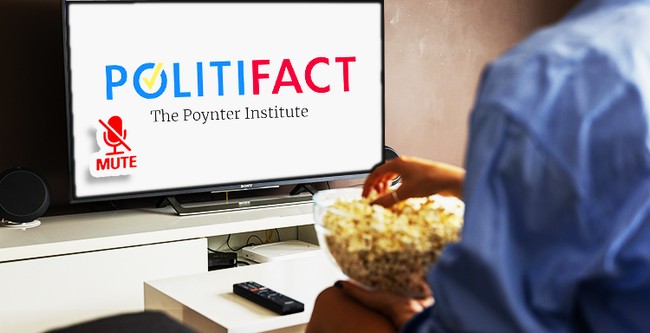
In a 2019 Columbia Journalism Review article, PolitiFact founder Bill Adair published an illustration that of the different types of journalism that put “Objective News” on one end of the spectrum, “Opinion” on the other end, and “Fact-checking” smack dab in the middle. Judge DeMarchi dismissed Stossel’s lawsuit because she found that fact-checking and opinion are one and the same.
I strongly suspect that it was Stossel’s lawsuit—and the likely six-figure (at least) legal bill that came along with it—that changed how Science Feedback and Meta work with applying labels to news articles and videos, including, obviously, some retroactively. When Science Feedback defended, to Stossel’s bewilderment, applying a fact-check of something that Stossel never said—that climate change had nothing to do with wildfires—to his video to reduce its distribution as “a misunderstanding of how fact-checking partners operate on Facebook,” it wasn’t Stossel that was out of line; it was Science Feedback.
Meta’s abandonment of its partnership with the IFCN in the United States, and some of the perverse incentives that financial support of sometimes questionable fact-checking entailed, is an indication that some fact-checking is beginning to reform itself.
However, the desire, especially by the political left, to combat “misinformation” remains. Too often, it is the labeling of political rhetoric as “False,” “Pants on Fire,” “Misleading,” “Missing Context,” or “Four Pinocchios” that both coarsens and distorts our political discourse.
There are many ideas and topics that are being removed from the shelves of the marketplace of ideas by fact-checkers. Adding the ubiquitous power of unrestrained AI and government impulses toward censorship—regardless of which party controls the White House—to the fact-checking industry’s quiver is a recipe for disaster.
This article is adapted from “Fact-Checking Frauds: How Fact-Checkers Distract, Deceive, and Distort Our Politics,” available now on Amazon.com. Read more from Matthew Hoy at his website and on his Substack, Hoystory On Air.
Editor’s note: We now have the room to run outside commentary by some of our favorite and most provocative thinkers on the Right. That only happens because of the support of our readers, who ensure that we have the resources to keep providing an independent platform and independent voices in a sea of Protection Racket Media domination.
Help us maintain that fight! Join Hot Air VIP and use promo code FIGHT to get 60% off your membership.