Every year in March, tens of thousands of Americans take to the streets – and bars – to celebrate St. Patrick, the patron saint of Ireland. Similarly, Mexican Americans celebrate the Feast of Our Lady of Guadalupe, Mexico’s patron saint, in December.
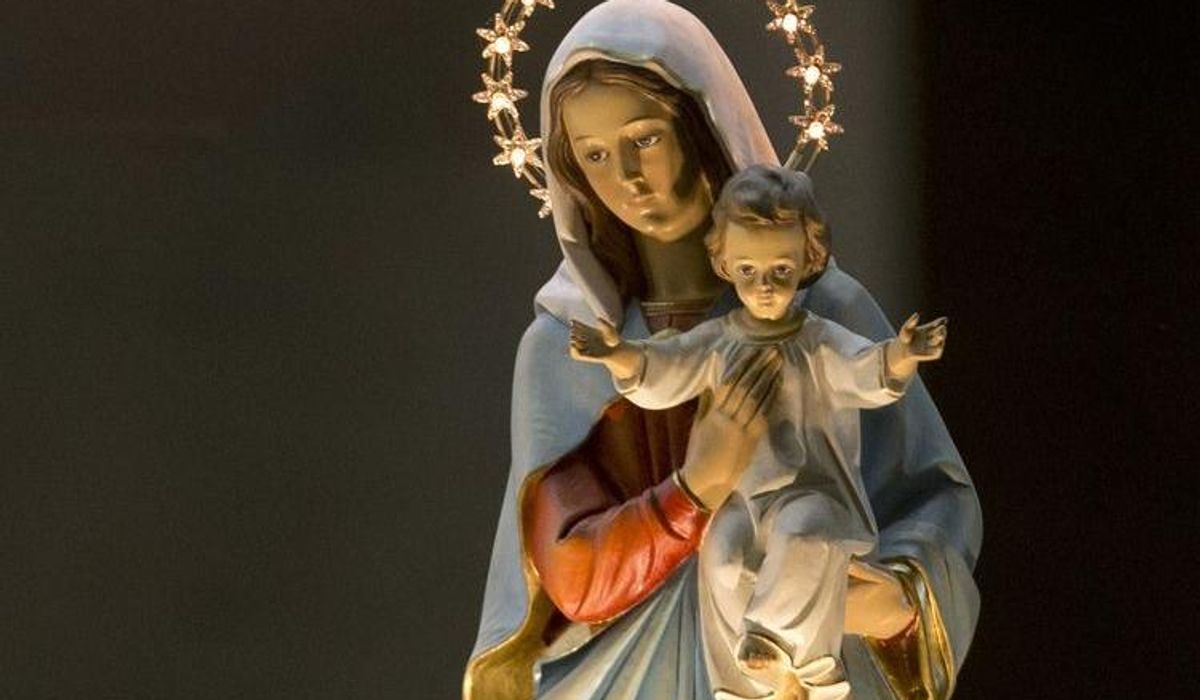
But did you know that the U.S. has its own patron saint? Nearly 200 years ago, in May 1846, Catholic priests and bishops named the Virgin Mary patroness of the United States of America – specifically, under her title as the Immaculate Conception, referring to the belief she was conceived without sin.
According to the Catechism of the Catholic Church, which summarizes doctrine, a saint is a holy person who “leads a life in union with God through the grace of Christ and receives the reward of eternal life.” Catholics may venerate saints and ask them to intercede with God on their behalf. Some are recognized, whether formally or informally, as “patrons” of particular situations, conditions, identities or places, often inspired by their life on Earth.
We are librarians at the University of Dayton who work in the Marian Library and the U.S. Catholic Special Collection. We recently created a digital exhibit with objects pointing to the history of this devotion to Mary as the Immaculate Conception in the United States – objects that reflect both patriotism and faith.
The Immaculate Conception
Mary is known by many names and titles, including the Virgin Mary, Mary of Nazareth, Our Lady of Lourdes, Holy Mother of God, Queen of Heaven, Seat of Wisdom and Mystical Rose.
One important title is Immaculate Conception, referring to the Catholic belief that Mary was free of “original sin” and therefore suitable to be the mother of Jesus Christ. The Catholic Church teaches that all other people are conceived with original sin as a result of Adam and Eve’s disobedience to God in the Garden of Eden.
Originally, the idea that Mary was free of original sin was widely debated within the Catholic Church. But the teaching was defined as dogma on Dec. 8, 1854, by Pope Pius IX. The feast day of the Immaculate Conception is now celebrated by Catholics on Dec. 8 each year. Even before its official acceptance, devotion to the Immaculate Conception influenced the art and teachings of the Catholic Church.
Patroness of the United States
How did Mary, as the Immaculate Conception, become patroness of the United States?
John Carroll, who became the first American bishop in 1790, was devoted to Mary throughout his life. In 1791, he and other American Catholic clergy consecrated the Diocese of Baltimore to Mary, asking her to “[preserve] from all evil” the people of the diocese.
Half a century later, in 1846, a council of priests and bishops from across the country officially named Mary, under her title as the Immaculate Conception, the patroness of the entire United States, asking her for “the aid of her prayers.”
Devotion to the Immaculate Conception has remained an important part of the faith lives of many American Catholics, even if they are unaware of her patronage of the United States. This devotion is demonstrated by the many churches that are named for the Immaculate Conception, jewelry depicting the Immaculate Conception and the inclusion of the Feast of the Immaculate Conception as a holy day of obligation in the U.S. – a day when Catholics are expected to attend Mass.
On Feb. 7, 1847, the Vatican approved the request to make Mary, as the Immaculate Conception, the patroness of the United States. This was seven years before the dogma was defined by the pope, pointing to the popularity of this devotion even before official recognition.
Bicentennial holy card
Many items in the Marian Library’s collection, such as holy cards, also demonstrate American Catholics’ devotion to Mary as the Immaculate Conception. A holy card is a small portable devotional tool, often including an image of Jesus or a saint on the front. Typically, a prayer, devotion, scripture passage or commemoration of an important event is printed on the reverse side.
One of our cards features an image of Mary as the Immaculate Conception above the words: “Immaculate Mary, Patroness of the United States, Pray for Us.” The reverse commemorates the bicentennial of the United States in 1976, followed by the motto of the United States, “In God We Trust.”
The image of Mary is a reproduction of “The Immaculate Conception of El Escorial,” a painting by 17th-century Spanish painter Bartolomé Esteban Murillo in the collection of Madrid’s Museo del Prado. The painting reflects artistic traditions that symbolize the theology behind the Immaculate Conception.
Mary is shown with a blue garment: a color associated with faith, humility, the heavens and the sea. Since blue pigments were very expensive during the Renaissance, the color was reserved for important figures, particularly paintings of Mary.
Other symbols, though, are specific to Mary as the Immaculate Conception. She stands with a moon beneath her feet, inspired by the “apocalyptic woman” from the Bible’s Book of Revelation: “a woman clothed with the sun, with the moon under her feet, and on her head a crown of twelve stars.” Catholic theologians interpret this figure as a reference to Mary, establishing her as mother of all Christians.
In other artwork of the Immaculate Conception, Mary is depicted with a snake beneath her feet, a crown of 12 stars or a dragon – also inspired by Revelation, Chapter 12.
American rosary
Another important object of Catholic devotion, the rosary, encourages reflection on the lives of Jesus and Mary. The word can refer to a physical object – a set of 50 beads or knots on a string – or certain sets of prayers, including Hail Mary and Our Father. Touching the beads as they pray helps Catholics keep track as they recite the prayers.
The “American Rosary” in our collection was designed by Marie George of New York in 1956, though archivists do not know exactly who she was. It uses beads in the patriotic colors of red, white and blue, and it includes a Miraculous Medal, which depicts Our Lady of the Immaculate Conception. A card included with the rosary encourages Catholics to offer prayers “for World Peace, with Justice and Charity.”
Across centuries
For much of U.S. history, Catholics in the United States often faced prejudice and discrimination. In the mid-19th century, when Mary as the Immaculate Conception was named patroness, the Protestant majority of the U.S. was deeply suspicious of Catholics’ loyalty to the pope.
The bicentennial holy card and the American rosary from the following century, both dedicated to the Immaculate Conception, reveal how American Catholics still sought to demonstrate that their faith and their patriotism did not conflict with each other.
In 2026 – the 250th anniversary of the United States, and the 180th anniversary of Mary’s patronage – some of that history may feel distant. The Catholic Church elected the first American-born pope, Leo XIV, in 2025, and the United States has seen a surge in Catholic conversions in 2026. But Catholics still ask Mary, as patroness of the U.S., for her intercession: not only in their lives, but for their country.
The Conversation is an independent and nonprofit source of news, analysis and commentary from academic experts. The Conversation is wholly responsible for the content.