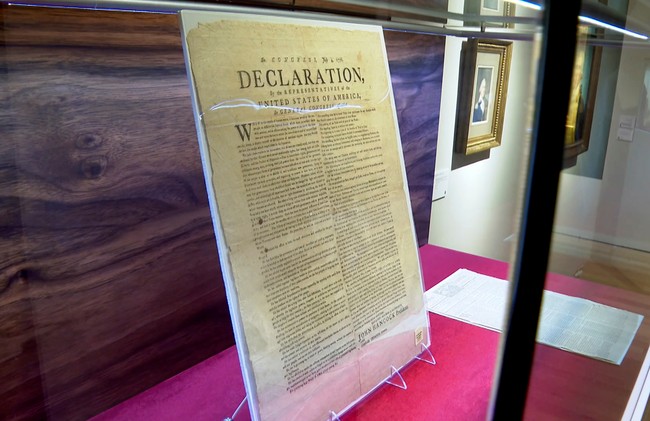
Saturday, July 4, 2026, we Americans celebrate the 250th commemoration of the Proclamation of our Declaration of Independence on July 4, 1776, and after God, we should also thank Scotland for much of the spirit that energized those original patriots.
Thank Scotland? Why yes, and in the spirit of full disclosure, I should let readers know here at the outset that, while my Dad’s last name, “Tapscott,” is likely from the English side of the England/Scotland border, I am a MacFarlane on Mother’s side.
The MacFarlane clan is said to have fought with William Wallace at Stirling Bridge and with Robert the Bruce at Bannockburn for Scottish independence, but they are probably more familiar these days for the “MacFarlane’s Moon.” That’s the full Moon that aided the clan in its frequent excursions of cattle thievery!
Now, with that out of the way, you bet I am proud to have Scots blood in my ancestry because it is quite possible the Revolutionary War would never have happened or been won but for the hundreds of thousands of Midland and Lowland Scots, and Scots-Irish from Ulster, Ireland, who migrated to the American colonies — mainly the Middle and Southern colonies — during the first seven decades of the 18th century.
The vast majority of those Scots were Presbyterians at a time when to be a Presbyterian meant you saw God as absolutely sovereign, Kings and other ministers of government as answerable to Him for their treatment of subjects, and when Jesus said “render unto God the things of God and to Caesar the things of Caesar,” He meant Caesar’s job was mainly to keep the peace and punish wrong-doing.
Plus, the right of every individual to read and follow the Bible as he understood it could never be encroached by the state, church, or anybody else. These were the core beliefs of the Scottish Kirk, the creation of the Reformation’s John Knox, founder of the Scots Presbyterian church. Combine such fiercely independent spiritual principles with the natural independence and fighting spirit of the Scots, and the result was a political powder keg to be lit on behalf of individual liberty and limited government.
It’s not coincidental that the lone minister signing the Declaration of Independence was John Witherspoon, the widely respected and influential New Jersey Presbyterian. Neither is it coincidental that then-British Prime Minister Horace Walpole told King George III and his cabinet that “there is no use crying about it. Cousin America has run off with a Presbyterian parson, and that is the end of it!” Walpole almost certainly had Witherspoon in mind.
Our history books once included the story from Revolutionary Lore about a certain Chaplain of the Continentals encouraging his fellows to “Give’em Watts, boys,” which was Rev. James Caldwell, another Scots Presbyterian from New Jersey. Caldwell was referring to the widely used hymnbook compiled by Isaac Watts that was in use throughout Protestant churches of the day.
The soldiers thus tore out pages of the book to use as the essential paper wadding for their muskets’ powder and balls. Caldwell, the “Fighting Parson,” was, like so many of the Founders, a graduate of Princeton, where he studied under multiple Presbyterian lights.
Among Witherspoon’s most admiring students was one James Madison, who provided the essential concepts underlying our Constitution, including separation of and balance of powers among three independent branches, each with specific rights and powers. Another Founder who was greatly influenced by Witherspoon and multiple men of the Scottish Enlightenment, like economist Adam Smith and philosopher Thomas Reid, was Alexander Hamilton.
Between them, Madison of Virginia and Hamilton of New York composed 84 of the 85 numbers that make up what we know today as “The Federalist Papers,” which appeared in newspapers throughout the 13 states and provided the decisive arguments that enabled the adoption of the Constitution and the official creation of the United States.
I could go on, but for those who yet nurture doubts about the influence of the Scots and Scots-Irish on the Founders, I invite them to compare the text of our Declaration, composed in June and July of 1776, with the following text composed in May 1775, and known as the Charlotte Mecklenburg Declaration:
1. Resolved, That whoever directly or indirectly abetted, or in any way, form or manner, countenanced the unchartered and dangerous invasion of our rights, as claimed by Great Britain, is an enemy to this country – to America – and to the inherent and inalienable rights of man.
2. Resolved, That we the citizens of Mecklenburg county, do hereby dissolve the political bands which have connected us to the Mother Country, and hereby absolve ourselves from all allegiance to the British Crown, and abjure all political connection, contract, or association, with that nation, who have wantonly trampled on our rights and liberties — and inhumanly shed the innocent blood of American patriots at Lexington.
3. Resolved, That we do hereby declare ourselves a free and independent people, are, and of right ought to be, a sovereign and self–governing Association, under the control of no power other than that of our God and the General Government of the Congress; to the maintenance of which independence, we solemnly pledge to each other, our mutual co-operation, our lives, our fortunes, and our most sacred honor.
4. Resolved, That as we now acknowledge the existence and control of no law or legal officer, civil or military, within this country, we do hereby ordain and adopt, as a rule of life, all, each and every of our former laws, wherein, nevertheless, the Crown of Great Britain never can be considered as holding rights, privileges, immunities, or authority therein.
5. Resolved, That it is also further decreed, that all, each and every military officer in this county, is hereby reinstated to his former command and authority, he acting conformably to these regulations. And that every member present of this delegation shall henceforth be a civil officer, viz. a Justice of the Peace, in the character of a ‘Committee-man,’ to issue process, hear and determine all matters of controversy, according to said adopted laws, and to preserve peace, and union, and harmony, in said county, — and to use every exertion to spread the love of country and fire of freedom throughout America until a more general and organized government be established in this province.
This document was composed by Scots Presbyterians who were the largest segment of the North Carolina population at the time of the American Revolution. They were reacting to the “shots heard round the world” at Lexington and Concord in Massachusetts.
It would not surprise me to learn that at least some of those North Carolina Scots Presbyterians knew this passage from the Declaration of Abroath, Scotland, signed by 50 some Scots nobles, in a warning to their King that should he “agree to make us or our kingdom subject to the King of England or the English, we should exert ourselves at once to drive him out as our enemy and a subverter of his own rights and ours, and make some other man who was well able to defend us our King; for, as long as but a hundred of us remain alive, never will we on any conditions be brought under English rule.” (Emphasis added)
Something worth pondering long and hard as we celebrate the miracle of America.
Editor’s Note: It’s America’s 250th birthday! Help PJ Media celebrate the greatest nation in history by honoring its past, defending its present, and preserving its future with reporting you can trust.
Join PJ Media VIP and use promo code AMERICA250 to receive 74% off your membership.