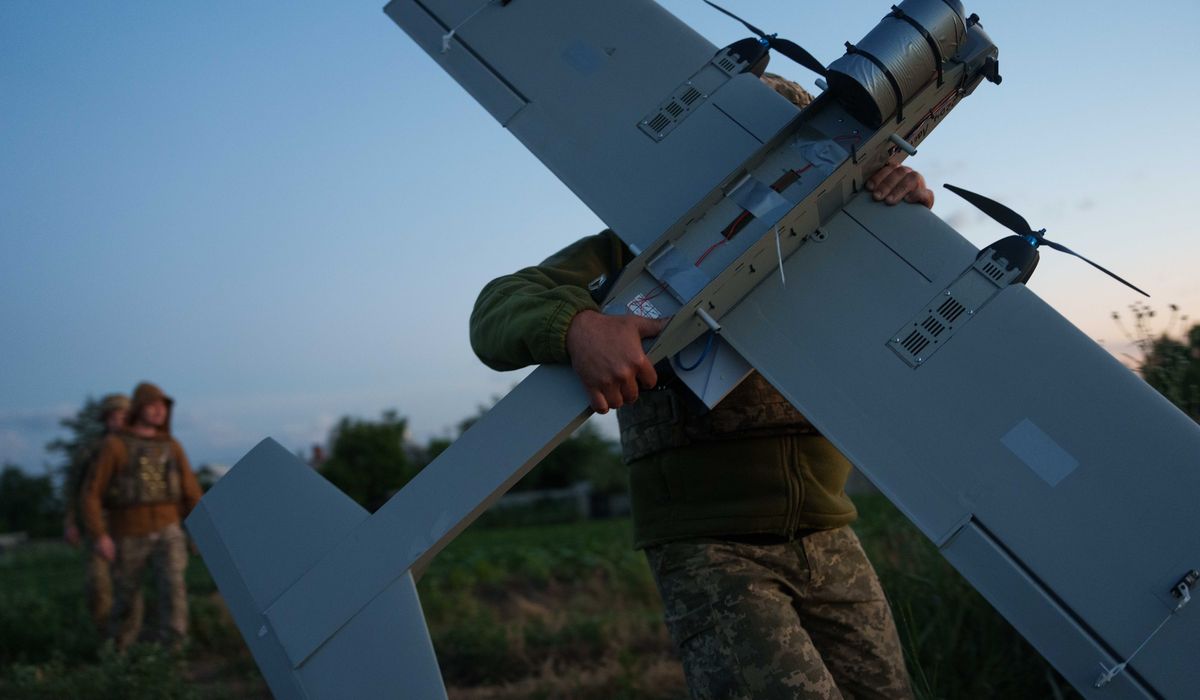
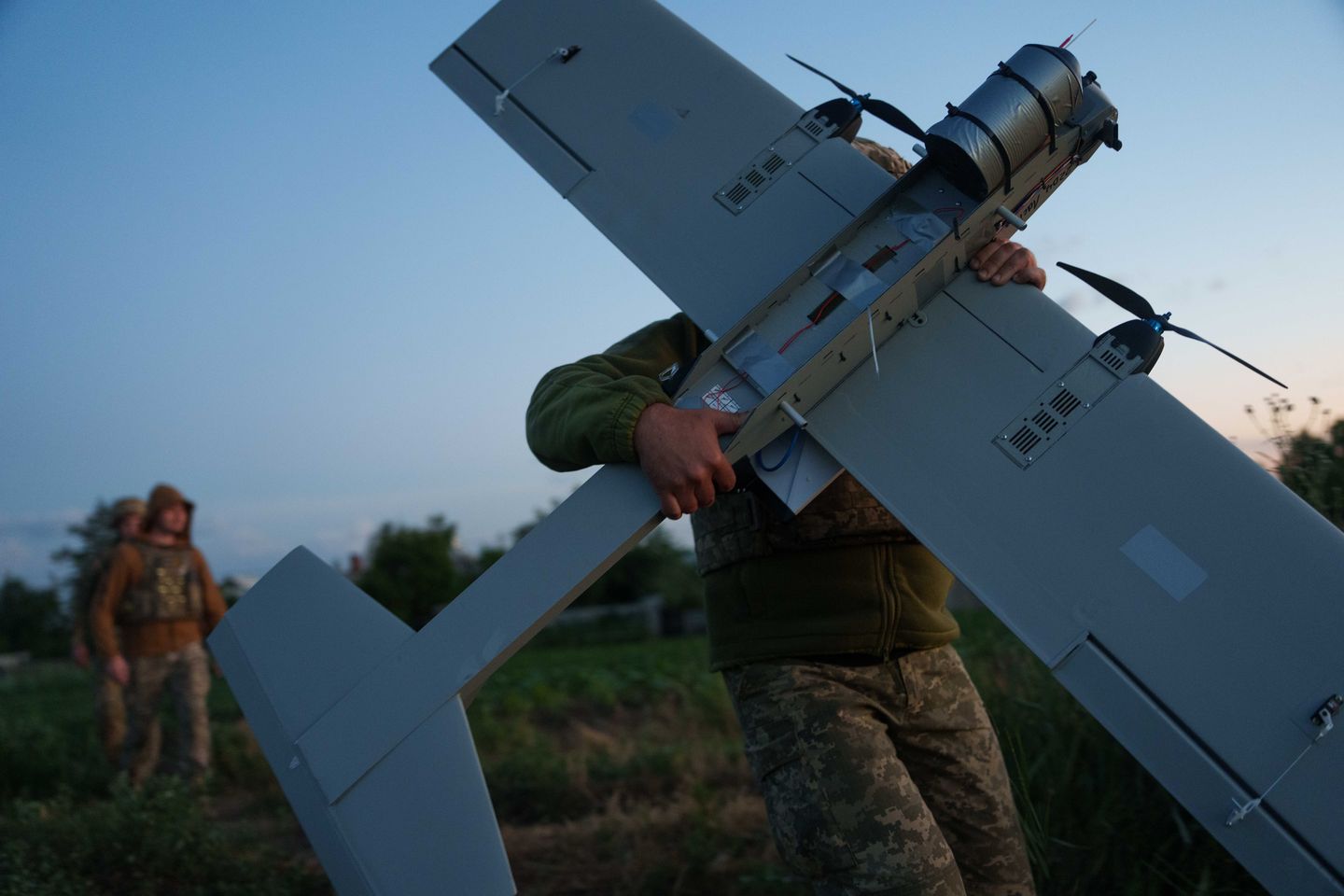
PARIS — At this year’s edition of Europe’s largest land warfare exhibition, Ukraine no longer looked like a mere recipient of foreign military aid.
Across the halls of Eurosatory, just outside Paris, Ukrainian firms displayed drones, ground robots, electronic warfare systems, battlefield software, missiles and counter-drone technology shaped by more than four years of modern, full-scale war.
While Ukraine is still dependent on Western aid, especially for air defense systems and ammunition, the country’s defense companies are increasingly looking like attractive partners for European officials and arms manufacturers.
The shift was visible in the size of Ukraine’s delegation: Organizers said about 80 Ukrainian companies were present at Eurosatory this year, compared with roughly a dozen at the previous edition.
Some came under the national ZBROYA brand. Others arrived with their own stands, their own products and, increasingly, their own foreign partners.
The war has turned Ukraine into one of the world’s most dynamic defense innovation laboratories.
That phenomenon is now beginning to reshape its relationship with Europe as Kyiv wants to move away from being an arms recipient to becoming a global defense supplier.
European firms, meanwhile, are looking at Ukraine for lessons in speed, drones, electronic warfare and battlefield feedback — as well as inspiration to reform and modernize their own procurement systems.
“The experience of Ukraine in defense is a real guarantee of security for Europe,” President Volodymyr Zelenskyy told European Union foreign ministers in March.
Ukraine has opened a controlled wartime export mechanism for domestic defense producers, a major step for a sector that has grown rapidly since the 2022 invasion but has often been constrained by export bans and a shortage of capital.
Under the new framework, companies will be allowed to export certain weapons, technologies and components to partner countries, while a share of proceeds will go back into a state defense fund.
The goal is to solve one of Ukraine’s central wartime paradoxes: Its manufacturers can build drones, electronic warfare systems, ammunition and other weapons at scale, but state demand and budget limits do not always match their production capacity.
Exports and foreign co-production could give companies the money to expand while keeping Ukraine’s army first in line for critical systems.
The model is already moving beyond theory.
Germany’s Quantum Systems and Ukraine’s Frontline Robotics created Quantum Frontline Industries, a joint venture producing Ukrainian-designed Linza drones in Germany for the Ukrainian Armed Forces. It is one of the clearest examples of the emerging formula: Ukrainian battlefield design paired with European capital and industrial infrastructure.
At Eurosatory, other partnerships pointed in the same direction.
Ukrainian company Fire Point announced a partnership with German radar maker Hensoldt around Freyja, a ballistic missile defense system. Brave1, Ukraine’s defense technology cluster, and France’s Defense Innovation Agency launched Brave France, a 20 million euro program meant to support joint French-Ukrainian projects in missile technologies, unmanned systems and counter-air capabilities.
For Andriy Hrytseniuk, chief executive of Brave1, Ukraine’s advantage is not any single weapon, but rather the dynamic ecosystem that produces them.
“The decisive factor is not any single element,” he told The Washington Times. “It is the defense innovation ecosystem Ukraine has built.”
That ecosystem has been forced to evolve at breakneck speed.
According to Mr. Hrytseniuk, drones now account for more than 80% of strikes on the battlefield. Around the front line, he said, a “kill zone” has formed, once estimated at roughly 20 kilometers deep, where vehicles can no longer move effectively because of the mass use of drones.
Ukraine is also pushing quickly into artificial intelligence and autonomy.
More than 200 Ukrainian companies are developing and producing AI-enabled drones, Mr. Hrytseniuk said, while more than 70 AI and computer vision systems are already in active use at the front.
“Quantity, autonomy, EW resistance, and interceptor drones all matter, but only when they are developed and deployed together,” he said. “What gives Ukraine an advantage is the ability to quickly integrate these elements, test them, and scale the solutions that work.”
That is the part Europe is now trying to absorb — and fast.
The lesson from Ukraine is not simply that armies need more drones, but rather that weapons now change faster than traditional defense procurement cycles can handle.
Achi Takagama, founder and chief executive of Ark Robotics, said the war should be understood as a turning point comparable to the arrival of gunpowder in late medieval Europe.
“It is the same kind of change in the dynamics and the same change in the asymmetry of defense,” he said.
Ark Robotics builds unmanned ground systems and related infrastructure, with operations across Ukraine, Estonia and Poland. Its core thesis is that defense should be treated as a subset of robotics rather than robotics as a narrow branch of defense.
“We are very bullish on the thesis that in the next five to 10 years, every defense force in the world is going to have 10 to 100 times more unmanned systems than human soldiers,” Mr. Takagama said.
That future requires armies to rethink how they move, supply, fight and command.
“People still think of drone defense in the paradigm of the previous war,” he said. “They try to layer drones on top of normal operations. You do convoys, and then there are drones protecting the convoy. But you don’t do convoys anymore. You do your logistics using robots, and you try to make it distributed.”
That change is already happening in Ukraine, where ground robots and aerial drones are increasingly used for supply runs, casualty evacuation, reconnaissance and direct attacks. Mr. Takagama said logistics has “already been transformed by robotics” and that the next wave will involve robotic platforms across air defense, breaching, strike and assault missions.
The economics are changing as well. In a war of attrition, exquisite platforms are often too expensive to lose and too slow to replace.
“You cannot have a ground robot that costs $200,000,” he said. “You need a ground robot for $20,000 or less.”
At Eurosatory, Mr. Takagama said, the tone of conversations with foreign customers had changed sharply from previous years.
“The conversation is no longer: do we want to buy this?” he said. “It is: when can you ship it, what are the dates, what is the price, and do you have manufacturing in Europe?”
From the other side of the partnership, Western European firms are drawing similar conclusions.
Daniel Nef, co-founder and chief executive of the French company Rift, said his firm was created at the beginning of the war after seeing what was happening in Ukraine and “the speed at which technologies were evolving.”
Rift develops an aerial surveillance infrastructure built around long-endurance drones, autonomous stations and software that can coordinate several aircraft over large areas. The company says its system can provide 24/7 surveillance of borders, coastlines, pipelines, railways and other sensitive military and civilian sites without putting operators in the field.
The Ukrainian influence is visible in its production model.
Mr. Nef said Rift can move from manufacturing a drone to testing it in about three days, a cycle inspired by the rapid iteration seen in Ukraine. The company is also working on counter-drone and interceptor capabilities, including concepts shaped by Ukraine’s fight against Russian Shahed attack drones.
“We were inspired by what is being done in Ukraine,” he said.
Ukraine has shown that the battlefield is increasingly transparent, fast and lethal. Drones find and destroy targets, electronic warfare disrupts them, software shortens the time between detection and strike, and cheap systems can impose painful costs on expensive platforms.
Yet the war has also shown that technology alone is not enough: Ukraine’s battlefield is still defined by artillery and ground warfare, complete with muddy trenches, endless lines of fortifications and manpower shortages. European armies need drones and AI, but they also need ammunition, maintenance, spare parts, trained operators and industrial depth.
That combination is driving a broader European response.
The European Union is moving to integrate Ukraine into its defense-industrial planning, including through funding mechanisms to modernize Ukraine’s defense base and proposed common European projects in drones, counter-drone systems, air and missile defense, maritime security and the eastern flank.
For Ukraine, exports and co-production bring much-needed liquidity and buy it political influence. For Europe, Ukraine offers a shortcut to lessons learned under fire.
The risk, however, remains that Europe admires Ukraine’s speed without truly adopting it.
Mr. Takagama said the old model of defense procurement, in which governments order complex systems and wait years for delivery, is no longer suited to the pace of war.
“The previous model was: order some fancy stuff, wait for 10 years, and then it ships,” he said. “This is a very different dynamic. Here, you have one-, two-, three-month iteration cycles. You get feedback and rebuild.”
That may be Ukraine’s most important export. Not a single technology, but a method: build fast, test in real conditions, listen to soldiers, adapt, and scale what works.