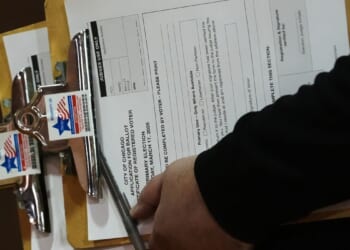
A federal judge on Friday shot down the Trump Justice Department’s attempt to get a look at Rhode Island’s voter lists, saying the feds were misusing a law meant to combat racial discrimination to try to clean up the registration rolls.
That makes the DOJ zero for 5 in judges’ rulings on its requests for states’ voter lists.
Judge Mary McElroy, a Trump appointee who has become a major legal opponent for the president, said the Civil Rights Act of 1960, which the DOJ was using to try to peek at the lists, was enacted to help the federal government combat Jim Crow practices that denied an individual’s right to vote.
She said pressuring states to rid their rolls of noncitizens, dead voters and those who have moved away doesn’t match that purpose.
Judge McElroy said that was not a “legally sufficient purpose” for the request.
The DOJ has seen similar losses in Oregon, California, Massachusetts and Michigan.
The only case where it has prevailed is in Oklahoma, where the state reached a settlement to turn over its data.
Roughly two dozen other cases are pending.
The American Civil Liberties Union said the Rhode Island decision was a needed block on President Trump’s interference in elections.
“This administration cannot bully the states,” said Ari Savitzky, an ACLU lawyer.
The Justice Department is seeking voter list information that includes names, addresses, birth dates, partial Social Security numbers and driver’s license numbers.
Most states have said the department is welcome to their public list of names, but their own state privacy laws prevent them from turning over some of the other information.
Yet that’s exactly the information the federal government would need to determine whether a specific voter is eligible, and whether he or she is also registered elsewhere.
The Justice Department said two laws, 1993’s National Voter Registration Act and 2002’s Help America Vote Act, push for cleaner voter rolls. The department said it was using the Civil Rights Act of 1960 to achieve that.
But judges in Oregon, California and now Rhode Island have said that’s not a sufficient purpose.
The judge in Michigan ruled on different grounds, finding that the feds would be entitled to the individual voter registration cards with all of the information, but the 1960 law doesn’t cover the state’s own list.
In Massachusetts, the federal judge ruled on yet another ground, saying the federal government didn’t describe its purpose for requesting the records, so it failed the test required by the 1960 law.