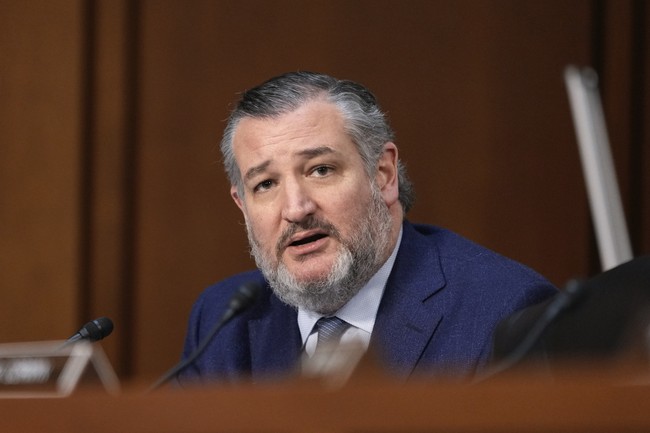
Sen. Ted Cruz (R-Texas) has the right instinct on the Department of Justice’s new $1.776 billion Anti-Weaponization Fund.
The idea behind the fund deserves a fair hearing; Americans who were targeted by abusive federal power should have some path toward relief, especially after years of lectures from the same political class pretending government weaponization only exists when Democrats campaign on it.
Still, a good idea turns rotten fast once Washington gets control of the checkbook.
President Donald Trump’s administration created the fund as part of a settlement connected to Trump’s lawsuit over the leak of his tax records. The agreement gives Trump and his family a formal apology but no monetary payout.
The fund would compensate Americans claiming abuse, with a five-member commission expected to handle claims. On paper, relief for real victims sounds defensible. In practice, however, loose language and weak oversight make almost any large federal fund look like an invitation to mischief.
Acting Attorney General Todd Blanche defended the fund before senators and argued the process would help people hurt by politicized investigations or prosecutions. Blanche also didn’t rule out potential claims from people tied to Jan. 6 cases, including applicants who may argue the government unfairly treated them.
Cruz and other Republicans had reason to press him hard: a program built to correct abuse can’t become a fog bank where eligibility rules appear after the money starts moving.
Cruz described the closed-door Republican meeting with Blanche as close to a revolt, and Senate Majority Leader John Thune (R-S.D.) acknowledged members had real questions about how the fund would work.
From CBS News.
Republican Sen. Ted Cruz of Texas said a two-hour meeting Thursday with Acting Attorney General Todd Blanche about the Justice Department’s new “anti-weaponization fund” was “one of the roughest meetings I’ve seen in my entire time in the Senate.”
“There were fireworks at an epic level,” Cruz said Friday on his podcast. “Fiery does not begin to cut it.”
Blanche was dispatched to the Capitol to try and convince skeptical Republican lawmakers to drop their opposition to the nearly $1.8 billion fund to pay people who claim they were politically persecuted. The announcement of the fund — part of a settlement to resolve President Trump’s lawsuit against the IRS — came as senators prepared to vote on a reconciliation package to fund border security and immigration enforcement through the end of Mr. Trump’s term.
Sen. Rand Paul (R-Ky.) also questioned the need for the fund, while Rep. Brian Fitzpatrick (R-Pa.) separately demanded answers from DOJ about the money, eligibility, oversight, and taxpayer protection.
None of those concerns undermine the fight against weaponized government; they strengthen it by forcing the administration to build a process the public and Congress understand.
The White House and DOJ should welcome strict guardrails instead of treating them like betrayal. Setting a strong and legal foundation now becomes critical.
- Define who qualifies
- Require sworn documentation
- Bar payouts for violent conduct
- Publish regular reports without exposing private victims
- Create an appeals process
- Keep commissioners independent from campaign politics
- Protect whistleblowers
- Build audit trails before the first dollar leaves Treasury.
A fund created to remedy political abuse should never rely on political discretion as its operating system.
As if on cue, Democrats already call the fund corrupt, and their outrage has a familiar theatrical quality. From the Independent.
Democrats have also sharply condemned the proposal. Sen. Dick Durbin, D-Ill., wrote in a letter to Blanche on Wednesday that “the notion of the federal government doling out compensation to rioters” is “absurd and offensive.”
On Thursday, Reps. Tom Suozzi, D-N.Y., and Brian Fitzpatrick, R-Pa., introduced bipartisan legislation that would prohibit federal funds from being used for the program.
Many of them showed far less curiosity when federal power ran against conservatives, pro-life activists, parents at school board meetings, Trump associates, and others who believed the system hand-picked sides.
Their hypocrisy doesn’t erase the need for discipline. A Republican administration shouldn’t answer double standards by creating a new system critics can attack fairly as sloppy, secretive, or self-serving.
For his part, President Trump isn’t backing down.
Cruz’s warning gives the administration a chance to fix the weak spots before enemies define the entire effort. Trump ran against government weaponization for good reason: millions of Americans believe federal agencies lost neutrality and punished disfavored targets.
A fund for victims serves justice only if it avoids favoritism, vague standards, and backroom handling. Cruz isn’t trying to kill the mission; he’s trying to keep it from turning swampy before the ink dries.
Readers who want sharp political analysis without the usual fog can become VIP subscribers. Use promo code FIGHT for 60% off and get full access here.