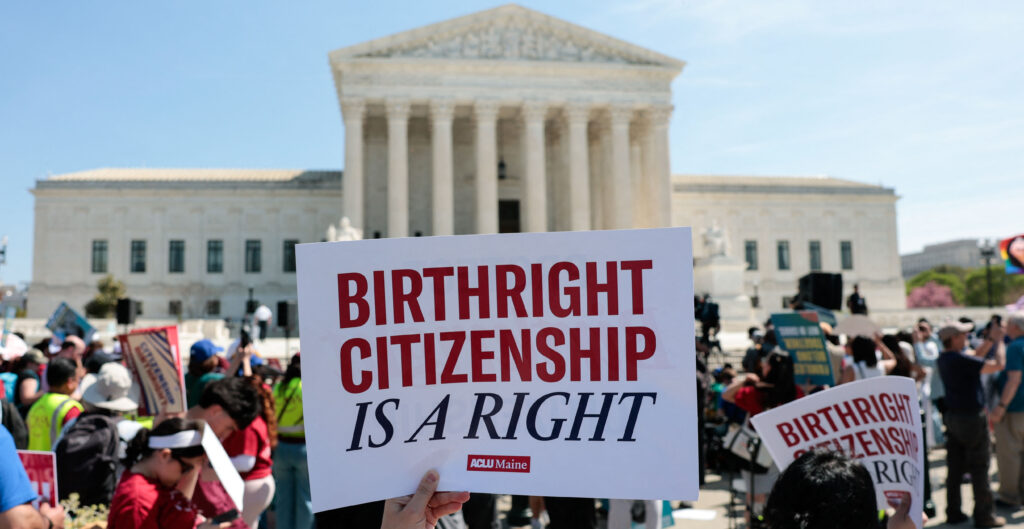
In a 6–3 ruling, the Supreme Court ruled against President Donald Trump on the issue of birthright citizenship, maintaining the status quo.
The majority held that children born in the United States to illegal immigrant parents are citizens at birth under the Fourteenth Amendment’s Citizenship Clause.
Chief Justice John Roberts, a George W. Bush appontee, wrote for the majority, and was joined by two Trump-appointed Justices Brett Kavananaugh and Amy Coney Barrett. They were joined by the trio of Democrat appointees, Justices Elena Kagan, Sonia Sotomayor, and Ketanji Brown Jackson.
Justice Clarence Thomas wrote the dissenting oppinion, joined by Justices Samuel Alito and Neil Gorsuch, all Republican appointees.
Some conservative-leaning justices had hard questions for Solicitor General John Sauer during arguments in April over reversing nearly 130 years of precedent on birthright citizenship, as President Donald Trump was in attendance.
The case involves Trump’s January 2025 executive order instructing federal agencies not to recognize citizenship for children born in the United States without at least one parent who is an American citizen.
Birthright citizenship is the view that anyone born in the United States—even a child of illegal aliens—is automatically a U.S. citizen.
The case has the potential to overturn a Supreme Court precedent dating back to 1898, when the court upheld birthright citizenship under the 14th Amendment, which granted citizenship to freed slaves after the Civil War.
The disputed provision of the 14th Amendment states, “All persons born or naturalized in the United States, and subject to the jurisdiction thereof, are citizens of the United States and of the State wherein they reside.”
The point of contention in the case is the phrase “subject to the jurisdiction thereof,” which Solicitor General D. John Sauer has argued was misinterpreted by the court’s late 19th-century ruling.