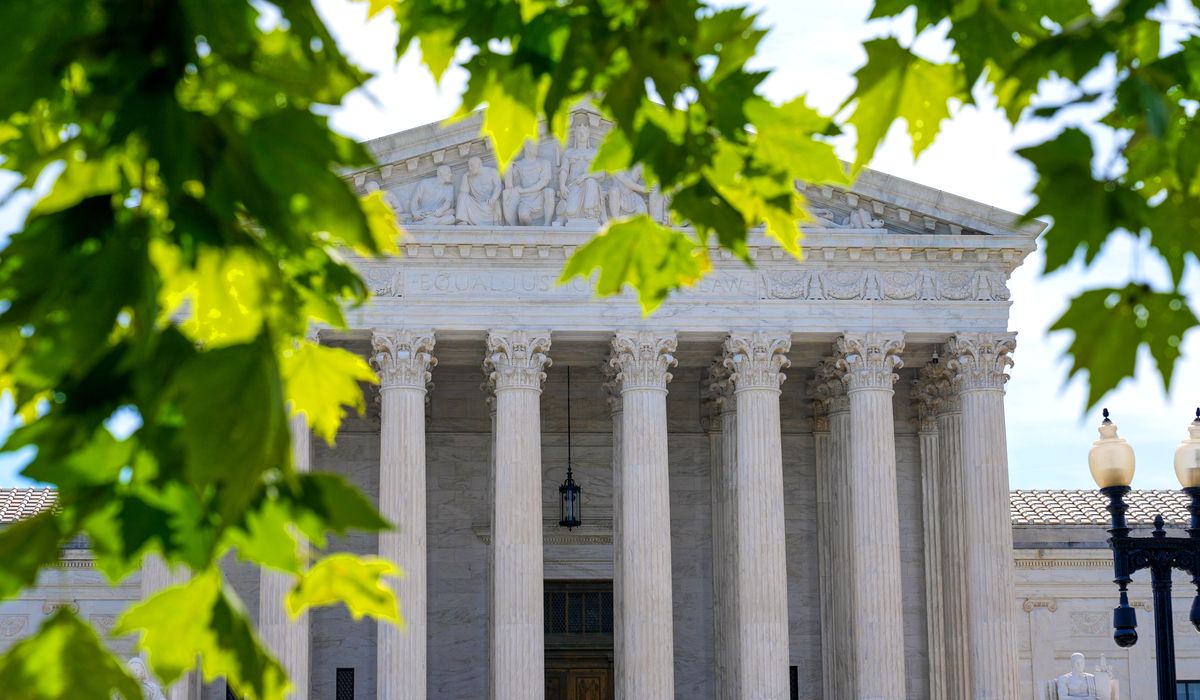
The Supreme Court ruled Tuesday that a Rastafarian inmate cannot sue the Louisiana prison officials who shaved his head, which he argued violated his religious rights.
Damon Landor had knee-length dreadlocks, known as “the Nazarite Vow,” that he had grown for more than 20 years, according to his court filing.
Mr. Landor reported to the Raymond Laborde Correctional Facility in 2020 to serve a five-month sentence for drug possession, carrying a copy of a 2017 federal court decision upholding his Religious Land Use and Institutionalized Persons Act claim to keep his hair.
The guards discarded the court order and shaved his head. He sued under the Religious Land Use and Institutionalized Person Act and targeted the officers individually in a lawsuit.
Congress passed the Religious Land Use and Institutionalized Persons Act in 2000 to protect individuals’ religious rights in certain institutions such as prisons and houses of worship.
The 5th U.S. Circuit Court of Appeals ruled against Mr. Landor, reasoning that he could not sue the prison officials in their personal capacity to collect damages. It dismissed the Religious Land Use and Institutionalized Person Act claim and the personal charges.
In Tuesday’s 6-3 ruling, the high court said the lower court correctly dismissed the claims against the individual officers since they had not consented with the government — their employer — to face personal suits.
“Mr. Landor does not allege that any of those individuals has entered any agreement with the federal government, let alone that any of them voluntarily and knowingly consented to answer private suits,” Justice Neil M. Gorsuch wrote for the majority. “To know that is enough to know the Court of Appeals was correct.”
Justice Gorsuch, a Trump appointee, was joined by the court’s other GOP appointees. They noted that on appeal, Mr. Landor did not appeal the 5th Circuit’s dismissal of his Religious Land Use and Institutionalized Persons Act claim against the government but only the lower court’s decision to dismiss cases individually against the guards.
The high court’s three Democratic appointees dissented.
Justice Ketanji Brown Jackson, a Biden appointee, argued that the majority incorrectly interpreted the Religious Land Use and Institutionalized Persons Act, suggesting it would permit lawsuits against individuals — in this case the guards — alleged to have acted wrongfully.
She said the law allows prison officials to face personal lawsuits.
“The severance of rights and remedies is a sleight of hand; it comes by way of the majority’s full-throated endorsement of a contact analogy even though what secures the rights at issue is nota contract but a law,” Justice Jackson wrote.
“Today’s decision magically transforms a federal statute into an invitation to be accepted or declined, deemed binding only if each particular defendant has explicitly agreed to be penalized. No matter that laws, as opposed to contracts, don’t ordinarily work this way.”
Justices Sonia Sotomayor and Elena Kagan, both Obama appointees, joined the dissent.