The cost of living has risen to unsustainable levels for millions of working Americans. Delivering immediate relief by lowering these costs and restoring affordability is essential. The first step is using budget reconciliation in the coming weeks to enact targeted spending reforms and structural changes that put money back in the pockets of families.
Few Americans realize that a little-known Federal Reserve Bank (Fed) practice has already cost taxpayers hundreds of billions of dollars—and Congress has the power to stop it.
For its first 95 years of existence, the Fed paid no interest to banks for balances held in reserve. Financial institutions were mandated by the reserve requirement ratio to hold a certain percentage of their deposits in reserve at the central bank to ensure liquidity and to control monetary supply. Banks could also park “excess” reserves at the Fed voluntarily beyond the minimum requirement.
In 2006, Congress authorized the Fed to pay interest on reserves (IOR), effective 2011. The global financial crisis accelerated its implementation to 2008. The policy was intended to influence short-term interest rates by encouraging banks to hold reserves rather than lend them overnight. In 2020, the Fed eliminated the required reserve ratio entirely, embracing an “ample reserves” floor system.
Since September 2022, elevated interest payments on reserves have forced the Fed into operating losses. These shortfalls are recorded as a “deferred asset” on the Fed’s balance sheet, currently totaling roughly $240 billion. The Fed must first repay this amount from its future profitable operations before resuming any remittances back to the U.S. Treasury.
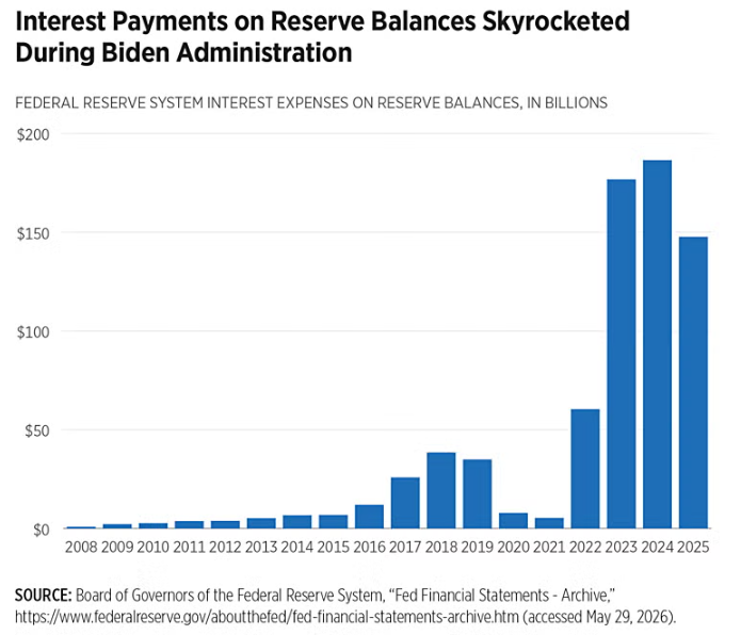
As of early June 2026, banks hold just over $3 trillion in reserves at the Fed, approximately 12% of the $25.5 trillion in total commercial bank assets. Annual IOR payments have exploded since the central bank raised rates to combat inflation—$177 billion in fiscal year (FY) 2023, $186 billion in FY 2024, and $148 billion in FY 2025—representing the single largest Fed expense in recent years.
Cumulative interest payments since 2008 total $728 billion, with approximately 60% accruing under the Biden administration. The IOR framework is not monetary policy; it is a quiet transfer of wealth from Main Street to Wall Street and foreign capitals.
The Foundation for Government Accountability projects that continued interest payments will cost taxpayers $1 trillion in foregone revenue to the Treasury over the next decade. Other independent analyses from the Andersen Institute similarly project cumulative IOR expenses approaching $1.3 trillion.
These payments disproportionately benefit the largest banks, which hold the bulk of the reserves. According to an oversight report from Sen. Rand Paul, R-Ky., foreign or foreign-owned banks have received roughly 39% of payments since 2013—totaling $235 billion.
Under Chairman Jerome Powell’s mismanagement and persistent losses, the Fed has left taxpayers on the hook for lost revenue to the U.S. Treasury. This directly increases federal deficits and debt, as the government must borrow to replace the foregone revenue. What was once a reliable source of tens of billions annually in Treasury income has vanished.
The Federal Reserve’s IOR program functions as a hidden subsidy to banks, especially large domestic and foreign institutions. Eliminating interest on reserve balances would restore the central bank to profitability and redirect billions back to the U.S. Treasury for the benefit of American taxpayers.
Sens. Rick Scott, R-Fla., and Ted Cruz, R-Texas, introduced the Fiscal Accountability for Interest on Reserves (FAIR) Act (S. 2499) in July 2025 to repeal the Fed’s authority to make these payments. A companion bill in the House, led by Rep. Warren Davidson, R-Ohio, would achieve the same goal.
The Federal Reserve Bank has been on welfare, courtesy of American taxpayers, for far too long. While families across America stretch their weekly paychecks to afford groceries, gas, and rent, the Fed has quietly funneled hundreds of billions of taxpayer dollars straight into the coffers of the biggest banks—including foreign ones.
Congress must stop this hidden tax on Main Street and eliminate interest on reserves through budget reconciliation. Only then can the Federal Reserve return to profitability, remittances to the Treasury resume, federal deficits shrink, and the perverse incentives that discourage lending be removed.