On August 7, Saudi Arabia, Pakistan, and Turkey signed a joint defense agreement in Mecca.
The signatories said in a joint statement that the Mecca Joint Defense Agreement is “intended to strengthen collective deterrence against any act of aggression and stipulates that an armed attack against any of the three would be regarded as an attack on all.”
However, the coalition’s statement does not name specific conditions; nor is it clear how the agreement binds them to any particular military action in each other’s defense.
Two days later, the Iranian-backed Houthis struck an oil facility on Saudi Arabia’s Red Sea coast. The coalition has not yet responded to the attack.
Iran and its proxy-allies (including the Houthis) have been continuously firing on Gulf states and blockading their energy shipments since Feb. 28, 2026. The situation began when the war between the United States and Israel and the Islamic Republic of Iran and its terrorist proxies escalated.
Although Pakistan signed a mutual defense pact with Saudi Arabia last year, it has not militarily responded to Iran’s attacks on the Saudi kingdom. It has also played down suggestions that its nuclear deterrent could extend to allies, saying last year that its pact with Saudi Arabia does not include nuclear weapons.
On August 14, the Saudi Ministry of Defense said that Saudi-led Multinational Maritime Defense Coalition finalized key arrangements to activate its command structure. Fifteen countries have so far signed the coalition’s joint statement. 13 countries formally became members. And the first deputy commander will be from Pakistan.
Both Pakistan and Turkey support the Saudi-led multinational maritime security coalition, the alleged purpose of which is to protect critical regional shipping and energy routes from Houthi and regional threats.
Pakistan has provided training and technical assistance to Saudi forces for decades, while Turkey and Pakistan exchange warships and training aircraft. Saudi Arabia is also a major purchaser of drones from Turkey.
Pakistan has deployed about 8,000 troops, a squadron of fighter jets, and an air defense system to the Saudi kingdom. It has further opened negotiations with Kuwait to provide security in exchange for energy cooperation and investment.
Meanwhile, Pakistan’s Interior Minister Mohsin Naqvi met Iran’s President Masoud Pezeshkian and the country’s Foreign Minister Seyed Abbas Araghchi on August 11, the state-run Islamic Republic News Agency (IRNA) reported.
Naqvi arrived in Tehran and met Pezeshkian, IRNA reported, during which meeting the Iranian president stressed the need to deepen ties with Pakistan in all fields.
“The Islamic Republic of Iran is ready to further deepen its relations with Pakistan in all areas of interest to the two countries and to pave the way for the development of joint cooperation,” IRNA quoted Pezeshkian as saying.
Naqvi stated that the purpose of his visit to Iran was to follow up on agreements and understandings reached during the recent visit of Iranian Interior Minister Eskander Momeni to Pakistan, the Iranian state media said.
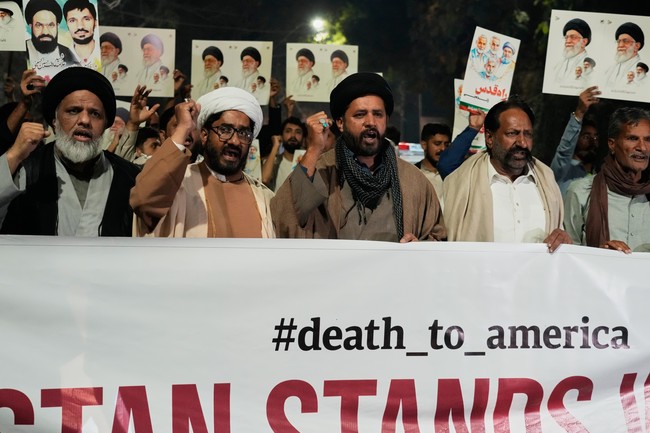
For decades, Iran-Pakistan relations have faced severe strain due to cross-border militant strikes and shifting regional alliances.
Pragmatic cooperation despite divergent strategic orientations traditionally characterize their relationship. Though both maintain robust trade links, periodic frictions have arisen over Pakistan’s close defense cooperation with Saudi Arabia; Tehran’s suspicion of Islamabad’s alignment with U.S.-led coalitions in Afghanistan and Iraq, and mutual allegations of providing space for cross-border activities of terrorist groups such as Jaish ul-Adl and Baloch militant organizations.
Persistant mistrust between Iran and Pakistan causes frequent cross-border security friction, proxy competition, and diplomatic tightropes. Both nations are navigating rival regional alliances and porous, volatile frontier regions.
Proxy and sectarian dynamics play a major role — Pakistan is majority-Sunni and Iran is majority-Shia. Past competition for influence in Afghanistan and concerns over sectarian proxy mobilization within domestic populations limit deep strategic cooperation.
Iran’s southeastern province of Sistan-Baluchistan and Pakistan’s southwestern Baluchistan province have been the scene of decades-long insurgencies. The vast and impoverished provinces are home to the Baluch, an ethnic minority in Iran and Pakistan who have long faced discrimination and violence at the hands of both governments, whom they accuse of exploiting the region’s natural resources.
Separatist groups operating in the Baluchistan regions use the shared border to launch attacks, leading to occasional cross-border military strikes and sovereignty disputes.
In January 2024, Iran and Pakistan were on the brink of a full-blown conflict after they exchanged deadly cross-border attacks. The flare-up reignited a long-running dispute between the neighbors over cross-border militancy. For decades, the countries accused each other of harboring armed groups that carry out attacks on the other.
However, experts say that Pakistan and Iran — who are both dealing with economic crises — also have financial incentives for expanding cooperation and tackling cross-border militancy. The 2023-24 period saw a modest thaw, marked by high-level visits and agreements on energy transit, yet underlying mistrust persisted regarding external security partnerships.
Meanwhile, Pakistan’s near-bankrupt economy could face collapse without international bailouts. Pakistan is heavily reliant on energy imports, with Saudi Arabia, Qatar and neighboring Gulf states supplying more than 85% of its oil needs and nearly all its liquified natural gas (LNG). On April 17, Saudi Arabia stepped in to provide $3 billion in additional support to Pakistan. Riyadh also extended the roll-over arrangement of a $5 billion facility for a further three years.
Meanwhile, Islamabad has positioned itself as a potential mediator for the ongoing Iran-U.S. conflict. They have offered to shuttle dialogues between Tehran and Saudi Arabia and to convey back-channel messages between Iran and the United States.
Yet Pakistan’s economic and military ties with Saudi Arabia and the United States clash with Iran’s core regional security interests and anti-Western posture.
Pakistan’s mediation overtures are premised on its historical ties to both sides and its desire to prevent further escalation that could potentially trigger the Strategic Mutual Defense Agreement (SMDA) it had signed with Saudi Arabia last year. However, Tehran’s current narrative casts Pakistan as complicit in external aggression, limiting Islamabad’s credibility as an impartial broker.
As Dr Farzana Shaikh, an associate fellow of Chatham House, notes,
Pakistan’s ongoing military campaign against Afghanistan, its historically uneasy relations with Iran, and the ambiguous terms of its yet to be ratified mutual defense agreement with Saudi Arabia do cast a shadow over its credibility as a peacemaker and neutral host.
Meanwhile, Hossein Shariatmadari, an adviser to Iran’s Supreme Leader and editor-in-chief of hardline Iranian newspaper Kayhan, said Pakistan had lost its neutrality by joining a new defense pact with Saudi Arabia and Turkey, and it should abandon its role as a mediator between Tehran and Washington.
While Pakistan acts as a diplomatic go-between or mediator in the U.S.-Iran conflict, Tehran remains suspicious of Islamabad’s simultaneous defense commitments to Gulf Arab monarchies. For Pakistan has formalized defense cooperation agreements with Gulf states, signed a pact with Saudi Arabia, and has a pending agreement with Kuwait. Iran, therefore, regards Pakistan’s alignment with the Gulf bloc as a strategic tilt toward U.S. and Saudi security frameworks, eroding any residual trust.
The main question is: how efficient can Pakistan be as a mediator between Tehran, Washington, and Islamabad when it is attempting to play all sides while simultaneously losing the trust of all?
Editor’s Note: Thanks to President Trump and his administration’s bold leadership, we are once again respected on the world stage, and our enemies are being put on notice.
Help us continue to report on the administration’s peace through strength foreign policy and its successes. Join PJ Media VIP and use promo code FIGHT to receive 60% off your membership.