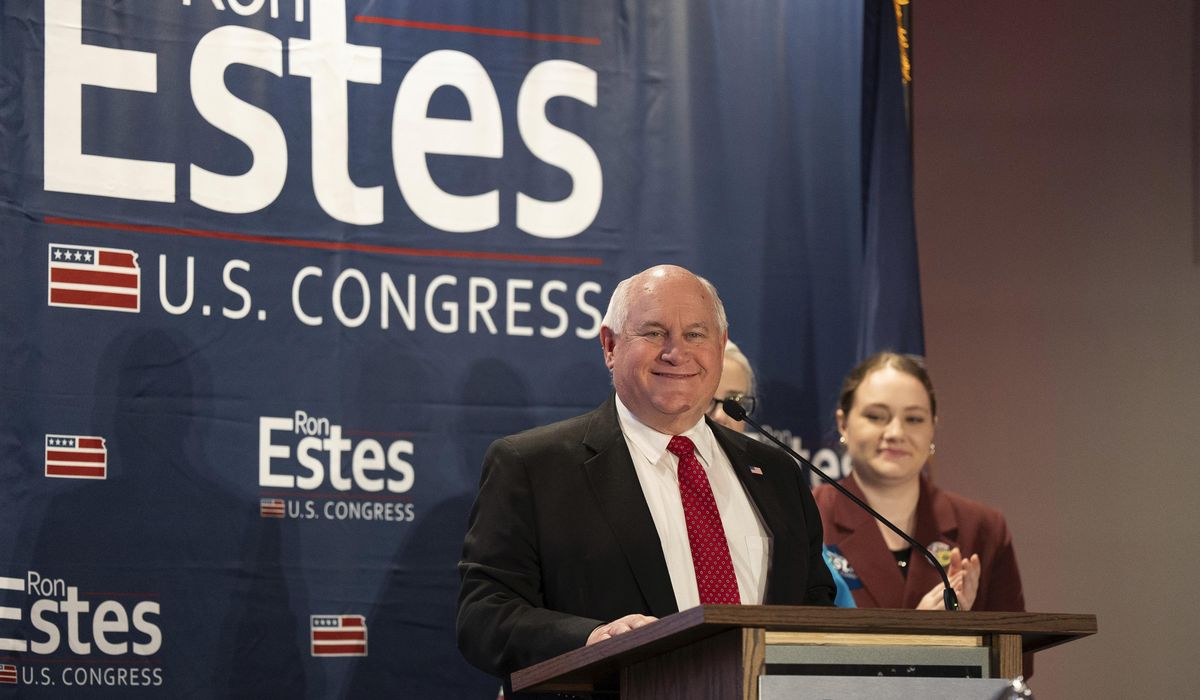

Americans for Tax Reform praised Rep. Ron Estes for introducing a bipartisan resolution opposing foreign digital services taxes that they say unfairly target American companies and workers.
Foreign digital services taxes, or DSTs, are imposed on revenue generated by large digital companies — typically multinational tech firms — from services provided to users in their country, even if the company does not have a physical presence in the country.
A report published by ATR and the Tholos Foundation found that U.S. firms currently pay nearly $3 billion annually in digital services taxes — a figure expected to nearly double by 2030, and potentially reaching $9.6 billion under a scenario where more countries pile on.
“Rep. Ron Estes and his colleagues are standing up for American workers and businesses against a coordinated effort by foreign governments to shake down U.S. companies. Digital Services Taxes are not legitimate tax policy, said Grover Norquist, President of Americans for Tax Reform.
“They are protectionist schemes designed to pick the pockets of Americans. Congress is right to put the world on notice that the United States will use every tool available to fight back against this discriminatory overreach. We urge all members to support this resolution.”
DSTs largely target a company’s revenue, not profit, from activities such as online advertising, digital marketplaces, social media platforms and subscription-based digital services.
Countries including France, Italy, Spain, Turkey, Austria and the United Kingdom have implemented these taxes. Poland and Belgium are actively considering them.
Traditional corporate tax rules require a physical presence (like an office or factory) before a country can tax a company’s profits there.
Digital companies such as Google, Amazon, Meta and Apple earn enormous revenue from users in a country without having a significant physical presence, meaning that country collects little or no tax on that activity. DSTs were designed to fill that gap.
The Office of the U.S. Trade Representative investigated DSTs under Section 301 of the Trade Act of 1974 and determined they are explicitly discriminatory against U.S. digital companies, particularly burdensome because of retroactive application, and in violation of prevailing international tax and trade agreements.
The anti-DST bill was led by Mr. Estes, Kansas Republican, and Democratic Rep. Suzan DelBene of Washington. Co-sponsors included GOP Reps. Darin LaHood of Illinois and Nathaniel Moran of Texas, and Democratic Reps. Jimmy Panetta of California and Brad Schneider of Illinois.
Alarm sounded over New York’s move to strip words ’mother’ and ’father’ from state laws
America First Policy Institute denounced New York state lawmakers for advancing legislation that would replace the word “mother” with “gestating parent” and “father” with “non-gestating parent” in state law.
AFPI said it was not an innocuous language change, but yet another example of elected bureaucrats pursuing a radical agenda to undermine the institutions of motherhood, fatherhood and family.
“Only in New York could politicians look at falling birth rates, struggling families and a generation of young women searching for purpose and decide the real problem is the word ’mother,’” said Ashley Hayek, Executive Vice President of the America First Policy Institute.
“Motherhood is not a medical condition to be renamed by bureaucrats,” she said.
The legislation passed the New York State Legislature and is headed to Gov. Kathy Hochul, a Democrat. She has until year’s end to sign or veto it.
Jack Brewer, chair of AFPI’s Opportunity Now and vice chair for 1776, said the legislature’s wordplay was dangerous.
“Removing ’father’ from state law is an attempt to erase something irreplaceable,” Mr. Brewer said. “A father’s presence gives children stability, discipline, and a model of responsibility that no one else can provide. We must reject any ideology that strips away the truth of what a father is.”
AFPI said the bill was part of an intentional, coordinated effort by “America-last” politicians to strip away common sense from laws and weaken the moral and cultural foundations that hold communities together.
Advocates of the legislation say the changes to the terminology modernize custody law for LGBTQ+ parents and those using surrogacy or assisted reproduction, without altering any substantive parental rights.
However, others say that the new terminology is clinically imprecise — “gestating/non-gestating” does not cover adoptive parents, for instance, and that rewriting decades of settled legal language risks creating courtroom confusion without solving a concrete problem.
Congress lobbied to force auto makers to share repair information with small shops
The National Federation of Independent Business is pushing House lawmakers to require automakers to share repair information with independent shops and vehicle owners — not just their own dealers.
In a letter to the top Republican and Democrat on the House Committee on Energy and Commerce, NFIB objected to recent changes to the BUILD America 250 Act, also known as the Surface Transportation Reauthorization Act, or the Highway Bill.
“Since the start of this Congress, NFIB has strongly supported H.R. 1566, the ’Right to Equitable and Professional Auto Industry Repair’ (REPAIR) Act,” NFIB’s Louis Bertolotti wrote. “Small businesses were disappointed to see key provisions from the REPAIR Act dropped during the recent markup of the Surface Transportation Reauthorization Act.”
The NFIB said it is disappointed that the updated language does not include key provisions from the REPAIR Act, which would allow customers and auto shops to have access to necessary information from vehicle manufacturers for repairs.
“NFIB member ballots have shown that nearly 90% of small businesses from across the country believe that ’customers and repair shops [should] be able to access the necessary information from manufacturers to repair their products.’”
Mr. Bertolotti said that the nearly 300,000 small and independent businesses the NFIB represents rely on working motor vehicles to operate and grow.
“NFIB encourages the committee to advance substantive REPAIR Act provisions into the full Highway Bill on the House floor, in order to maintain competition in the automotive repair industry.”
• The Advocates column is a weekly look at the political action players who drive the debate and shape policy outcomes in Washington. Send tips to theadvocates@washingtontimes.com. Click here to receive The Advocates in your inbox each week.