The US and Iran have spent the past fortnight back at war, with the US accelerating its strategic-strike campaign and Donald Trump’s promises of a “massive” bombardment a fresh threat. Iran has responded by continuing and accelerating its attacks on shipping in the Strait of Hormuz, while adding a threat to shipping in the Red Sea via the Houthis. The IRGC has escalated its threats against its neighbors, and this morning, the regime claimed attacks on US bases in Jordan and Saudi Arabia.
However, Iran has not fired missiles at one target in the renewed hostilities, and the omission of Israel is certainly … curious. Iran had not been shy in March about targeting what it calls “the Zionist entity,” although Israel was also targeting Iran at the time, too. Benjamin Netanyahu has not joined the new American offensive, reportedly because Trump doesn’t want the diplomatic and strategic complications that might arise. But why has Iran left Israel off its target list, even while targeting nearly everywhere else in the Gulf?
According to a military analyst contacted by the Jerusalem Post, the IRGC worries about Israeli retaliation not against Tehran, but against Beirut and its proxy army in Lebanon:
Iran is refraining from striking Israel partially due to fears of Hezbollah’s collapse in Lebanon if fighting resumes with Israel, according to retired military Lt.-Col. (res.) Or Horowitz, a senior fellow at the Jewish People Policy Institute (JPPI) and former head of the military intelligence Hezbollah desk. …
“A historic change is taking shape in Lebanon. Hezbollah is in a weaker state than ever before, Horowitz said. “On the other side, there is a brave president; he wants to end the hostility once and for all. At the end of the day, he is a politician; he wants to avoid a civil war and being murdered himself, and despite that, he is making very brave moves.”
He then analyzed the expansion of Lebanese Army activity in the area alongside Hezbollah’s weakening.
“We are seeing the Lebanese Army, which in the past did nothing; its activity against Hezbollah was absolutely zero, and now that is changing,” said Horowitz. “Alongside very deep American involvement, they are affecting both the motivation and the capabilities.
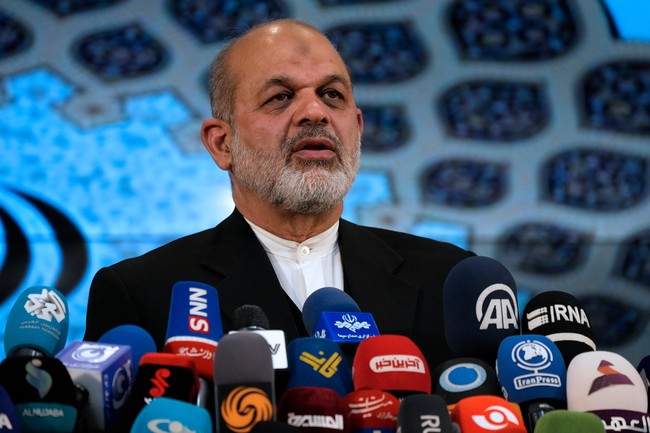
Just how “dramatically weakened” is Hezbollah? The IRGC worried enough about its survival to repeatedly blow up the negotiating process with the US and push a wedge between Trump and Netanyahu. Vahidi succeeded in that strategy, but it had the opposite effect intended, as Netanyahu simply refused to be bound by the MOU and continued its push against Hezbollah in southern Lebanon. The Israelis agreed to a separate ceasefire with Lebanon, but that excluded any Hezbollah units that refused to disarm and/or threatened IDF troops.
Those strikes continue today, in fact:
The Israeli military launched fresh strikes across southern Lebanon on Friday, July 24, carrying out drone attacks and demolition operations despite an existing ceasefire framework and renewed diplomatic efforts between the two countries.
According to Lebanon’s National News Agency (NNA), an Israeli drone targeted the outskirts of the southern town of al-Mansouri, while powerful explosions were reported in the nearby village of Majdal Zoun. The blasts were heard as far as the coastal city of Tyre, around 15 kilometres away. …
NNA said Israeli forces carried out a large-scale demolition operation in the town of Khiam at around 3 am after reportedly setting fire to a house near the Al-Mabarrat area. It also reported that Israeli forces conducted a two-stage demolition operation in the Al-Mashaa and Jabal Suwaid neighbourhoods of Majdal Zoun, while the village’s outskirts came under gunfire on Friday morning.
Israeli forces also blew up several culverts along the main roads linking the towns of Hadatha, al-Tiri and Kunin, disrupting movement in the area. Another drone strike reportedly targeted the area between Deir Siryan and al-Qusayr.
This isn’t “despite an existing ceasefire framework,” but well within it, although the Joseph Aoun government in Beirut may object anyway. The ceasefire framework does not include Hezbollah per se because Hezbollah refuses to comply with earlier agreements (and UN Security Council Resolution 1701) to disarm and move out of the sub-Litani and Bekaa regions. Israel has made clear that it intends to dislodge and destroy Hezbollah positions in these areas until they either surrender or the Lebanese army can take over these areas and force compliance themselves.
The Trump administration wanted to break this stalemate, and got both sides to agree to a pilot program to accelerate Lebanon’s claims to the region. Israel has agreed to disengage at specific points where Lebanese troops will guarantee compliance, and for the first time in decades, it appears to be working:
On Tuesday, Lebanese army troops deployed in the town of Zawtar al-Gharbiyeh in the Nabatieh region after the IDF withdrew from the area. It was the first of several pilot zones Israel is to evacuate under a framework agreement reached with Lebanon under American auspices in late June.
What makes that agreement potentially historic is that it goes well beyond another temporary ceasefire. A product of five rounds of the first direct political negotiations between Israel and Lebanon in more than 40 years, it establishes a permanent security framework by explicitly linking Israeli withdrawal to Hezbollah’s disarmament.
Call it land for arms.
That linkage is what distinguishes this initiative from nearly every previous attempt to stabilize southern Lebanon.
Earlier efforts focused primarily on changing Israel’s behavior – persuading it to withdraw, relying on international peacekeepers, or assuming that time itself would somehow calm the border.
This framework instead seeks to change Lebanon’s behavior by making Israeli withdrawal contingent on Hezbollah’s removal. Whether that formula succeeds remains to be seen, but it represents a fundamentally different framework.
Under the agreement, Israel will withdraw from territory it captured to establish a buffer zone only after Hezbollah has been verifiably removed from those areas. In accepting that formula, the Lebanese government has effectively acknowledged for the first time that Hezbollah’s weapons are the principal obstacle to a full Israeli withdrawal.
In other words, the Lebanese government has finally acknowledged reality, which is that Iran has used Lebanon as a launching pad for its wars against Israel through its occupation by Hezbollah. In fairness, though, the reason why the Aoun government can acknowledge that reality and act on it is because Israel has devastated Hezbollah over the last three years since Hamas’ October 7 war began, and because the US has devastated Iran over the last few months. Iran and Hezbollah no longer dictate outcomes in Lebanon, although they still have some influence.
That may be what Iran is attempting to preserve by its target-selection daintiness at the moment. If they launch attacks on Israel again, Netanyahu will likely open more offensive operations against what’s left in Lebanon rather than duplicate what the Americans are doing in Iran already. The IRGC’s only play now would be to salvage what’s left of its proxy and hope to rebuild later when the pressure is off, and that may be enough to keep from targeting Israel in the short run.
Editor’s Note: For decades, former presidents have been all talk and no action. Now, Donald Trump is eliminating the threat from Iran once and for all.
Help us report the truth about the Trump administration’s decisive actions to keep Americans safe and bring peace to the world. Join HotAir VIP and use promo code FIGHT to get 60% off your VIP membership.