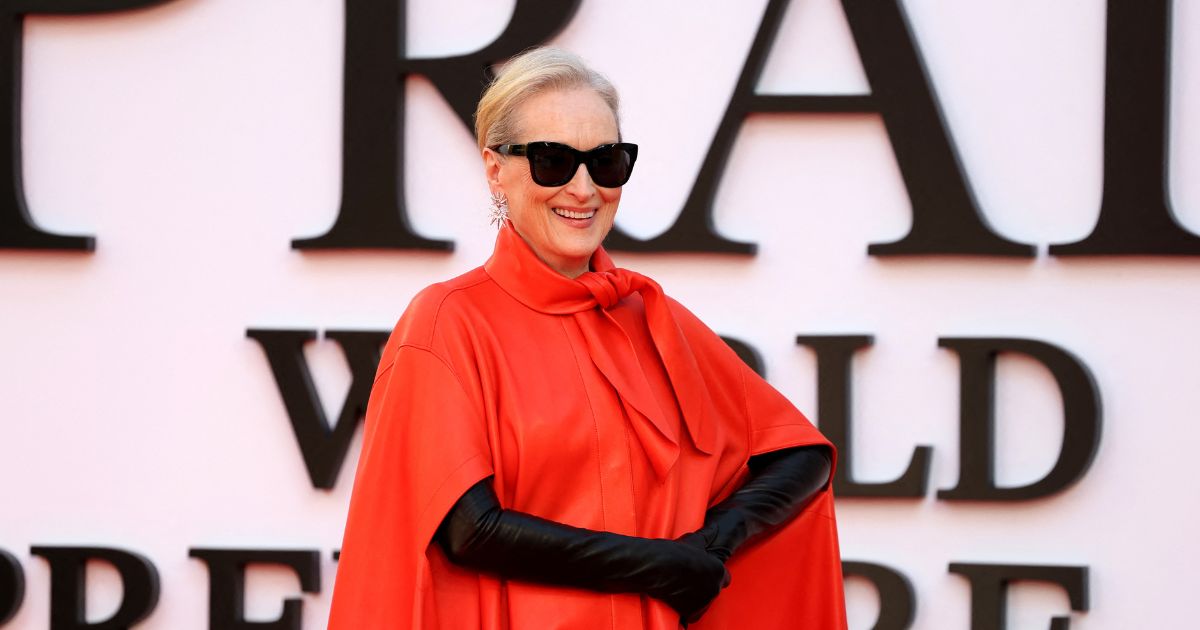
The new “Narnia” movie from Netflix, based on the series of books written by Christian apologist C.S. Lewis, is slated to have actress Meryl Streep serve as the voice of Aslan, the messianic figure of Lewis’s story.
Within the world of Narnia, Aslan is not merely an allegory for Jesus. He is, in fact, Jesus Christ himself, who chooses to enter — and redeem — the fictional world of talking animals in the form of a lion. When one character asks if Aslan is in the real world, the lion replies “I am… But there I have another name. You must learn to know me by that name.”
Netflix’s upcoming adaption of the first chronological book of the series, “Narnia: The Magician’s Nephew”, instantly drew backlash for the casting choice, with many Christians especially noting the issue with casting a woman to play a fictional character who is meant to be the Son of God.
Director Greta Gerwig said that she “wanted someone who was profound but not pretentious, who had gravitas but not morose self-seriousness,” per an interview with Empire.
“Someone who could communicate depth and pathos as well as joy and delight,” she continued.
“I wanted someone who was older than 70, so there was a wisdom of experience, but who also had the capacity of fresh wonder, like a child. And also to be one of the greatest actors to ever do it. That list is not a long one.”
The only requirement Gerwig seemed to not include in this list is that the male lion Christ — who was clearly depicted with a mane in “The Chronicles of Narnia” movies that started their releases in 2005 — be played by a male.
Beyond disagreement from thousands of “Narnia” fans online, Lewis would himself have taken issue with the subversive casting choice.
As noted by Michael Carlona, a deacon at Kenwood Baptist Church and the operations director for the Council on Biblical Manhood and Womanhood, Lewis staunchly affirmed the importance of recognizing the role which the sexes play in the Christian faith.
Lewis wrote in a 1948 essay called “Priestesses in the Church?” that toying with the sexed language regarding God actually results in “a different religion.”
“Why should a woman not in this sense represent God? Certainly not because she is necessarily, or even probably, less holy or less charitable or stupider than a man. In that sense she may be as ‘God-like’ as a man; and a given women much more so than a given man. The sense in which she cannot represent God will perhaps be plainer if we look at the thing the other way round,” he described.
“Goddesses have, of course, been worshipped: many religions have had priestesses. But they are religions quite different in character from Christianity. Common sense, disregarding the discomfort, or even the horror, which the idea of turning all our theological language into the feminine gender arouses in most Christians, will ask ‘Why not? Since God is in fact not a biological being and has no sex, what can it matter whether we say He or She, Father or Mother, Son or Daughter?’”
Lewis wrote that while God indeed does not have biological sex, God Himself has also “taught us how to speak of Him.”
“To say that it does not matter is to say either that all the masculine imagery is not inspired, is merely human in origin, or else that, though inspired, it is quite arbitrary and unessential. And this is surely intolerable: or, if tolerable, it is an argument not in favour of Christian priestesses but against Christianity.”
In summary, Lewis noted that innovators with respect to sexed norms in the church are “really implying that sex is something superficial, irrelevant to the spiritual life.”
“To say that men and women are equally eligible for a certain profession is to say that for the purposes of that profession their sex is irrelevant. We are, within that context, treating both as neuters,” he continued.
“With the Church, we are farther in: for there we are dealing with male and female not merely as facts of nature but as the live and awful shadows of realities utterly beyond our control and largely beyond our direct knowledge. Or rather, we are not dealing with them but (as we shall soon learn if we meddle) they are dealing with us.”
Advertise with The Western Journal and reach millions of highly engaged readers, while supporting our work. Advertise Today.