Democrats will vote this weekend on a resolution to ban ranked choice voting, in a proxy battle between the establishment wing of the party and the ascendant Democratic Socialists of America.
On Saturday, delegates attending the Democratic National Committee’s Summer Meeting in Austin, Texas, will vote on a resolution to ban ranked choice voting in presidential primary contests. The DSA favors the policy.
“Replace the two-party system with a multi-party democracy. Expand the House of Representatives, implement proportional representation and ranked choice voting in all elections, and abolish the Senate,” the national organization’s program says.
The DSA first included ranked choice voting in its 2021 platform, noting it “has been adopted by several countries, most notably Ireland, where it has allowed left-wing parties like Sinn Féin and People Before Profit to secure parliamentary representation.” Domestically, the group added, states and municipalities used it to provide “such an opportunity for proportional political and ideological representation.”
Under ranked choice voting, voters rank their first, second and third choices of candidates. If no candidate gets 50% or more of the vote, another round of counting commences in which the lowest-ranked candidates are eliminated. Rounds continue until one candidate reaches a majority. This is also known as the “instant runoff.”
“Clearly this is a setback for the DSA because they embraced ranked choice voting,” Trent England, executive director of Save Our States, told the Daily Signal of the Democratic National Committee’s vote. His group opposes the policy.
“RCV was a way for them to flex their muscle, even if they were in a race where their candidate had no chance to win, their candidate could possibly win first or second place in the first round of voting. It’s really about their messaging,” England said of the DSA.
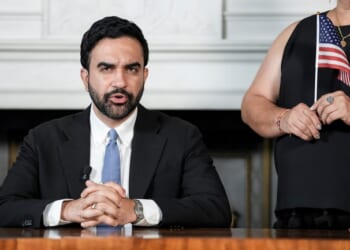
Prominent DSA-backed candidates have won elections featuring the system. DSA member Zohran Mamdani won a ranked choice voting Democrat primary before his election as New York City mayor in 2025. This year, DSA-aligned candidate Janeese Lewis George won the Democrat mayoral primary for the District of Columbia, which also featured the system.
Neither the DSA nor the DNC responded to inquiries for this story.
Jim Roosevelt, the co-chairman of the DNC Rules and Bylaws Committee, told WABI of Maine that ranked choice voting “is incompatible with the party’s delegate allocation process at this time, since RCV is a winner-take-all system while the DNC uses proportional delegate allocation.”
The DNC action is coming three years after the Republican National Committee approved a 2023 resolution in opposition to ranked choice voting. The party affirmed that for the 2024 primary season, if a state uses ranked choice voting, the RNC would count only the first round of votes.
It’s significant that both parties are on the cusp of opposing the system, England said.
“People deciding this, the rules and bylaws committee, are people that understand an efficient nominating process, not focused on posturing and messaging,” England said.
Alaska and Maine are the only states that use ranked choice voting, while 15 cities and counties use it for local elections, according to FairVote, an organization that advocates for the system.
In 2020, the last competitive Democratic presidential primary, five states—Alaska, Hawaii, Kansas, Nevada and Wyoming—used ranked choice voting to pick a nominee, according to FairVote.
Voters in several states, both red and blue, rejected the system in 2024. Missouri, a red state, voted to ban its implementation statewide, while red Idaho rejected it. Meanwhile, voters in blue and battleground states of Arizona, Colorado, Nevada and Oregon also rejected proposals to adopt ranked choice voting. Voters in Alaska, a red state, opted to keep it.
“A lot of this likely has to do with how poorly ranked choice voting did on the 2024 ballot,” England said. “A lot of Democrats voted against RCV. The DNC donor base is not on board, and DNC realizes this is not the wave of the future.”