Last week’s excellent jobs report for May contained very good news for a White House hoping to get back to its economic messaging in the midterm cycle. The US economy not only had its best three-month period in more than two years, it also showed wage growth continuing to accelerate. At the time, it appeared that wages were keeping ahead of inflation, if only just barely.
The penny dropped on that hope earlier today. Wages had increased year-on-year by 3.4% last month. The consumer price index (CPI) for May showed a year-on-year increase of 4.2%, the hottest in at least two years. Core CPI inflation, which excludes food and energy, rose by 2.9% on an annualized basis as well:
The Consumer Price Index for All Urban Consumers (CPI-U) increased 0.5 percent on a seasonally adjusted basis in May, after rising 0.6 percent in April, the U.S. Bureau of Labor Statistics reported today. Over the last 12 months, the all items index increased 4.2 percent before seasonal adjustment.
The index for energy rose 3.9 percent in May, after rising 3.8 percent in April and 10.9 percent in March. The energy index accounted for over sixty percent of the monthly all items increase. The index for shelter also increased in May, rising 0.3 percent. The food index increased 0.2 percent over the month as the food at home index rose 0.1 percent and the food away from home index increased 0.3 percent.
The index for all items less food and energy rose 0.2 percent in May. Indexes that increased over the month include communication, airline fares, medical care, personal care, and recreation. Conversely, the indexes for motor vehicle insurance, household furnishings and operations, and new vehicles were among the major indexes that decreased in May.
The all items index rose 4.2 percent for the 12 months ending May, after rising 3.8 percent for the 12 months ending April. The all items less food and energy index rose 2.9 percent over the year, following a 2.8-percent increase over the 12 months ending April. The energy index increased 23.5 percent for the 12 months ending May. The food index increased 3.1 percent over the last year.
Needless to say, this is not the best news for Republicans in light of their attempts to get a grip on “affordability.” Inflation that outstrips wage growth becomes painful for middle- and working-class American households, whose buying power erodes sharply in this scenario. That also makes it painful for the party that controls the White House, and especially so if they also control Congress.
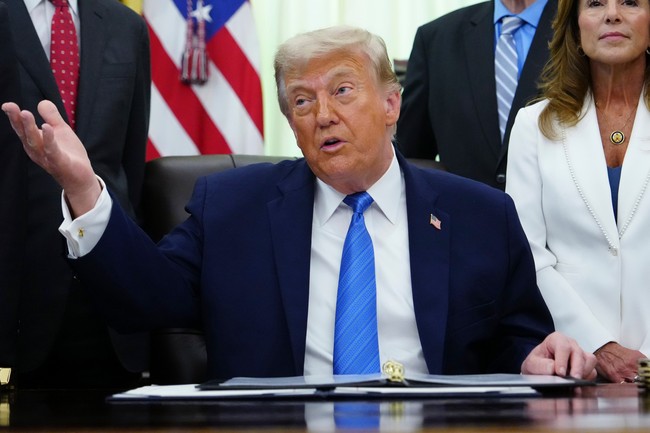
Much of this comes as a result of the war with Iran, which has been frozen in the worst position possible for inflation for at least two months. Donald Trump revealed that the US Navy has accelerated the passage of commercial shipping through the Strait of Hormuz in recent weeks, putting millions of barrels of oil back on the market in an attempt to push energy prices down again:
🚨 WOW! President Trump reveals the United States has been TAKING MILLIONS of barrels of oil at night during the Iran blockade
“I’m just announcing today for the first time. We’ve been taking MILLIONS of barrels of oil! Every night, we took out oil.” 🔥
“Nobody knows about it.… pic.twitter.com/iOtNOfYp1c
— Eric Daugherty (@EricLDaugh) June 10, 2026
While that’s good news, it’s also insufficient to drop prices enough to take the edge off inflation. Plus, the drop in prices are real but also recent. The impact of this Project Freedom effort will likely be seen in the next CPI report, but one has to wonder whether Trump’s declared impatience with Iran today relates to this inflation issue and the dangers it holds for the midterms.
The Wall Street Journal reports that nearly all of this relates to prices at the pump:
Surging gasoline prices have erased more than a year of Americans’ wage gains.
The hole got deeper in May, when consumer prices rose 4.2% from a year ago, the Labor Department reported Wednesday. That was significantly higher than the 3.4% gain in average hourly earnings registered in the May jobs report.
That inflation-adjusted gap—average-hourly earnings falling 0.7% below their year-earlier level—is the biggest since February 2023.
May marked the second month in a row that inflation topped year-over-year growth in earnings, hurt mainly by a surge in prices at fuel pumps after the U.S. and Israel launched attacks on Iran at the end of February. Another factor: Wage growth has been trending lower, making it harder for workers to keep up with higher prices.
There’s some good news in this, too. If Trump can solve the Hormuz crisis, then he can inflation back under control fairly quickly. The inflationary wave of 2021-3 was created by supply-chain crises that got amplified by demand-side stimulus policies. Trump is attempting to solve this by fixing the supply of oil rather than cutting checks that would only act to accelerate demand and amplify inflation. The fundamentals of this economy are still strong, and the fact that the global oil shock has taken this long to show up as wage erosion — along with the strong jobs reports of the last three months — shows the strength of those fundamentals.
Nevertheless, the economic pain is real, and Republicans have to stop it before it becomes spectacular. That may be why Trump has apparently decided to give war a chance again with Iran.
Rick Santelli offered some other positives from today’s report, but he also flagged the wage erosion issue. That will not play well if we’re still talking about it in October.
Editor’s Note: Thanks to President Trump’s leadership and bold policies, America’s economy is back on track.
Help us continue to report on the president’s economic successes and combat the lies of the Democrats. Join HotAir VIP and use promo code FIGHT to receive 60% off your membership.