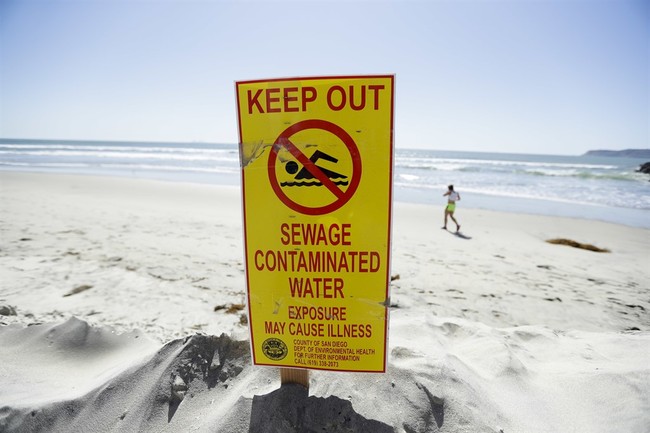
Tijuana River sewage is barreling toward the California coastline every day, and there’s no polite way to dress it up. Up to 30 million gallons of sewage-contaminated water flow from Tijuana into the Pacific Ocean every day.
Ocean currents then do what ocean currents do: they carry the mess up north and help close beaches across San Diego County.
Montezuma’s Revenge usually waits until after vacation!
California gets the municipal version delivered ahead of time.
Watch the latest video at Fox News.
San Diego County Supervisor Paloma Aguirre, who represents District 1, has pushed for stronger emergency steps, targeted cleanup of toxic hot spots, air purifiers for schools and homes, and a broader health study for South Bay families.
Ben Cost, writing at the New York Post, calls the situation a “poonami.”
New Jersey resident Kristin Cohen, 36, claimed she attempted to take her 3-year-old daughter Chloe, only to be stopped in her tracks by a sign that read “Water Contact May Cause Illness.”
“I guess we can’t do that, babe,” she lamented.
And it’s not just sunbathers who are affected by the “poonami.” Larry Delrose, entertainment director at the Coronado Shores condo community, claims that he’s forced to close his windows several times a week to keep out the “sewer”-like aromas.
In 2025, the beaches in front of the historic Hotel del Coronado, whose rooms can cost up to a grand per minute, were shuttered for 129 days due to the fecal flood. Many of these were during the peak of summer, like a malodorous version of the movie “Jaws.”
Aguirre’s office describes untreated sewage and industrial waste flowing through the Tijuana River as a decades-long threat to the coastline, public health, and local accountability.
President Donald Trump has pressed Mexico to stop the untreated wastewater from crossing into American communities. EPA Administrator Lee Zeldin has also made the same crisis a priority, visiting San Diego, meeting with local leaders, and signing a memorandum of understanding with Alicia Bárcena Ibarra, Mexico’s secretary of Environment and Natural Resources.
In other words, Mexico is sending tons of doo-doo to American shores, and we sent a strongly worded memo about it.
Zeldin committed the agency to a permanent 100% solution, which sounds grand until another beach closure sign reminds everyone that pipes, pumps, treatment plants, and deadlines matter more than ceremony.
EPA’s February 2026 update listed practical work that has to happen: repairing and replacing Tijuana River gates, diverting 10 million gallons per day of treated effluent from two Mexico-side wastewater plants, and rehabilitating the Parallel Gravity Line that moves sewage from central Tijuana to a coastal treatment plant.
Put plainly, the answer involves infrastructure, not another round of official frowning.
Aguirre released an encompassing picture of the situation, leaving nothing out of it.
The Tijuana River sewage crisis is more than an environmental disaster—it’s a public health emergency. When toxic waste and bacteria-laden water cross our border, families lose access to safe beaches, lifeguards and Navy SEALs are exposed to hazardous contaminants, and local businesses that rely on clean water suffer. Studies by the Center for Disease Control and academic institutions show that these flows contain high levels of pathogens, heavy metals, and chemicals that pose serious health risks, and families that live in the South Bay are falling in.
A newly published, peer-reviewed study in Science, led by researchers from UC San Diego, UC Riverside, SDSU, and the National Center for Atmospheric Research, reveals an alarming new dimension: polluted waters from the Tijuana River are also degrading air quality. The team detected hydrogen sulfide—commonly known as “sewer gas”—at concentrations up to 4,500 parts per billion (ppb) in the Nestor neighborhood, far exceeding safe exposure levels.
Beyond hydrogen sulfide, researchers identified hundreds of other airborne toxins—including chemicals from industrial waste, personal care products, and even drug residues—suggesting widespread exposure across South Bay communities. This is the first study to establish a direct link between waterborne sewage pollution and airborne health hazards in our region.
The pollution creates real health risks for nearby people. Hydrogen sulfide gas, the rotten-egg stink that nobody wants as a coastal breeze, has been tied to headaches, breathing trouble, asthma, skin irritation, and stomach illness.
CalMatters, a nonprofit news organization in California, writes that local officials are hoping to speed solutions up.
Community advocates, healthcare professionals and environmental experts with the Tijuana River Coalition on Thursday offered updates on the toxic pollution that plagues south San Diego. And they outlined efforts to fix it, including state legislation, cleanup funding and studies on health and economic impacts.
“As so many folks know, this is one of the longest standing public health issues facing the United States,” said Courtney Baltiyskyy, vice president of public policy and advocacy at the YMCA of San Diego County. “It is a unique issue because it’s on the border between Mexico and the United States and in a place with thriving commerce and extremely unique ecological, natural resources. But we know that the threat to our communities is dire. And it’s worse than ever before.”
Sewage pollution from Mexico enters the Tijuana River and sickens swimmers and surfers, forces beach closures and endangers Navy SEALs training in Coronado. The river also emits airborne toxins including foul-smelling hydrogen sulfide gas, which causes breathing problems and other ailments in neighboring communities. That air pollution has worsened in recent months, with more unsafe air warnings, speakers said.
Since 2018, over 100 billion gallons of raw sewage have flowed from the Tijuana River into Southern California, and local doctors have reported sharp increases in respiratory problems during sewage surges.
Navy SEALs training near Coronado have also had to deal with contaminated water, because apparently even elite military training now includes dodging someone else’s wastewater gift.
Beach closures don’t just inconvenience swimmers; they batter hotels, restaurants, shops, lifeguard planning, military training, and families who bought into the California coastline dream and got warning signs instead.
Coronado’s beaches face 129 closure days in 2025, while the wider region has seen long-running closures that drained tourism and patience alike. Nobody builds a seaside economy around the phrase “avoid ocean water.”
San Diego Mayor Todd Gloria joins the list of local officials demanding faster results, while federal and binational agencies keep pointing toward upgrades on both sides of the border.
Tijuana’s population growth has overloaded aging wastewater systems, and California communities now pay part of the price in lost business, health worries, and closed sands. Residents don’t need more sympathy; they need Mexico to own up to the s**tstorm and stop the flow, while Washington continues to keep the pressure on, and every agency involved to remember that cleanup means cleaner water.
Not better language around dirty water.
Stories like California’s sewage crisis deserve blunt coverage, not polite government fog. PJ Media VIP members help keep that kind of writing alive, especially when official explanations smell almost as bad as the problem itself. Use promo code FIGHT and grab 60% off your subscription here.