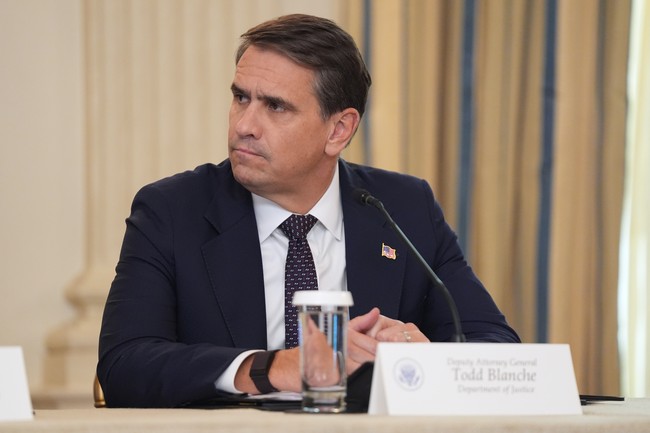
Acting Attorney General Todd Blanche didn’t dress up the message in diplomatic lace. In a June 29 letter to Judge Tomoko Akane, president of the International Criminal Court, Blanche told The Hague what President Donald Trump’s administration had already made clear: Americans answer to American courts.
In a letter this week addressed to the President of the International Criminal Court (ICC), Acting Attorney General Todd Blanche wrote that the Department of Justice rejects any assertion of jurisdiction by the ICC over Americans.
The United States is not a party to the Rome…
— U.S. Department of Justice (@TheJusticeDept) July 2, 2026
A foreign tribunal the United States never joined doesn’t get a roving claim over its liberty. The legal language was polished, but the meaning was blunt enough.
The Hague can go pound sand!
The DOJ said the United States isn’t a party to the Rome Statute, never consented to ICC authority, and will not accept ICC jurisdiction over U.S. people anywhere in the world.
“The ICC has acted in an increasingly lawless and illegitimate manner,” writes Blanche in his letter to Judge Tomoko Akane, President of the International Criminal Court. “Its record of selective enforcement and credible allegations of internal misconduct raise serious doubts about the ICC’s impartiality, credibility, and legitimacy.”
In 2002, Congress passed the American Servicemembers’ Protection Act which expressly repudiates ICC jurisdiction over U.S. persons, including U.S. servicemembers, government officials, and civilians. The statute prohibits cooperation with the ICC and authorizes the President to use all means necessary and appropriate to secure the release of any U.S. person detained pursuant to any ICC warrant or request.
Going forward, the United States will not cooperate with any ICC investigation, inquiry, summons, or proceeding. This includes the extradition or transfer any U.S. person to the ICC. The Department will also oppose any effort by other countries to do so.
“The Department of Justice is fully committed to defending our Nation’s sovereignty and protecting the rights of U.S. persons against unlawful international overreach,” the letter continues. “Our Constitution — the supreme law of the land — vests the judicial power of the United States in its own courts, and our legal system is the envy of the world. The United States will not subordinate the liberty and security of our people to a foreign tribunal in The Hague with no accountability to any electorate or fidelity to the Constitution.”
Blanche also wrote that DOJ will not cooperate with ICC investigations, inquiries, summonses, proceedings, extraditions, or transfers involving Americans.
For once, Washington said the quiet part in plain American terms. Sovereignty isn’t a mood; it’s the hard border around who may judge our soldiers, our officials, and our people.
If the Constitution vests judicial power in American courts, then no unelected panel in The Hague gets to borrow that power because it prefers a different answer.
𝐓𝐑𝐔𝐌𝐏 𝐃𝐎𝐉 𝐓𝐄𝐋𝐋𝐒 𝐓𝐇𝐄 𝐈𝐂𝐂 𝐈𝐓 𝐇𝐀𝐒 𝐙𝐄𝐑𝐎 𝐀𝐔𝐓𝐇𝐎𝐑𝐈𝐓𝐘 𝐎𝐕𝐄𝐑 𝐀𝐌𝐄𝐑𝐈𝐂𝐀𝐍𝐒, 𝐄𝐕𝐄𝐑
Acting Attorney General 𝐓𝐨𝐝𝐝 𝐁𝐥𝐚𝐧𝐜𝐡𝐞 sent a formal letter to the International Criminal Court this week making one thing permanent: the United… pic.twitter.com/fMGAodDIQr
— M.A. Rothman (@MichaelARothman) July 3, 2026
Congress drew the same line in 2002 with the American Servicemembers’ Protection Act. The law blocks U.S. cooperation with the ICC, bars extradition from the United States to the court, and prohibits support for the transfer out of U.S. people or lawful permanent residents to ICC custody.
It also gives the president authority to act to secure the release of protected Americans held by or for the ICC.
Blanche’s letter also accused the ICC of selective enforcement and raised concerns about internal misconduct. Those words landed while ICC Prosecutor Karim Khan KC remains under a cloud of disciplinary trouble. From the Associated Press:
In an unprecedented move, the embattled chief prosecutor of the International Criminal Court was suspended from his duties late Monday, after the court’s oversight body referred British barrister Karim Khan for disciplinary proceedings.
The 56-year-old is facing allegations of sexual misconduct with a female aide, in a scandal that has dragged on for more than two years. He has steadfastly denied any wrongdoing.
A final decision on Khan’s fate is now up to the Assembly of States Parties, the body that oversees the ICC, which will hold a special session to decide if Khan can remain in his job at the global court.
The Bureau of the Assembly of States parties — the executive committee of the court’s oversight body — said in a statement that it based its decision “on the report of an investigation undertaken by the United Nations Office of Internal Oversight Services (OIOS), the underlying evidence, the advice of an ad hoc Panel of judicial experts, and written submissions.”
Khan has denied the allegations, but the court’s own oversight process has moved against him, and deputy prosecutors have handled his duties during the fight over his future.
The ICC’s reach hasn’t been aimed only at America. President Trump’s 2025 executive order imposed sanctions after the court targeted Israeli Prime Minister Benjamin Netanyahu and former Israeli Defense Minister Yoav Gallant.
The order said the ICC has no jurisdiction over the United States or Israel, because neither country is a party to the Rome Statute, and neither has accepted the court’s authority.
Critics will call Blanche’s letter defiant.
Good.
Defiance has its place when foreign institutions act as if consent is a small detail. America can punish war crimes, and we can hold our own accountable.
America can work with allies and still refuse to hand its people to a court that answers to no American voter, no American jury, and no American Constitution.
PJ Media readers know where the fight goes next: sovereignty, courts, soldiers, and the people who are lectured by global institutions that never pay the price for their overreach. Join PJ Media VIP while the 74% discount is live. Use promo code FIGHT.