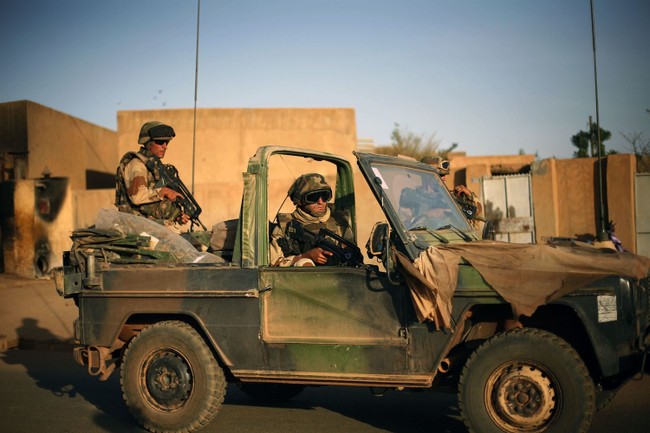
On Saturday, April 25, 2026, the world awoke to a nightmare that seasoned observers of the Sahel had been forecasting for years. Fighters from Jama’at Nusrat al-Islam wal-Muslimin (JNIM), the al-Qaeda-linked umbrella group operating across West Africa, launched a coordinated nationwide assault on Mali. Striking before dawn, they hit Bamako’s Modibo Keïta International Airport, the main military base at Kati, the home of Defense Minister Sadio Camara, and cities including Mopti, Gao, and Kidal. JNIM’s longtime tactical partners, the Tuareg separatists of the Azawad Liberation Front (FLA), simultaneously moved on northern strongholds, reportedly seizing much of Kidal and lowering the Malian flag.
By midday, the U.S. Embassy had ordered citizens to shelter in place. The airport was closed and a three-day curfew announced. Russian Africa Corps mercenaries — who had replaced French and UN forces — were dragged into firefights alongside the Malian army. Mali Defence Minister Sadio Camara was killed in an attack on his residence. While government spokespeople insisted the situation was “under control,” social media flooded with images of jihadist fighters parading through captured military bases and FLA fighters raising their flag over the north. A Malian air force Mi-35 was reportedly shot down in Gao.
Whether Bamako survives this offensive, falls in the coming days, or descends into a prolonged siege, one thing is now beyond dispute: the warnings about Mali were not exaggerated. They were, if anything, understated.
Following the 2012 Tuareg rebellion and ensuing military coup, northern Mali quickly fell under the control of jihadist groups, most notably al-Qaeda in the Islamic Maghreb (AQIM) and its affiliates, who exploited weak governance and cross-border instability to impose Islamic sharia law. Christian life in these regions became untenable.
A military government currently controls Mali, which has compounded the pressures on Christians and monitoring of church leaders and activities. The military government suspended political parties in 2025, which has increased fears of greater authoritarianism and instability.
Some parts of Mali are currently unlivable for Christians because of rampant jihadist activity. Christians endure violence, kidnappings and churches burnt to the ground.
In September 2024, my co-author Uzay Bulut and I wrote in JNS that “an Islamist insurgency in Mali may destroy the country’s Christian communities.” We documented how, in Mali’s Mopti region, jihadists had summoned pastors and given them three options: provide men to fight alongside the militants, hand over money to hire mercenaries, or convert to Islam and shutter their churches. Those who refused were told to flee. Christians were forced to pay a religious tax — an Islamic tithe. Converts were killed on sight if discovered. Women and girls were kidnapped and “married” off as sexual slaves to fighters. Schools were shuttered by the thousands; over half a million children lost access to education, and those who returned were forced into Quranic curricula in Arabic. Foreign missionaries, like Swiss humanitarian Béatrice Stöckli, were kidnapped and murdered. Churches were destroyed, Christians driven out, and religious symbols desecrated.
We warned then that the trajectory was clear. The Malian government, having just suffered two military coups in less than 12 months, had no capacity to push back. The junta expelled the French in 2022 and forced out the UN peacekeeping mission MINUSMA by the end of 2023. Into the security vacuum poured Russia’s Wagner Group — and jihadists who exploited the absence of the only forces with the will and capability to contain them. As Open Doors observed, “the jihadist violence is spreading southward, and the country’s institutions are breaking apart at a fast rate, further playing into the hands of jihadist groups.”
The situation for the country’s Christians remains perilous, according to Open Doors 2026 report:
Christian communities in Mali face escalating and multi-layered persecution, making many regions effectively uninhabitable for them. Jihadist groups such as Jama’at Nasr al-Islam wal-Muslimin (JNIM) and Islamic State in the Greater Sahara (ISGS) have expanded beyond the north into central and southern Mali, targeting Christians with violence, abductions, and church burnings. Evangelical pastors and worshipers are especially vulnerable, often accused of being agents of Western influence. The threat is compounded by the convergence of Islamist militancy, organized crime, and systemic corruption. Jihadists exploit smuggling routes, illegal mining, and patronage networks, creating lawless zones where Christians, especially in rural areas, are left exposed and defenseless.
This is precisely what has now come to pass. In the months following our piece, JNIM attacked a gendarmerie training school near Bamako’s airport, killing roughly 70 people. By 2025, the group had imposed a fuel blockade on the capital, paralyzing Bamako at times. The April 25, 2026 offensive — described by Sahel analyst Ulf Laessing as “the largest co-ordinated jihadist attack on Mali for years” — is the logical culmination of a strategy that has been visible all along.
What we did not say loudly enough then, and what must be said now, is what a JNIM victory would actually mean. Should Bamako fall, this would be the first time an al-Qaeda affiliate took over an entire country. Sudan, after Islamists seized power in 1989, hosted Osama bin Laden and birthed the modern era of jihadist terror. A jihadist Mali, in the heart of the Sahel and bordering seven other states, could become worse: a continental platform for radicalization and export. Burkina Faso and Niger would be exposed and likely next. Every coastal West African state, from Senegal to Nigeria, would feel the pressure.
For Mali’s Christians — currently ranking 15th on Open Doors’ World Watch List — the implications are existential. The 867,000- strong Christian community, plus over two million practitioners of tribal faiths, face the choice already forced on their countrymen in the north and center: convert, pay, fight for the jihadists, or die. The pattern, from Iraq to Nigeria to Burkina Faso, is well-established. No one paying attention should be surprised where it leads.
There is plenty of blame to share for how Mali got here. The junta’s decision to expel France and the UN — even granting legitimate grievances about colonialism and counter-insurgency failure — handed the country to forces it could not control. Russia’s Wagner and Africa Corps brought brutality without strategic competence; mercenaries cannot save a state. Western capitals, in turn, lost interest in the Sahel after the rupture and found it convenient to look away as a terrorist proto-state metastasized.
Under Colonel Assimi Goïta’s transitional military government, formed after the 2021 coup, the state has failed to restore territorial control or protect civilians. Despite a 2023 constitutional referendum and pledges of civilian transition by 2024, Mali has become increasingly isolated, withdrawing from both the G5 Sahel, a regional security bloc, and Economic Community of West African States (ECOWAS). This has further weakened diplomatic ties and regional conflict management mechanisms.
Mali, whose population is about 25 million, is becoming even more unstable. For Christian communities, this means increasing danger, being pushed out of public life, and facing threats to their very survival.
The U.S. Commission on International Religious Freedom (USCIRF) has identified Islamic militant groups operating in Mali as “Entities of Particular Concern.” These jihadist groups also target moderate Muslims and traditional religious practitioners. The USCIRF described jihad in Mali as follows:
Jama’at Nasr al-Islam wal Muslimin (JNIM)—which formed when al-Qaeda in the Islamic Maghreb and its affiliates Ansar al-Din, the Macina Liberation Front, and al-Mourabitoun merged in 2022—continued expanding its activities across the Sahel region, using taxation and ransom of kidnapped captives to extract money from all religious communities. JNIM imposed strict dress codes, banned most music and smoking, ordered men to grow beards, and prevented women from being in public spaces alone. The group continued to levy jizya (Islamic poll-tax) on adult Christian men in the Mopti region of Mali.
But the deeper lesson is the one Uzay and I tried to convey in 2024: the persecution of Christians, the imposition of jizya on non-Muslims, the kidnapping of girls, the destruction of churches, the closure of schools — these were not side effects of state collapse. They were the leading indicators of it. Wherever a society begins to tolerate the religious cleansing of its most vulnerable minorities, the cleansing rarely stops there. The same forces that came for the Christians of Mopti two years ago are now firing on Bamako’s airport.
On Wednesday, April 22, at a briefing held at the Capitol on the ongoing jihad massacres in Nigeria, representatives heard first hand reports of continuous and expanding assaults on Nigerian Christian villages by Boko Haram and Fulani jihadists, including an emotional account of her enslavement, captivity, and escape by a young Nigerian woman. Nigerian Americans have been warning Western democracies that the jihad there is spreading across the continent. Speakers were critical of Christian church leaders who are failing to even take note of the intended destruction of Christianity in Africa.
Mali’s government may yet hold. The Russians may yet reinforce. The jihadists may be pushed back this week, or next. But the trajectory has not changed, because the conditions that produced this offensive — radicalization, institutional collapse, and a vacuum of accountable security — have not changed. The world was warned, through dozens of human-rights groups, monitors, and yes, opinion writers like ourselves. The question now is whether anyone will act before the warning becomes an obituary.
Editor’s Note: The American people overwhelmingly support President Trump’s law and order agenda.
Help us fight back against the Democrats and Soros-backed DAs that refuse to enforce our laws to hold criminals accountable. Join PJ Media VIP and use promo code FIGHT to receive 60% off your membership.