Senior U.S. District Judge Michael Urbanski has told Shenandoah County, Va., that two school names restored by an elected board must disappear again.
On Thursday, Urbanski ruled that restoring Stonewall Jackson High School and Ashby-Lee Elementary violated the 14th Amendment and the Equal Educational Opportunities Act.
In an opinion filed Thursday in U.S. District Court of Virginia, Judge Michael F. Urbanski said the school board in Shenandoah County violated Black students’ rights under the 14th Amendment’s equal protection clause, which forbids racial discrimination in state-supported institutions. The decision also violates the Equal Educational Opportunities Act, the court found.
Confederate army officers’ names are “vestiges” of Shenandoah County’s segregationist history that required separate schools for Black and white students.
“The Confederate names were restored with complete awareness of their historic legacy and ongoing discriminatory impact,” Urbanski wrote. “In the court’s view, the affirmative act of reinstating these vestiges of segregation is far more problematic than a passive failure to remove a long-standing name or symbol.”
The judge ordered the board to settle on new school names “on a racially nondiscriminatory basis with all deliberate speed.”
Unlike memorials named after Confederate figures, schools are places where children should have an “educational environment free of vestiges of racial discrimination,” Urbanski added.
He called the Confederate names “vestiges” of segregation and ordered the board to select new names on a racially nondiscriminatory basis “with all deliberate speed.”
The legal argument deserves a fair hearing; black students and their parents sued after the board restored the names in 2024. Last September, Urbanski also ruled that forcing students involved in extracurricular activities to use the Stonewall Jackson name violated the First Amendment rights against compelled speech.
The larger fight reaches beyond two school signs.
Shenandoah County removed the Confederate names in 2020. Four years later, a newly constituted school board voted 5-1 to restore them, with private donations paying the costs. Residents had argued over the issue for years, and voters elected the board members who made the choice.
Friday’s vote reversed a decision by the school board in 2020 when school systems across Virginia and the South were removing Confederate names from schools and other public locations in response to the Black Lives Matter movement.
The Southern Poverty Law Center’s Intelligence Project, which maintains a database of more than 2,000 Confederate memorials nationwide, is not aware of another case of a school system restoring a Confederate name that was removed, said senior research analyst Rivka Maizlish.
Overall, the trend toward removal of Confederate names and memorials has continued, even if it has slowed somewhat since 2020, she said, noting that the Army renamed nine installations named for Confederate leaders, and removed a Confederate memorial from Arlington National Cemetery.
In Virginia, local governments had been banned from removing Confederate memorials and statues until the law was changed in 2020, though the statute did not apply to school names.
Now a federal court has overridden it.
Here in Wisconsin, I’ve watched the same national argument play out around First Nation names and symbols. UW-La Crosse once called its teams the Indians before adopting Eagles. Cleveland’s baseball club became the Guardians. Washington’s NFL franchise retired the name Redskins and eventually became the Commanders.
Native opinion isn’t uniform, either. The National Congress of American Indians opposes unsanctioned Native mascots, while the Seminole Tribe of Florida formally supports Florida State University’s use of the Seminole name and imagery.
A respectful use can survive when the people being represented support it.
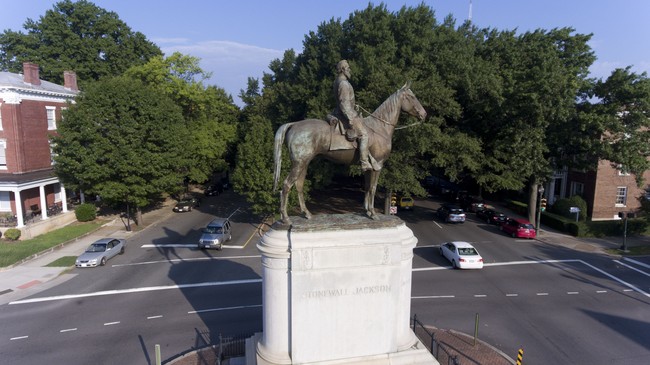
Stonewall Jackson is a harder case, and history should be honest about him.
Jackson owned slaves and fought for the Confederacy. Those facts can’t be scrubbed away; neither can the rest of his life. He grew up poor and orphaned, graduated from West Point, served with distinction in the Mexican War, taught at Virginia Military Institute, became one of the Civil War’s most gifted commanders, and was deeply religious.
In Lexington, he taught Sunday school to black children despite local resistance.
A society capable of understanding history should be able to hold all of those facts at once.
A school board may conclude Jackson should no longer be honored, voters may replace that board, while another board may restore the name.
Democracy leaves room for arguments over memory, honor, and local history. Urbanski’s ruling moves the final decision from the ballot box to the federal bench.
The Virginia NAACP filed the suit on behalf of six students and their parents in June 2024 after the school board voted 5-1 to change Mountain View High School back to Stonewall Jackson High School and Honey Run Elementary back to Ashby-Lee Elementary, which combines the names of Gen. Robert E. Lee and Turner Ashby, a Confederate cavalry officer. The board reversed a 2020 decision to remove the original names against a backdrop of nationwide protests over racial injustice.
The NAACP argued in its lawsuit that Black students, who make up less than 3% of the school system’s population, would be “required against their will to endorse the violent defense of slavery pursued by the Confederacy and the symbolism that these images have in the modern White supremacist movement.”
Under President Donald Trump’s second administration, some statues honoring Confederate figures have been restored after being removed in 2020. It is part of Trump’s ongoing efforts to control how American history is framed at Smithsonian museums, monuments in national parks and in classrooms.
Board members who voted to restore the Confederate names said they were honoring popular community sentiment. They said the previous board members who voted to remove the names in 2020 had ignored constituents and due process on the matter.
Virginia is now led by Democrat Gov. Abigail Spanberger, but she didn’t issue this order; a federal court did. The school board’s attorney, Jim Guynn, said months before the ruling that his client was prepared to take the case as far as necessary, including the U.S. Supreme Court.
I hope it does.
A country protects itself from old sins by teaching them fully. Removing names, statues, and markers may settle an argument for a moment, but it can also make the past easier to forget.
History demands to be examined, challenged, and remembered. Courts should be careful before deciding which parts a community is allowed to keep in public view.
Support independent conservative journalism and get 60% off a PJ Media VIP subscription with promo code FIGHT. VIP membership helps us keep digging into the stories, court fights, and cultural battles others would rather simplify or ignore.