Listen my children and you shall hear
Of the midnight ride of Paul Revere,
On the eighteenth of April, in Seventy-five;
Hardly a man is now alive
Who remembers that famous day and year.
He said to his friend, “If the British march
By land or sea from the town to-night,
Hang a lantern aloft in the belfry arch
Of the North Church tower as a signal light,–
One if by land, and two if by sea;
And I on the opposite shore will be,
Ready to ride and spread the alarm
Through every Middlesex village and farm,
For the country folk to be up and to arm.”
“Paul Revere’s Ride” by Henry Wadsworth Longfellow (February 27, 1807 – March 24, 1882)
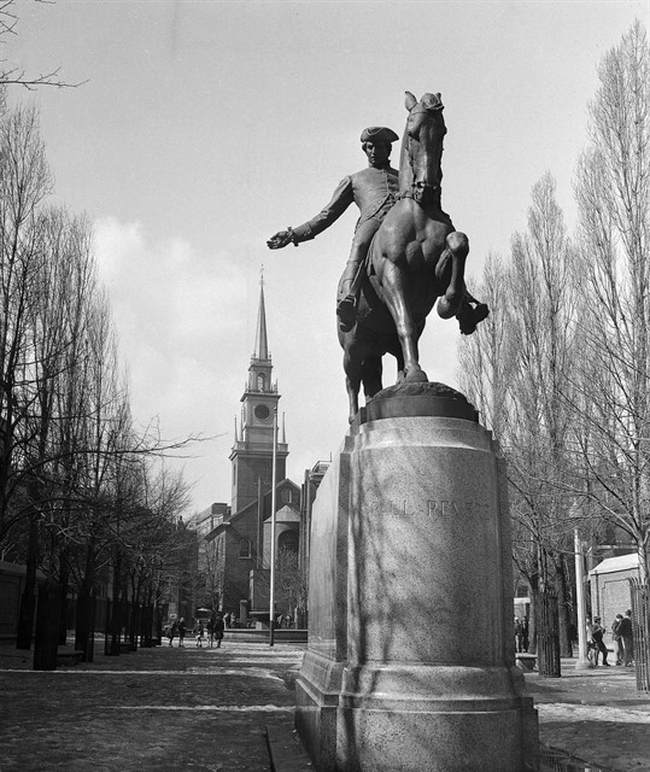
The image has captured the imagination of American school children for more than 160 years. A lone rider, braving capture at the hands of the British, riding along the narrow country lanes and cobblestone streets of the picturesque towns and villages of New England, shouting out defiance to tyranny, raising the alarm “through every Middlesex village and farm,” his trusty horse carrying him on his ride into legend.
Too bad it didn’t quite happen that way.
Longfellow was one of the first international literary superstars that America produced. Like James Fenimore Cooper and Nathaniel Hawthorne, he used distinctly American themes and motifs to tell powerful narrative stories that have stood the test of time.
He wrote “Paul Revere’s Ride” 85 years after the fact, in 1860, so perhaps he can be forgiven for fudging some of the details. “Paul Revere’s Ride,” while historically inaccurate, nevertheless conveys the breathless spirit of resistance of the colonists to British rule. His goal wasn’t faithfulness to history. It was to generate a burst of patriotism to try to dissipate the gathering storm clouds of civil war.
He picked a good subject and man. Paul Revere may not have been a political force, but he was in the middle of most of the key moments of early American history.
A silversmith by trade, Revere served on the Massachusetts Committee of Safety, and was a member of the Sons of Liberty. At some point, he met and became friends with Sam Adams, and one of the most important partnerships in American history was born. Adams, the intellectual, and Revere, the man of action, complemented each other perfectly. They were to do great things together.
The real story of Revere’s famous ride is dramatic enough. On the evening of April 18, 1775, Dr. Joseph Warren, a core member of the inner circle of the Sons of Liberty, and a frequent collaborator with John Hancock and Samuel Adams in coordinating resistance against British policies, sent Revere on a ride to Lexington to warn Adams and Hancock that the British had dispatched 800 regulars to arrest them and destroy the stores of powder and shot being stored on a farm outside of town. As it turns out, Warren’s intel was faulty. The British weren’t out to arrest anyone. But the threat to the Patriots’ small stash of armaments was real. The local militias must be warned.
Revere had served as one of the primary messengers of both the Committee of Safety and the Sons of Liberty. This is significant, because Revere would have to avoid the numerous British roadblocks and pickets that had kept Boston bottled up for months.
Revere asked a friend, probably the sexton of Christ Church (now called the Old North Church), to hang two lanterns in the belfry to let the Sons of Liberty across the Charles River know that the British were on their way. This was a safeguard in case Revere was arrested or blocked from leaving the city.
Another patriot rowed him across the river, slipping past a British warship in the process. Before leaving, Revere was warned about several British patrols in the area, no doubt to prevent word of the marching troops from reaching Concord.
Revere borrowed a horse and started on his ride into history and myth. William Dawes, another member of the Sons of Liberty, joined him near Lexington. Dawes had taken the land route to Lexington over Boston Neck in order to warn militias on the South side of the River.
The Paul Revere House, a historical association that has preserved the structure since 1800, describes Revere’s meeting with Adams and Hancock in Lexington.
In Lexington, as he approached the house where Adams and Hancock were staying, Sergeant Monroe, acting as a guard outside the house, requested that he not make so much noise. “Noise!” cried Revere, “You’ll have noise enough before long. The regulars are coming out!” According to tradition, John Hancock, who was still awake, heard Revere’s voice and said “Come in, Revere! We’re not afraid of you”. He entered the house and delivered his message.
After Revere and Dawes left Lexington around midnight, Dr. Samuel Prescott, another prominent patriot who had taken it upon himself to warn the countryside that the British were on the move, joined them on the road to Concord.
Around 1:00 a.m., the little group ran into a roadblock manned by British regulars, who had been told to stop the colonists from trying to communicate with one another. Revere was captured, while Dawes and Prescott got away. Prescott eventually made it to Concord and alerted the militia there.
Revere was extremely cooperative with his captors. He told them that he had already warned Hancock and his friends and that 500 militia men were assembling at that moment to resist the British. That last part was pure bluff, but the regulars didn’t know that. Deciding that discretion was the better part of valor, the British soldiers decided to return to barracks, releasing Revere around 3:00 a.m.
The events the following day at Lexington and Concord would have unfolded quite differently if Revere, Dawes, and Prescott had been unable to leave Boston to arouse the countryside. There may not have even been a confrontation at Lexington, since the militia, which Revere had duly warned, mustered in before dawn.
The powder and shot stores in Concord had already been moved, but the 1,500 angry militiamen who confronted the British on the road back to Boston may not have been as numerous, and probably wouldn’t have inflicted the huge number of casualties on the British regulars.
Revere’s participation in the revolution was by no means over. He was commissioned a Major of infantry in the Massachusetts militia in April 1776; was promoted to the rank of Lieutenant Colonel of artillery in November; was stationed at Castle William, defending Boston harbor, and finally received command of this fort. He served in an expedition to Rhode Island in 1778, and in the following year participated in the disastrous Penobscot Expedition. Upon his return from that fiasco, he was court-martialed for failing to obey orders. His commanding officer, trying to absolve himself of blame for the military disaster that cost of the lives of 500 men and 43 ships, trumped up the charges. Revere was acquitted.
After the war, Revere proved himself a canny businessman and bold entrepreneur. He took advantage of the religious revival sweeping the country after the revolution by manufacturing church bells, a business that made him wealthy. He also pioneered copper plating in America, and supplied the young country’s navy with copper spikes for the planking. In effect, he became one of the first successful industrialists in American history.
Revere was not a politician, so he is rarely considered a “Founding Father.” However, while not among the more unruly elements who took part in the Boston Massacre and the Tea Party, he and his friend Sam Adams were not above using those elements to further the cause of revolution, a goal for which he worked for more than a decade. In that respect, perhaps we can call him a “Founding Brother.”
PJ Media will give you all the information you need to understand the decisions that will be made this year. Insightful commentary and straight-on, no-BS news reporting have been our hallmarks since 2005.
Get 60% off your new VIP membership by using the code FIGHT. You won’t regret it.