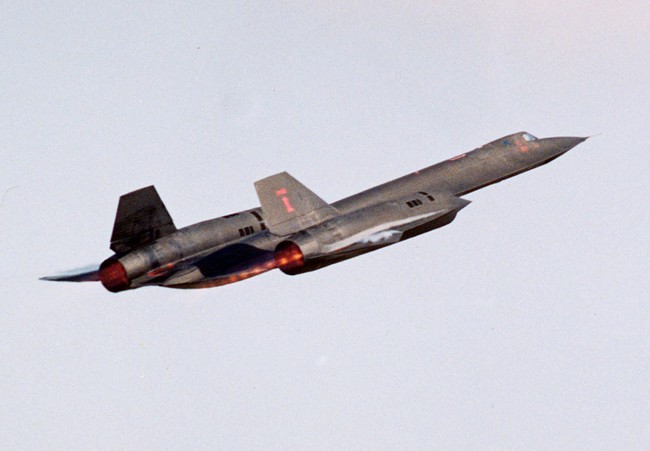
The Habu is a venomous pit viper that inhabits the Japanese Ryukyu Islands. Residents around the U.S. Air Force base of Kadena on the island of Okinawa nicknamed the sleek, black, supersonic, and uber-mysterious aircraft that would rise from the air station’s runways in the gloaming after that deadly, nocturnal serpent.
It stuck instantly and was soon adopted by the pilots who flew and the crews who worked on the legendary Lockheed Blackbird SR-71.
They, too, called themselves ‘Habus.’
Dear God, what a magnificent aircraft. Brings tears to my eyes.
And what a testament to the glory days of American aviation – Kelly Johnson and his geniuses at the Lockheed Skunk Works.
The Birth of the SR-71 Blackbird
The SR-71 Blackbird was born out of the Cold War era’s need for high-speed, high-altitude reconnaissance. Developed by Lockheed’s Skunk Works division, the Blackbird was designed to fly faster and higher than any other aircraft in existence. It featured a sleek, futuristic design, and its distinctive black color was the result of the heat-resistant paint used to cope with the extreme temperatures generated during supersonic flight.
Unprecedented Performance
The SR-71 was not just a reconnaissance aircraft; it was a technological marvel that shattered records:
– Speed: The Blackbird could reach speeds exceeding Mach 3 (2,200+ mph), making it the fastest operational aircraft in history.
– Altitude: It could soar to altitudes of 85,000 feet or more, well into the upper reaches of the stratosphere.
– Stealth: While not a stealth aircraft in the modern sense, its speed and altitude made it nearly impossible to intercept or track by enemy forces.
Jeremy Clarkson’s lyrical ode to his dream plane originally aired in 2001. Below is a clip from it.
THE FASTEST PLANE EVER MADE
Although we’ll never know how fast it could really fly. Classified, you know.
REALLY classified.
New York to London in 114 minutes, Clarkson says, and I bet they weren’t even pushing it.
And there’s a reason the Darkstar experimental aircraft that Tom Cruise crashes, as well as the testing facility in Top Gun: Maverick, looked so authentic – it was all built by the real Skunk Works guys.
The Darkstar in the new @TopGunMovie seems pretty realistic for good reason. Jerry Bruckheimer told me that it was actually designed with Skunk Works engineers. The US Navy told him China reoriented a spy satellite to get pics of it, thinking it was a real experimental aircraft. pic.twitter.com/uefNnQYREw
— Alex Hollings (@AlexHollings52) May 2, 2022
And of course the Chinese were monitoring their every move. There have been rumors of a younger sister plane – the SR-72 – floating for years, and the Chinese can’t be caught with their whatever passes for underwear down.
They never did figure out how the Lockheed guys built this one, and it’s all analog.
Two weeks ago, NASA administrator and complete aviation freak (who also is a jet pilot) Jared Isaacman teased the world with a cryptic little slide that set the aviation community on fire.
An unidentified aircraft resembling the SR-71 Blackbird appeared in Jared Isaacman’s All-In Summit presentation. Asked whether it was an SR-71, the NASA administrator cryptically replied: “You sure that’s a Blackbird?”.
NASA Administrator Jared Isaacman has offered an intriguing glimpse of what could be ahead for the agency’s aeronautics research. During his keynote titled “A New Era for NASA and American Space Exploration” at the All-In Summit few days ago, he presented a slide titled “Rebuilding our X-plane portfolio” that showed a dark aircraft emerging from clouds. Although the rendering obscured much of its design, seen head-on, the shape of the mysterious aircraft clearly reminded the iconic SR-71 Blackbird.
NASA Chief Teases Mysterious Aircraft as Agency Plans New X-Planes
An unidentified aircraft resembling the SR-71 Blackbird appeared in Jared Isaacman’s All-In Summit presentation. Asked whether it was an SR-71, the NASA administrator cryptically replied: “You sure that’s a…
— The Aviationist (@TheAviationist) September 23, 2026
Oh, we all went nuts, and then the excitement exploded when someone realized that, seemingly in the dead of night, the one technically salvageable and operational SR-71 left on Earth?
Had vanished.
And no, I would never thought I would ever write this headline seriously in my lifetime.
— Tyler Rogoway (@Aviation_Intel) September 25, 2026
Steve Trimble, Aviation Week‘s defense editor and friend of TWZ, was first to report the disappearance of the former NASA SR-71, also known by the tail number 844, at Armstrong. That facility is collocated with Edwards Air Force Base in California. Trimble’s piece says that satellite imagery shows the jet has not been seen since at least May 17. The aircraft in question, which originally carried the U.S. Air Force serial number 61-7980, was the last Blackbird produced and the last one to fly, taking to the skies for the final time in 1999.
And ZOMG, the excitement and speculation were off the charts.
…“The current disposition of the aircraft is unclear, but Aviation Week sources suggest that the aircraft was moved into a hangar earlier this year for an inspection,” according to the story. “The presentation and the disappearance of the display SR-71S with the 844 tail number for NASA raises the possibility of a return-to-flight program after a more than 26-year-long hiatus.”
This was one special airframe – literally the last to be built and the last of the breed.
…The Serial 61-7980 was the last SR-71 built and the last to fly, completing its final flight in 1999 after the Air Force had already retired the type and NASA had retained a few surviving airframes for high-speed research.
Lockheed Martin produced 32 of the reconnaissance aircraft, 12 of which were lost in accidents and none to enemy action.
Mercifully, the answer wasn’t too long in coming. I don’t think anyone’s heart could have taken it for an extended period.
NASA is hiring if you’ve ever turned a wrench on a Habu.
NASA Asked Several Former SR-71A Staffers To Help Secret Restart
Mike Relja, a retiree in his late 70s, received an unexpected job offer from NASA about a month ago.
The assignment: Help put a former NASA-operated Lockheed SR-71A Blackbird back in the air after a nearly 27-year hiatus.
Relja, an ex-U.S. Air Force and NASA test engineer for the SR-71A, could not believe his ears. David Ash, a former U.S. Navy and Joby test pilot who was hired in June as a special projects director for NASA, asked Relja to provide his expertise for a secret effort to return a long-retired and neglected Blackbird to flight.
“I told the guy, ‘You know, I’m too old to be doing this,’” Relja recalls to Aviation Week. “‘I wish you well. I’d like to see you make it. It would be interesting. But I just don’t think you can get there from here.’”
It appears NASA is going to try.
Holy CRAP, is this exciting?!
Military aviation and speed geeks are giddy. Just giddy.
You know there is one grey beard there who has been waiting for years for this
— PaintSandRepeat (@SandRepeat) September 28, 2026
DAY-YUM!
I’m gonna just simply not get my hopes up so when they pull the plug in 6 months I dont cry.
— Tooth Chipper (@Tooth_Chipper) September 29, 2026
It’s like a dream, and I hope they can put her back together.
As Tyler says, there is so much to be learned from reverse engineering her.
For reviving the SR-71, learning from the journey could be just as valuable as the actual flight testing.
The whole NASA reviving the SR-71 thing is largely framed in terms of advancing high-speed research, and clearly that would be the primary objective. This is very relevant… pic.twitter.com/xxxg5gl7g1
— Tyler Rogoway (@Aviation_Intel) September 29, 2026
…This is very relevant again and especially in the regime the Blackbird could operate in, but the exercise in just achieving any flight testing at all has outsized value.
The reverse engineering, rapidly rebuilding supply chains, leveraging additive manufacturing and rapid prototyping, injecting new material, avionics, propulsion and other technologies where applicable, and above all else, building the digital toolkit to make it all happen as fast and efficiently as possible, are all exercises of great learning value.
I would not be surprised if a ‘digital twin’ is being created right now of the SR-71 using tail 844. Once the model exists, breakthroughs in digital engineering can be brought to bear to see how fast the program can be accelerated, both in terms of development and flight test.
Just in the act of doing all this, we can learn a LOT. And this is not an unprecedented concept, just look at programs like the X-55.
So, yes, the goal will be high-speed flight test, but so much can be learned in the journey to get there that it to must be quantified in a ‘business case’ for reviving the Blackbird.
I hope they can find someone to fly her if they do. Those boys that are left might be a little long in the tooth for that sort of mission, but you know you’d have to fight them off.
I’ll leave you with something that’s helped cement the Habu’s legend, besides its natural beauty, innate grace, and glorious power.
And it’s fun. It’s the story of the ‘ground speed check,’ a tool pilots use to check their airspeed indicator against what radar on the ground shows they’re actually doing. It’s good to know your instruments are accurate, right? A pilot calls into whatever control tower has them, asks for a ‘ground speed check,’ the tower checks what’s indicated on the radar and reads it back to the plane. Hopefully, it all matches up.
Here’s how it went one night over Los Angeles when Air Force Major Brian Schul was on a training mission in his SR-71 with a new backseater named Walter.
It’s a classic
And I can’t wait to hear that it’s rockin’ the afterburners again.
What a country.
Editor’s Note: The mainstream media continues to gaslight, spin, and lie about President Trump, his administration, and conservatives.
Help us continue to expose their left-wing bias by reading news you can trust. Join HotAir VIP and use promo code FIGHT to receive 60% off your membership.