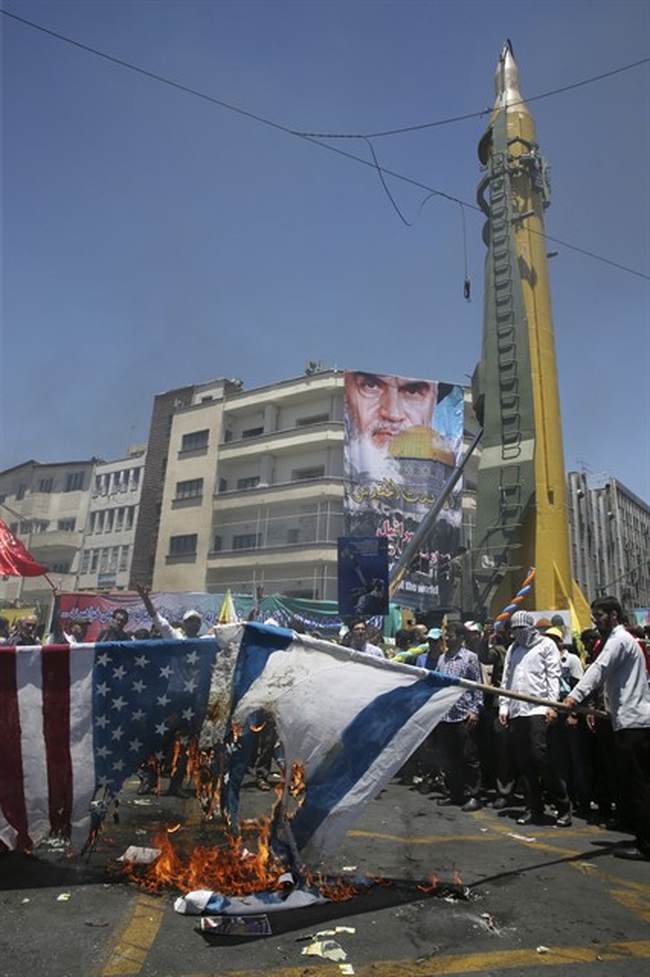
There are no guarantees, since Iran’s Islamic regime is so bloodthirsty, remorseless and repressive, but as demonstrations once again sweep across the country, the Islamic Republic of Iran could be in its final days. After 46 years of harsh Islamic rule, the Iranian people are chanting the name of Reza Pahlavi, the crown prince and son of the shah who was overthrown in 1979, and making no secret of their disgust with the regime.
As all this is happening, it’s worth recalling how it all came to this. The people of Iran have suffered under this criminal, rogue regime for over four and a half decades in no small part because the shah’s friends in the West deserted him, and lavished their ardor upon the Ayatollah Khomeini, the dour, scowling harridan who, thanks to various forms of aid and comfort he received from the Westerners whom he held in such contempt, ended the nearly 2,500-year-old Iranian monarchy and imposed the Islamic Republic.
As The Complete Infidel’s Guide to Iran shows, Khomeini had been an opposition figure in Iran for years. It wasn’t, however, until the shah had him exiled and France welcomed him, allowing him to work to destroy the Iranian monarchy from the safety of Neauphle-le-Château, outside Paris, that he began to be a hero in the eyes of the Western analysts who should have been sounding the alarm about his intentions.
Andrew Young, President Jimmy Carter’s ambassador to United Nations, predicted improbably that “Khomeini will eventually be hailed as a saint.” The U.S. ambassador to Iran, William Sullivan, said: “Khomeini is a Gandhi-like figure.” Carter adviser James Bill declared the ayatollah a “holy man” of “impeccable integrity and honesty.”
Worst of all, however, was the New York Times. On Feb. 16, 1979, when Khomeini had been back in Iran for just a bit longer than two weeks, the Paper of Record published a plea that he be accepted. Unironically entitled “Trusting Khomeini,” the op-ed notes sorrowfully that “more even than any third‐world leader,” Khomeini “has been depicted in a manner calculated to frighten.”
That wasn’t a hard thing to do, as Khomeini himself behaved in a manner that seemed calculated to frighten; he was careful never to smile in public, and forbade publication of photos in which he was caught smiling in spite of himself. Machiavelli told tyrants that it was better to be feared than loved, and Khomeini listened. He also taught a violent, bellicose faith, saying of the assertion that “Islam is a religion that prevents men from waging war”: “I spit upon those foolish souls who make such a claim.”
In the Times, however, the far-left political analyst Richard Falk complained that “President Carter and [his National Security Advisor] Zbigniew Brzezinski have until very recently associated him with religious fanaticism.” Yeah, Khomeini himself did nothing to make anyone think he was a religious fanatic.
The Times even took a page from the patriots who have called it out for its leftist propaganda over the years, blaming “the news media” for Khomeini’s bad reputation in the West. The big bad media, of which the Times was and is a flagship, has, you see, “defamed him in many ways, associating him with efforts to turn the clock back 1,300 years, with virulent anti‐Semitism, and with a new political disorder, ‘theocratic fascism,’ about to be set loose on the world.” Wow, how could anyone have gotten the idea that the Ayatollah Khomeini was an adherent of a seventh-century ideology, hated Jews, and wanted to establish a theocracy in Iran? Will that dastardly media stop at nothing?
Related: The Myth of Islamic Tolerance and the Long History of Islamic Antisemitism
Falk touted “the character and role of Ayatollah Khomeini” as a “hopeful sign” for Iran’s future. It’s hard to read this now without recalling the suspicious death in custody of Mahsa Amini, a young woman who had been arrested in 2022 for wearing her hijab improperly. The many women who are serving lengthy prison terms in the Islamic Republic for daring to venture out without a hijab also come to mind.
Meanwhile, if it manages to survive the present unrest, the Islamic Republic will eventually resume its war against Israel, which stems not from any geopolitical considerations, but from Islam’s claim that any land that was once under Islamic rule belongs by right to Muslims forever, and from its deeply rooted antisemitism.
The New York Times, however, didn’t see fit to say anything about the positions Khomeini had made clear in numerous statements spanning several decades. Instead, it gave its readers a rosy, whitewashed view of the man and his revolution, and thus helped condemn Iranians to decades of misery. Let us hope that, despite the Times’ best efforts, those days are finally coming to an end.
Give yourself a new source that actually tells you the news. Become a PJ Media VIP, and you’ll get all our content and none of the ads. In keeping with the holiday spirit, use code MERRY74 for 74% off.