In the early morning hours of Jan. 3, “Operation Absolute Resolve,” the mission to capture Venezuelan dictator Nicolás Maduro, was already well underway. Several MH-47G Chinook helicopters from the Army’s elite 160th Special Operations Aviation Regiment (SOAR), the legendary “Night Stalkers,” flew into Caracas at barely 100 feet off the ground in a blacked-out city.
The city was dark because U.S. Cyber Command flipped the switch and cut power to the entire grid. They also wreaked havoc on Venezuelan air defenses in a tour de force demonstration of the real capabilities of electronic warfare.
SOAR flew directly to the presidential palace, where about two dozen Delta Force special operators disembarked and carried out their mission flawlessly and with total surprise.
The Chinese were angry that their major client in America’s backyard had been taken off the board. They were also awestruck. No other nation has this capability, and it was made possible by the most effective overwatch operation in military history.
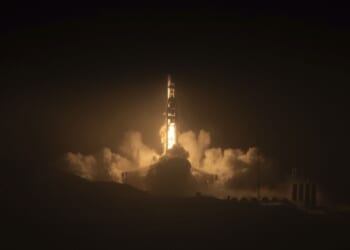
The fact that the overwatch was conducted from outer space, that U.S. Space Command was able to guide the Nightstalkers to their target, keep them safe, and facilitate their safe exit from an aroused, hostile urban environment demonstrated the future of warfare in space.
John Shaw, a former SPACECOM deputy, told Breaking Defense that the level of coordination between the Joint Force and U.S. Space Command was unprecedented.
“The integration of space into joint warfighting has reached a new apogee. We saw this with Midnight Hammer [taking out Iran’s nuclear program] last year, with spectacular results of an operation on a global scale that relied highly on space capabilities, and now we’ve seen it with Absolute Resolve: the coordination between US Space Command, US Southern Command and US Special Operations Command appears to be at an all time high,” he said. “There is a likely a strong correlation between the success of these two recent operations and the integration of space capabilities to achieve this phenomenal success.”
Shaw added, “These successes are evidence that Space Command’s organic integration into joint warfighting is reaching a higher maturity level, but also demonstrates that other combatant commands and joint warfighting organizations themselves are organically integrating space into their operations more effectively than ever before.”
We’re ahead, Russia and China are far behind, and they are just realizing what it’s going to take to catch up.
“There really is a high-stakes competition unfolding in space, and we’re seeing China and Russia really deploying significantly more capabilities,” Susanne Hake, executive vice president of satellite imaging company Vantor, told Axios.
“What’s notable here is the line between routine activity and nefarious behavior is getting thinner,” she said. “Space has no national boundaries, right? So it’s inherently a global challenge.”
Russia may be deploying more assets in space, but what they and the Chinese lack is the force integration capability that was on display in capturing Maduro.
The Chinese are making a serious effort to jump-start their force integration capabilities, to include space-based assets in a program they’re calling the “Nantianmen Project.”
Enter the so-called “Nantianmen Project,” less a realistic military program and more of a futuristic fantasy. That’s not to say that some—or maybe all—of the platforms and weapons that are part of the project are a total fantasy. It’s to say that they are still far-off concepts.
The aspirational nature of this program was cited by the South China Morning Post when interviewing People’s Liberation Army Air Force Command College analyst Wang Mingzhi. According to Wang, “These frontier technologies [from the Nantianmen Project] reflect both expectations for future aerospace and space superiority, and the directions being pursued to safeguard national security.”
It is rarely a good idea to underestimate the Chinese, who have made ingenious technological advancements in the last quarter-century. But the Nantianmen Project, while real, is clearly puffery—and will be for the foreseeable future, simply because those “frontier technologies” are such important elements of the project.
Lauryn Williams, Center for Strategic and International Studies (CSIS) deputy director of the strategic technologies program, and Taylar Rajic, an associate fellow there, told Breaking Defense that Caine’s comments “indicate the combined operations led to suppressed air defenses, disrupted communications and internet outages, and GPS jamming all to cripple Venezuela’s ability to coordinate any meaningful response.”
All of that was carefully coordinated with the Army, Navy, Air Force, and Special Forces Commands in a jaw-dropping exhibition of military efficiency and effectiveness.
No wonder Moscow and Beijing are worried.
Exclusively for our VIPs: The Real Problem With Ending the Current ‘World Order”
The new year promises to be one of the most pivotal in recent history. Midterm elections will determine if we continue to move forward or slide back into lawfare, impeachments, and the toleration of fraud.
PJ Media will give you all the information you need to understand the decisions that will be made this year. Insightful commentary and straight-on, no-BS news reporting have been our hallmarks since 2005.
Get 60% off your new VIP membership by using the code FIGHT. You won’t regret it.