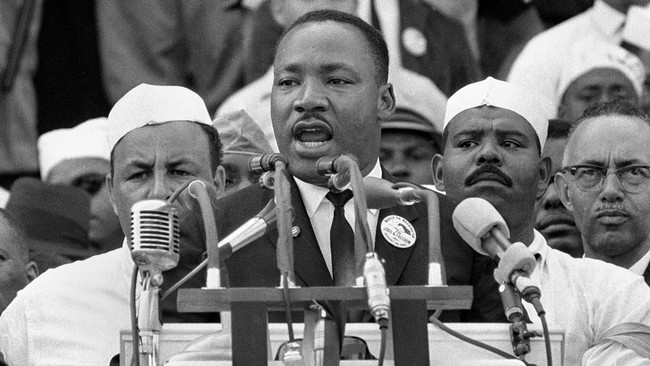
I stumbled across a quote from Martin Luther King Jr. today that I somehow had never seen before:
“I have decided to stick with love. Hate is too great a burden to bear.”
What struck me was not agreement. It was recognition. I have tried, imperfectly and often at cost, to live by that principle for years. Seeing it stated so plainly felt less like instruction and more like confirmation – language for a moral discipline I already understood.
That recognition raised a question I have been circling for a long time: why are conservatives so often told to keep King’s words out of our mouths? Why is his wisdom treated as the exclusive property of progressives, when so much of what he actually taught fits poorly with modern progressive practice?
I absorbed that framing myself for years. I assumed King “belonged” to the left. But the more seriously one takes him on his own terms, the less sense that claim makes.
Measured honestly, King’s moral framework – rooted in Christianity, natural law, human responsibility, and disciplined restraint – aligns at least as naturally with conservative instincts today as it does with progressive ones. That does not make King a conservative. It does mean he cannot be cordoned off without being diminished.
To see why, we have to return to King himself – not the mascot, not the holiday abstraction, but the man.
King Before the Slogans
Before he became a symbol, King was a Christian minister whom scripture, tradition, and moral discipline shaped. That fact is often acknowledged and then quietly set aside. It should not be. Regardless of what the left thinks, King’s Christianity was central to his life.
King was educated at Morehouse, Crozer Theological Seminary, and Boston University. He read Augustine, Aquinas, Reinhold Niebuhr, and Gandhi, not as ornaments, but as tools. His worldview assumed that moral truth exists, that human beings are accountable, and that power does not override conscience.
This grounding mattered. King did not argue primarily from grievance or identity. He argued from ought. When he condemned segregation, he did not say it was merely inefficient or unfair. He said it was wrong, because it violated human dignity, deformed the oppressor as well as the oppressed, and corrupted the moral character of the nation.
King’s insistence on nonviolence is often mistaken for softness. It was the opposite. Nonviolence was discipline. It was the refusal to surrender moral agency to hatred. He believed hatred was not a weapon, but a weight, one that crushed the person who carried it.
Just as important is what King refused to do. He refused to dehumanize opponents. He refused to excuse excess on his own side. He rejected violence, moral panic, and despair wherever he found them. He understood that just ends pursued by corrupt means do not stay just.
This is the King worth remembering: flawed, serious, disciplined, and morally demanding.
What King Actually Taught
Taken seriously, King’s teachings are not easy.
He insisted on intrinsic human dignity before anything else. Every person, good or bad or merely confused, possesses moral worth, without exception. Once dignity becomes conditional, cruelty becomes justifiable.
King believed in moral agency. Systems matter, history matters, injustice matters – but none of these erase responsibility. To deny agency was not compassion. It was a quieter form of dehumanization.
King insisted that means matter as much as ends. Hatred, humiliation, and coercion rot even righteous causes. Victory purchased at the cost of conscience is not victory.
Finally, King believed restraint is strength. He rejected the idea that anger clarifies truth or that outrage confers moral authority. Love, for King, was disciplined action aimed at redemption, not domination. He believed in rules: the rule of law, the rule of God, and one’s own internal moral rules should all act as a scaffolding for one’s actions.
These were not abstractions. King applied them to enemies, allies, and himself. They are also the teachings that sit most uneasily within today’s political culture.
Today Progressivism Struggles With King
This is not an indictment of individual liberals. Many remain thoughtful and humane. The problem lies in what modern progressive culture rewards, and in where it appears to be headed.
King believed hatred deforms the hater first. Contemporary progressivism increasingly treats anger as virtue. Outrage is incentivized. Moral authority is measured by denunciation rather than restraint. King rejected that logic entirely.
King insisted that means constrain ends. Modern progressive practice often reverses this. Public shaming becomes “accountability.” Dehumanization is excused as “punching up.” Speech is treated as violence, while reputational destruction is treated as justice. King would have recognized this as moral confusion, not progress.
Most fundamentally, King rejected moral exemption. Belonging to the “right side of history” did not suspend ethical obligation. Today’s progressivism struggles with that restraint. Wrongdoing by opponents is magnified; wrongdoing by allies is minimized. King would have found that asymmetry corrosive.
King also resisted the instrumental use of tragedy. He demanded truth, patience, and proportion before action. Modern activism often treats urgency as justification and narrative as more important than accuracy. King believed this multiplies injustice rather than curing it.
King does not sit comfortably in a culture that sanctifies outrage or treats dehumanization as a tactic. That discomfort is not evidence of his irrelevance. It is evidence of his standards.
Why King Aligns More Naturally With Conservatives Today
This is not a claim of ownership, but it is an observation of how well ideals fit together.
King believed human beings are responsible creatures, or ought to be in order to have a happy and healthy life. Conservatives still speak this language. They emphasize responsibility, work, and character. They resist narratives that reduce people to passive products of systems. That resistance is imperfect, but it is closer to King’s insistence that dignity and responsibility rise together.
King treated restraint as strength. Conservatives are more skeptical of mobs, moral panics, and cancellation. They emphasize due process and proportionality. King would have recognized that instinct, even as he would probably challenge conservatives to apply it consistently (and how disappointed he would be in his own side today!).
King refused to separate moral goals from moral methods. Conservatives tend to distrust righteous excess and coercive shortcuts. They warn that power corrupts, and that good intentions do not sanctify bad means. That skepticism sits squarely within King’s worldview.
King also appealed to inheritance rather than rupture. He grounded reform in scripture, natural law, and the American promise. He believed progress meant deeper fidelity, not permanent revolution. That posture aligns more naturally with conservatism than with a progressive culture that erasure and contempt for the past increasingly define.
King would judge conservatives sharply where they confuse order with justice or neglect the vulnerable. But he would speak to them from within a moral universe they still recognize. I am not certain he could do the same with progressives.
Once you understand this, the demand that conservatives “stop quoting King” rings hollow. King challenges conservatives – but increasingly, he challenges progressives more.
Martin Luther King Jr. Day
When we observe Martin Luther King Jr. Day on Monday, we should resist the temptation to treat it as a ritual or a convenient day off. It is not a day that belongs to one party, one race, or one faction. King belongs to all Americans, not as a slogan, but as a moral inheritance. He was, in the end, a good man: flawed, as we all are, but disciplined, courageous, and serious about his faith. A Christian icon not because he was perfect, but because he took the demands of love seriously enough to let them govern his life in a broken world.
Remembering King honestly is not about nostalgia or applause. It is about recognizing what the best of us can do when character, conviction, and opportunity align and asking, without excuses, whether we are willing to be judged by the same standard.
Editor’s Note: Help PJ Media keep bringing you great information and stories that will make you think and keep you informed. Join PJ Media VIP and use the promo code FIGHT to get 60% off your VIP membership!