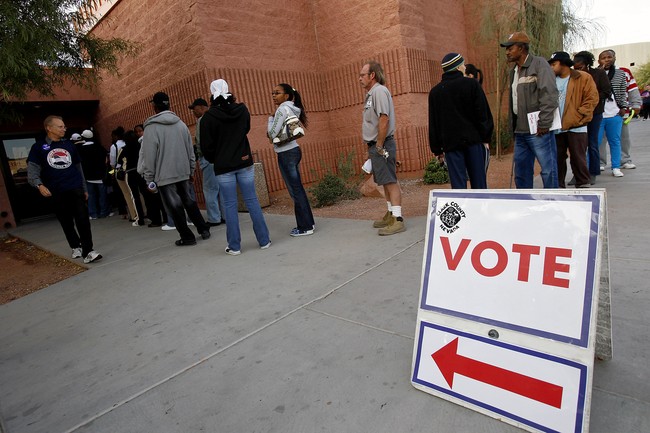
There has been a very contentious debate going on in this country for some time over voter ID, even while most Americans generally support the idea. Republicans have long pushed for a requirement that people simply show a valid government-issued picture ID when they vote.
Even CNN, hardly a pro-Republican voice in the media, reported that 83% of all Americans support some kind of photo ID requirement to vote. That included an amazing 71% of Democrats. By race, support broke down to 85% of Whites, 82% of Hispanics, and 76% of Blacks supporting the idea.
Gallup also polled this last October and found similar numbers, with 84% of all Americans supporting rules that would require “all voters to provide photo identification at their voting place in order to vote.” And 83% supported “Requiring people who are registering to vote for the first time to provide proof of citizenship.”
This should have been an issue where both sides could sit down together and find a way to write a bill that satisfies the concerns on both sides. But today’s political dynamics no longer allow for this kind of cooperation.
So Republicans moved forward on their own and created the SAVE America Act, a bill that creates requirements for voters to establish their eligibility to vote before casting a ballot. And this, a bill with overwhelming public support, that only received a 51-48 vote to begin debate on. Every Democrat voted no, along with one Republican. Democrats have vowed to kill the bill with a filibuster.
But why, considering how popular these measures appear to be with the American public?
The main argument from the left seems to be that it is too difficult for many Americans to have to show proof of citizenship when they register to vote. According to a paper from NYU’s left-wing Brennan Center for Justice, “more than 21 million Americans lack ready access” to a passport or birth certificate.
But by “ready access,” they literally mean that many of that 9% of voting-age people have these things, but “the documents might be in the home of another family member or in a safe deposit box.” They are seriously arguing that while these documents exist for almost everyone, some people may have to make a small effort to retrieve them.
And they claim that “at least 3.8 million don’t have these documents at all, often because they were lost, destroyed, or stolen.” So, for a tiny group of people, a little more effort might be required to get these documents that everyone should have anyway.
They aren’t making a real argument that these documents can’t be produced, but rather that it would be “inconvenient” for a small group of people to produce them, if they want to vote. And, like every good left-wing group loves to claim, “younger voters and voters of color would suffer disproportionately.”
But how? That’s become nothing more than a throw-away claim they use in every debate. They can’t prove any of these numbers, and that’s because the numbers don’t support their argument.
Birth certificate standardization was established by 1937 in the U.S. and since then we have had nearly 100% recording of births that, according to the American Bar Association, birth certificates are “so common that we might even overlook their significance” and are “necessary to obtain a social security number, apply for a passport, enroll in schools, get a driver’s license, gain employment, or apply for other benefits.”
That means that anyone under the age of 90 almost certainly has a record of their birth. Well, what if they are among that 3% of people who really can’t find it? A quick Google search directs anyone looking for a copy of their birth certificate to their birth state’s health department website, or a third-party document finder like vitalformsdirect.com. For a small fee, anyone can get a copy of his birth certificate.
Then there is picture ID. As of 2025, there are approximately 242.3 million licensed drivers in the U.S. Only roughly 21 million people do not possess a current non-expired driver’s license, and according to the Center for Democracy and Civic Engagement, only 7 million people have no form of government-issued photo ID.
Currently, 36 states require voters to present some form of ID at the polls to vote, and Help America Vote Act requires voters in all 50 states “who register to vote by mail and who have not voted previously in a federal election in their state must provide either their driver’s license or a paycheck, bank statement, current utility bill, or government document showing their name and address” according to Ballotpedia.
In the years since these rules have been enacted, there has not been an outcry of people angry about being refused at the polls. And a quick look at voter turnout may explain why.
For the 2024 presidential election, 174 million voting-age Americans were registered, or 73.6% of the total voting-age population, and of that, 154 million people, 65.3%, actually turned out to vote, according to the Census Bureau. Pew Research put the 2020 turnout rate at 66%, which they reported as the highest since 1908.
Midterm elections have even lower turnout, but Pew reports the 2018 election at 48% to be the highest since 1900, and the 46% for 2022 to be the highest since 1970.
So even as we had more ID requirements enacted at both the state and federal levels, voter participation actually increased in recent elections. There is no evidence to the contrary that any voter ID rules have prevented anyone who wanted to vote from actually voting. We still have millions of people who just don’t vote, even though many of them are registered, and that far exceeds the number of people the left claims don’t have “easy access” to voter documents.
Ultimately, people need ID to function in America. There are many basic things people need an ID for, including going to school, getting a job, getting a place to live, applying for any government benefits (including temporary jobs like shoveling snow in NYC), getting medical care and medicine, and exercising other basic rights like buying a gun for self-protection.
So, with nearly 100% of Americans having access to their birth certificate, 242 million holding valid driver’s licenses, and only 154 million people turning out to vote in 2024, it appears the problem is not voter ID but voter antipathy.
Yes, the right to vote is critical but no more so than any other right. And it took many years and multiple constitutional amendments to extend that right to every American. Voting today is more inclusive than at any time in our history. Even with basic voter ID rules.
While it’s important to make sure every eligible American who wants to vote can, it’s just as important to make sure those ineligible do not. Americans should feel that their voting system is secure with basic national voter ID laws.
Enjoying PJ Media? Get exclusive content and support independent journalism with 60% off a PJ Media VIP membership. Use promo code FIGHT and join today.