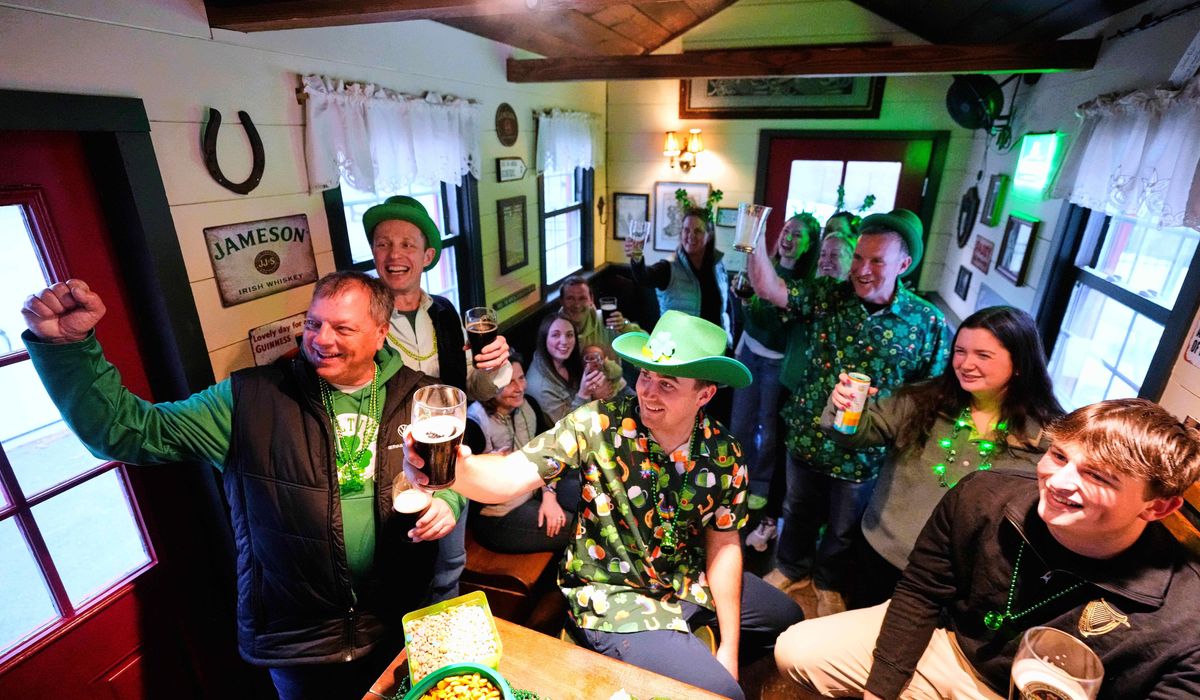

Every March 17, cities across America, and the world, turn green. Parades fill the streets, the Chicago River gets dyed emerald, and millions raise a glass in honor of Irish heritage. But the holiday’s origins are far quieter than the celebration it has become.
St. Patrick’s Day observes the death of St. Patrick, the patron saint of Ireland, a fifth-century missionary credited with bringing Christianity to the island. Patrick didn’t start out in Ireland. He was born and raised in Roman Britain at the end of the Roman Empire and was kidnapped to Ireland as a teenager, where he served as a slave for seven years before escaping and eventually returning as a missionary.
By the time of his death on March 17, 461, he had established monasteries, churches and schools. Over time, he came to be credited with using the three-leafed shamrock to explain the Holy Trinity to the Irish people, a legend that lives on in the holiday’s most recognizable symbol. Another famous legend holds that Patrick drove all the snakes out of Ireland, but these creatures never actually lived there, Ireland’s isolation as an island kept them away.
For centuries, the holiday was nothing like the celebration known today. For hundreds of years, St. Patrick’s Day in Ireland was a religious observation with modest fanfare, and pubs were even banned from opening for a time. The raucous parades and green-drenched festivities that define the modern holiday were largely an American invention.
During the 19th century, millions of Irish immigrants arrived in America, particularly during and after the Great Famine. These communities faced discrimination and economic hardship, and public celebrations of Irish heritage became a powerful way to express pride in their culture and identity. St. Patrick’s Day observances in America date back to before the country’s founding, with one of the earliest recorded parades held in Manhattan in 1762. As Washington University professor Leigh Schmidt told ABC7, celebrating the holiday was a way for Irish immigrants to stake their claim in American civic life.
The holiday also carries a lesser-known chapter of political history. In 1916, thousands of armed Irish Volunteers used St. Patrick’s Day parades in Dublin, Cork and Limerick not merely for celebration, but to rehearse the logistics of an insurrection against British rule — one that would culminate just weeks later in the Easter Rising. Over 38 processions were held nationwide, with nearly 6,000 total marchers practicing street fighting and conducting armed maneuvers, serving as a public display of military potential.
SEE ALSO: St. Patrick’s Day 2026: Best food and drink deals to celebrate the holiday
Today, the holiday has spread well beyond Ireland and Irish-American communities. Since 2010, over 300 landmarks in 50 countries have “gone green” on March 17, from the Colosseum in Rome to the Christ the Redeemer statue in Rio de Janeiro.
Whether the day means attending Mass, marching in a parade, or simply wearing green, it remains a celebration that has traveled far from its origins, shaped as much by the Irish diaspora as by Ireland itself.
This article was constructed with the assistance of artificial intelligence and published by a member of The Washington Times’ AI News Desk team. The contents of this report are based solely on The Washington Times’ original reporting, wire services, and/or other sources cited within the report. For more information, please read our AI policy AI policy or contact Steve Fink, Director of Artificial Intelligence, at sfink@washingtontimes.com
The Washington Times AI Ethics Newsroom Committee can be reached at aispotlight@washingtontimes.com.