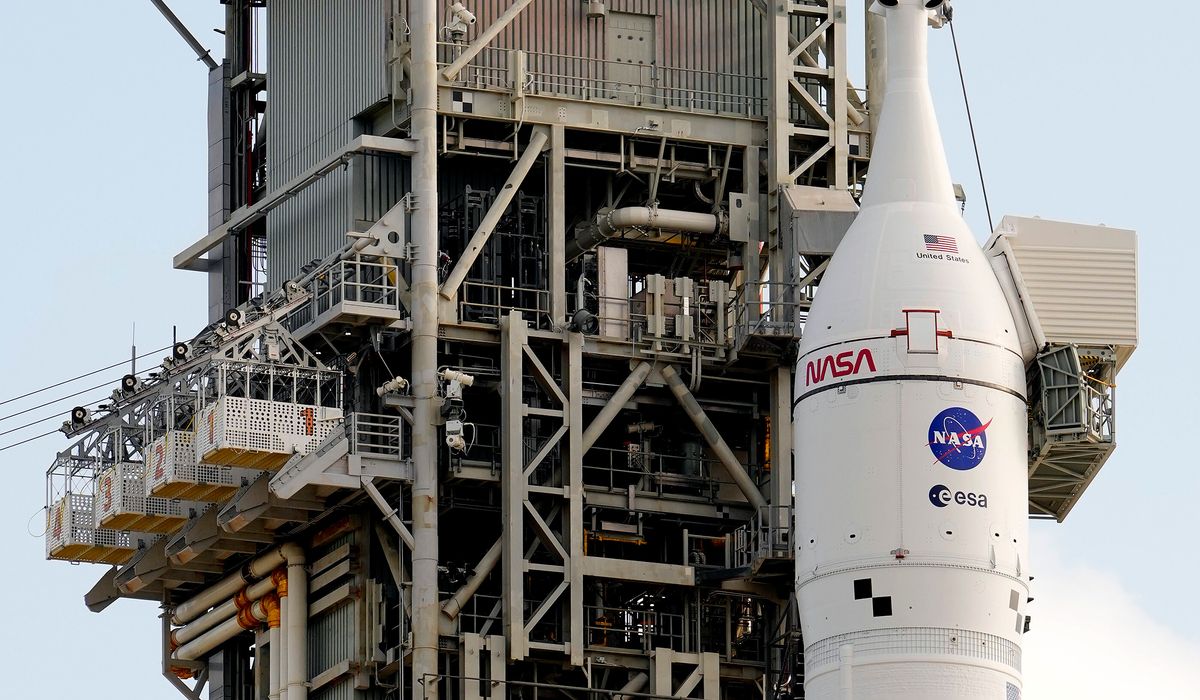
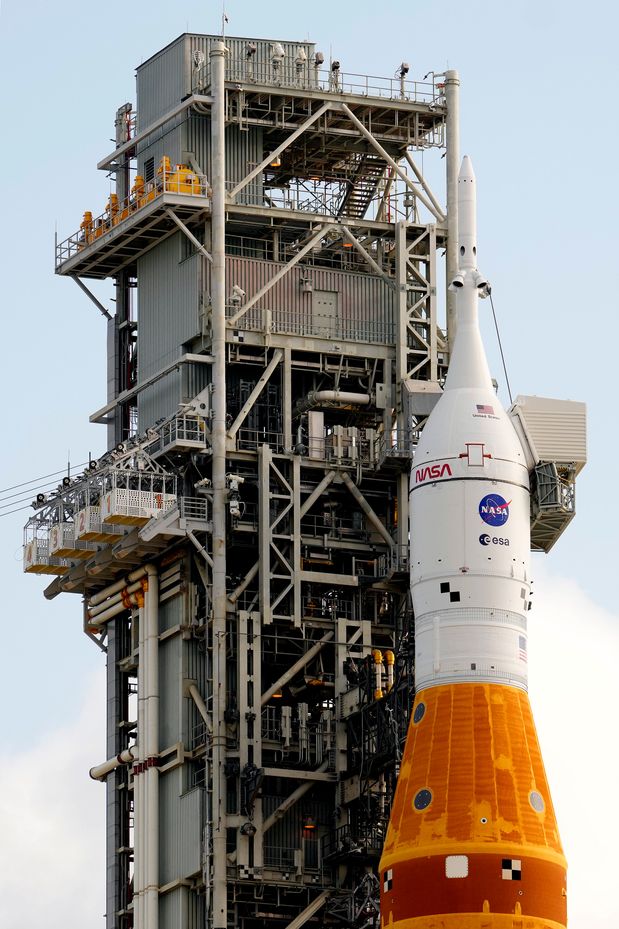
NASA’s long-anticipated return to the moon gets underway Wednesday, as the agency prepares to send four astronauts on the first crewed lunar mission in more than 50 years.
The agency’s Space Launch System rocket is set to lift off no earlier than 6:24 p.m. ET Wednesday, from Launch Pad 39B at Kennedy Space Center near Cape Canaveral, Florida, with a two-hour launch window. As of Wednesday morning, NASA reported an 80% chance of favorable weather conditions, with primary concerns being cumulus clouds and ground winds.
The mission
The Artemis II test flight will send Commander Reid Wiseman, Pilot Victor Glover and Mission Specialist Christina Koch — all NASA astronauts — along with Canadian Space Agency Mission Specialist Jeremy Hansen on a 10-day journey around the moon and back to Earth. The mission follows a free-return trajectory, meaning the crew will not land on the lunar surface. Instead, the Orion spacecraft will fly 4,000 to 6,000 miles above the moon — far higher than the Apollo command modules, which orbited roughly 70 miles above the surface — offering the crew a different vantage point and extended views of the lunar far side.
The mission is the second under NASA’s multibillion-dollar Artemis program and the first with crew aboard the SLS rocket and Orion spacecraft. It builds on Artemis I, the uncrewed 2022 test flight that spent 25 days in lunar orbit.
The 322-foot-tall SLS rocket will generate 8.8 million pounds of thrust, making it the most powerful spacecraft NASA has ever launched. Its core stage is propelled by four engines powered by liquid hydrogen and liquid oxygen, flanked by two 177-foot solid rocket boosters.
Records on the line
The mission is expected to set several human spaceflight records. Mr. Glover would become the first person of color to leave low Earth orbit, Ms. Koch the first woman to do so, and Mr. Hansen would become the first non-U.S. citizen to travel beyond low Earth orbit and to the moon’s vicinity.
The crew is also expected to travel farther from Earth than any humans in history, surpassing the distance record set by the Apollo 13 mission in 1970, traveling approximately 250,000 miles into space.
Where to watch
NASA’s full launch coverage begins at 12:50 p.m. ET on NASA+, Amazon Prime Video and YouTube. Tanking operations coverage begins earlier, at 7:45 a.m. ET on NASA’s YouTube channel.
NASA+ content is available as a free ad-supported channel through Amazon Prime Video’s Live TV section and does not require a Prime subscription.
Where can you see the launch?
Depending on weather and cloud cover, the SLS rocket could be visible across most of Florida and into parts of Georgia. Previous Florida launches have been spotted as far away as Myrtle Beach, South Carolina, and Fayetteville, North Carolina.
The best in-person viewing spots are along Florida’s Space Coast (the Melbourne area), the Fun Coast (Daytona Beach area) and the Treasure Coast (Vero Beach, Jensen Beach and Fort Pierce). Here is a rough timeline of when and where visibility expands after liftoff:
- Launch + 10 seconds: Space Coast
- Launch + 20 seconds: Space Coast, east Orlando, Kissimmee, Vero Beach, Daytona Beach
- Launch + 30 seconds: Orlando, Winter Park, Fort Pierce, Stuart, Port St. Lucie, St. Augustine, near Jacksonville
- Launch + 40 seconds: Most of Florida, including Jacksonville, Tampa, St. Petersburg, Clearwater, Sarasota, Fort Myers, Naples, West Palm Beach
- Launch + 50 seconds: Most of Florida extending to Fort Lauderdale, Fernandina Beach, Lake City, and just outside Brunswick, Georgia, and Valdosta, Georgia
- Launch + 60–70 seconds: Tallahassee, South Georgia, and potentially Savannah, Georgia
This article was constructed with the assistance of artificial intelligence and published by a member of The Washington Times’ AI News Desk team. The contents of this report are based solely on The Washington Times’ original reporting, wire services, and/or other sources cited within the report. For more information, please read our AI policy or contact Steve Fink, Director of Artificial Intelligence, at sfink@washingtontimes.com
The Washington Times AI Ethics Newsroom Committee can be reached at aispotlight@washingtontimes.com.