
KYIV, Ukraine — “Watch out,” a worker says, carrying the wing of an FP-1 drone past rows of neatly stacked carbon-fiber parts.
Under white industrial lights, men in respirators and gloves drill, sand and glue as machines hum in the background. One sands a wing section. Another fits electronic components onto the narrow central frame.
Farther down the production line, as the drones the workers are assembling near completion, a technician uses a computer to test the flaps on the wings, watching each control surface twitch in response.
Then the aircraft is broken down again. The wings are loaded onto one trailer, the central frame onto another, ready to be shipped to its end user: the Ukrainian armed forces.

Soldiers of the 127th Separate Territorial …
more >
Earlier this month, The Washington Times was granted access by Ukrainian defense manufacturer Fire Point to one of its workshops, offering a glimpse into the industrial network helping sustain Kyiv’s expanding long-range strike campaign.
The site, whose location cannot be disclosed for security reasons, is only one node in Ukraine’s fast-growing domestic drone and missile industry.
Fire Point’s CEO and CTO Iryna Terekh told The Times that the company now delivers “200 FP-1s and FP-2s a day,” when in 2023, turning out “20 a month” would have seemed ambitious.
Fire Point rose to prominence with the FP-1, a low-cost long-range strike drone built for scalable production.
“The initial idea was very simple: to make an alternative to Shahed,” Ms. Terekh told The Times. The goal, she said, was not to copy the Iranian-designed drone Russia uses against Ukrainian cities, but to create something with similar battlefield utility that could be made cheaply and in large numbers.
The company has since moved into missiles, producing the FP-5 Flamingo and the newer FP-7 ballistic missile. Yet Fire Point’s growth reflects more than wartime necessity.
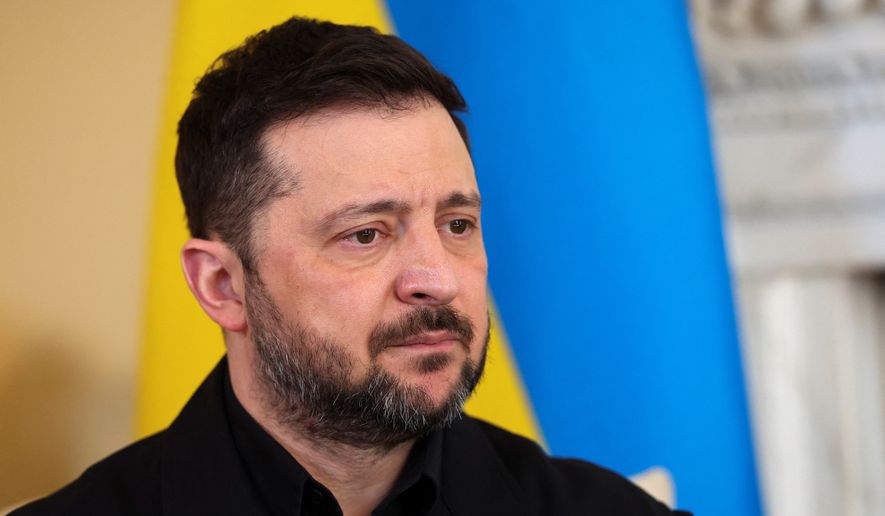
Ukrainian President Volodymyr Zelenskyy reacts during …
more >
Ms. Terekh said Ukraine inherited “great engineering capabilities in missile building and space building” from the Soviet era, even if Moscow deliberately prevented Kyiv from controlling a full production cycle of its own. Fire Point, she said, was able to draw on surviving expertise, technical knowledge and older technologies that existed before 1991 while building other elements from scratch.
That combination of inherited know-how and wartime improvisation helped fuel Ukraine’s new missile industry. Just as important, she said, was what Fire Point did not inherit.
“The main, most important lesson learned and the biggest bottleneck is a mental block,” Ms. Terekh said, arguing that too many Ukrainians had long assumed advanced weapons development belonged only to old state structures and legacy factories.
Fire Point’s lack of institutional baggage became an advantage, she said, because it allowed the company to borrow from rocket engineering, aviation and civilian industry without much attachment to inherited habits.
“We will use any sort of technical capability to achieve this goal,” she said. “No matter whether it’s from rocket industry or aviation industry or civil industry … until it works, we don’t care.”
That pragmatism helps explain how the company scaled so quickly. As Russia changes flight paths, disperses assets and adapts its air defenses, Ukrainian manufacturers say they have had to move just as fast.
“Each and every countermeasure that we meet from our enemy, information about this countermeasure becomes our technical task the same day or the same night,” Ms. Terekh told The Times.
She said Fire Point has spent nearly two years building strategic independence in key components. “Right now, both FP-7 and FP-9 are 90% home produced.”
Thanks to this industrial surge, Ukraine no longer has to rely only on a limited stock of Western long-range weapons or on sporadic raids. Kyiv is increasingly using domestically made drones and, in a smaller but growing number of cases, Ukrainian missiles to hit targets far behind the front.
Analysts say this pairing of drones and missiles is beginning to stretch Russian air defenses and turn Russia’s depth into a vulnerability. The latest example came Saturday.
Ukraine’s General Staff said it had struck the Promsintez explosives plant in Russia’s Samara region with FP-5 Flamingo missiles. According to the Ukrainian military, the facility produces more than 30,000 tons of military-grade explosives a year, and the strike caused an explosion in the production area.
On Wednesday, Ukrainian strikes hit Russia’s Aviastar aircraft plant in Ulyanovsk and the 123rd aircraft repair plant in the Novgorod region, both tied to military transport aviation. Four days earlier, Ukrainian drones struck the Afipsky oil refinery and Port Kavkaz in Krasnodar region, damaging a service vessel and port infrastructure.
The pressure on Russia’s energy sector has grown sharper still.
Reuters reported this week that damage to the Ust-Luga terminal could force four large Russian refineries — in Kirishi, Yaroslavl, Moscow and Ryazan — to cut runs because one of their main export outlets had been disrupted. In a separate estimate, Reuters said that at one point this month at least 40% of Russia’s oil export capacity had been halted by a mix of Ukrainian strikes, pipeline disruption and tanker seizures.
Russia has since said it will suspend gasoline exports from Wednesday, April 1, through July 31 to stabilize the domestic market.
While Ukraine is still hitting refineries and export terminals, it is also going after more consequential nodes of Russia’s war machine: aircraft repair plants, ammunition depots, factories producing engines, explosives and missile components, and the energy infrastructure that helps finance the war.
Some of the clearest public signs of Ukraine’s growing missile reach have come from strikes on military-industrial targets.
On Feb. 21, Reuters reported that Ukraine said it had struck the Votkinsk plant in Russia’s Udmurt Republic, a missile-production facility tied to ballistic missile systems, using domestically produced Flamingo missiles at a range of about 869 miles.
Taken together with the reported use of Flamingo missiles at Promsintez, the Votkinsk strike appears to show that Ukraine’s home-built long-range campaign is moving beyond harassment of oil infrastructure and toward more direct attacks on core military-industrial targets.
The campaign’s results, however, remain difficult to measure precisely. Public attribution is often murky, and Kyiv rarely discloses exactly which system was used in a given strike.
But the direction is clear: What began largely as a campaign to bring the war home to Russia is becoming more deliberate and more industrial.
And even senior figures in Moscow are acknowledging the shift.
On Tuesday, Sergei Shoigu, secretary of Russia’s Security Council and a former defense minister, said the Urals were now in a “zone of immediate threat” from Ukrainian strikes.
None of this means Ukraine can strike its way to victory on its own, as Russia remains too large and too heavily armed for even a successful deep-strike campaign to produce collapse by itself.
Still, Ukraine is building more of its own long-range weapons, sending them farther and using them more often.