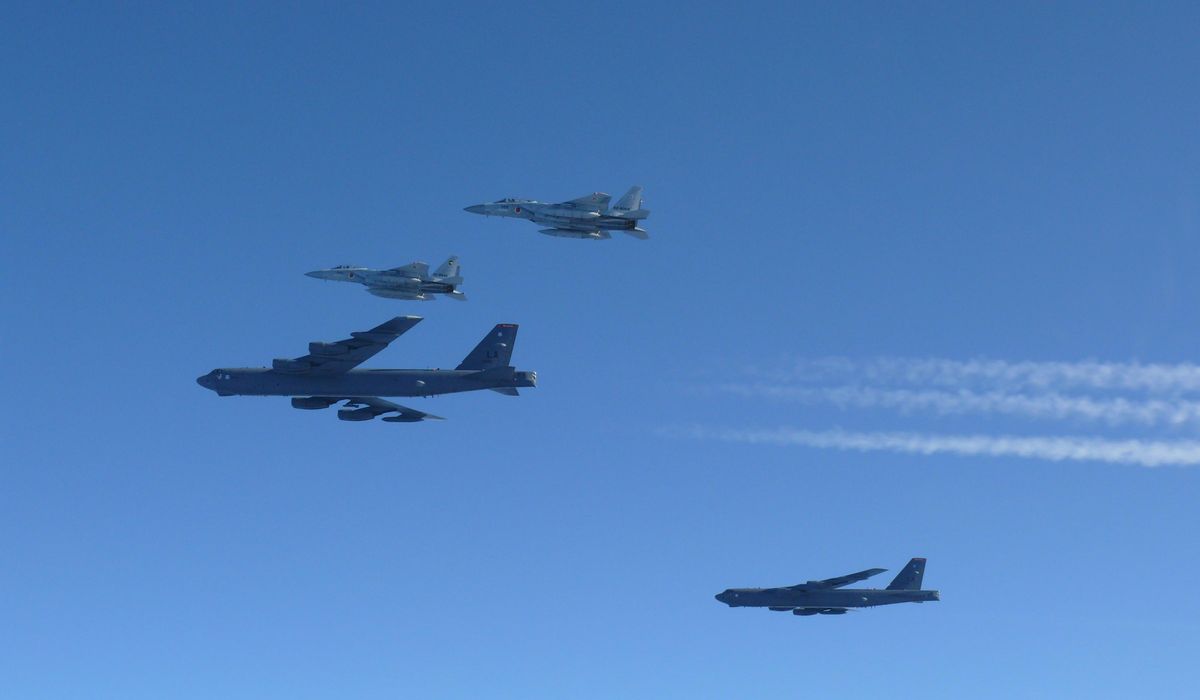
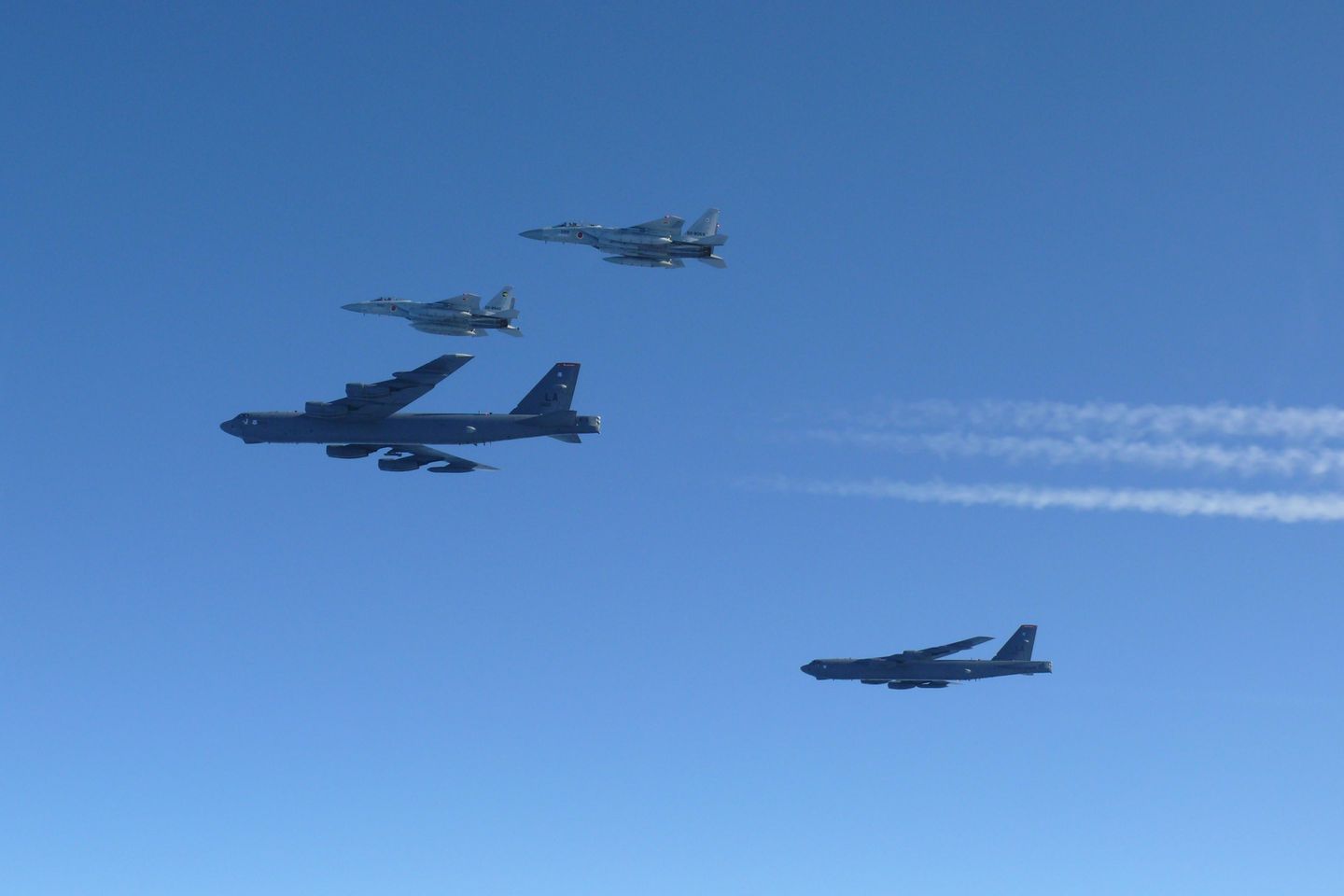
SEOUL, South Korea — Nuclear-capable U.S. B-52 heavy bombers took to the skies over the Sea of Japan with an escort of Japanese F-35 and F-15 fighter jets Thursday, two days after Washington had verbally sided with Tokyo in its fast-escalating confrontation with Beijing.
The Japan-U.S. show of force followed joint aerial exercises in the region by Chinese and Russian aircraft on Wednesday. Those drills prompted separate fighter scrambles by both Seoul and Tokyo on the day, though the drills took place in international airspace between South Korea and Japan, and also east of Japan.
The day prior, on Tuesday, the U.S. State Department had intervened verbally, stating its support for Japan.
Northeast Asia is on edge as heightened tensions between China and Japan accelerate into a second month, escalating from the diplomatic sphere into the economic, geopolitical, information and military domains. The dispute began with a November comment from Japanese Prime Minister Sanae Takaichi indicating that Japan would come to the defense of Taiwan in the event of a Chinese attack.
The remark infuriated Beijing, and the pushback since has shown no sign of waning.
Flying up the escalation ladder
Ms. Takaichi, responding to a question in the Diet on Nov. 7, said a potential military contingency around Taiwan would represent an existential threat to Japan. Though she did not say it, that situation, constitutionally, greenlights Japanese “collective defensive” military operations.
Beijing, hypersensitive to any support for democratic Taiwan, which the communist state is intent upon one day absorbing, reacted with a well-practiced, cross-domain retaliatory spiral.
First came aggressive commentary that resurrected Beijing’s former practice of “wolf warrior” diplomacy.
Next was economic action: the halting of Chinese tourism to Japan, the banning of Japanese pop acts and movies in China and an embargo on Japanese seafood imports.
With Tokyo hanging tough, a new front was opened in the information space.
Beijing initiated an academic/media campaign questioning the sovereignty of Japan’s Ryukyu Islands, which dominate naval choke points northeast of Taiwan.
Japan returned fire, sending Defense Minister Shinjiro Koizumi to Yonaguni, the closest of the Ryukyus to Taiwan, on Nov. 23. There, he checked on Japanese military bases being upgraded there. Yonaguni has also been the scene of recent drills by U.S. Marines.
Some Tokyo sources believe Mr. Koizumi, the photogenic and popular — but, at 44, youthful — son of ex-premier Junichiro Koizumi, is cutting his teeth in defense, in expectation of a future premiership of his own.
After his Yonaguni visit, matters escalated into the military sphere.
Japan vocally protested after claiming that on Saturday, carrier-borne Chinese jets locked onto Japanese aircraft shadowing the Chinese flotilla with their target radars.
China shot back that it had warned Japan of its carrier drills — taking place in international waters off Okinawa, the largest Ryukyu — and released what is said were related radio conversations to state media CGTN, which broadcast them.
Though U.S. President Trump is finessing a series of wide-ranging trade deals with China, the U.S. State Department finally sided with Tokyo late on Tuesday.
“China’s actions are not conducive to regional peace and stability,” a State Department spokesperson said, regarding the radar lock-ons. “The U.S.-Japan Alliance is stronger and more united than ever. Our commitment to our ally Japan is unwavering, and we are in close contact on this and other issues.”
The support may have been a relief in Tokyo. Chief Cabinet Secretary Minoru Kihara, the nation’s top spokesperson, said the remarks ” … demonstrate the strong U.S.-Japan alliance.”
There was more to come.
Wednesday’s patrols by two Russian TU95 “Bear” bombers and two Chinese H6 bombers were the latest regional exercises the two authoritarian Pacific powers have conducted. Their patrol routes covered the Sea of Japan and skies east of the island nation, proximate to Okinawa.
That appears to have generated a U.S. physical response, with the brace of B-52s joined by top-tier Japanese fighters.
Even so, Japan’s highest-ranked military officer, speaking in a regular press briefing Thursday, declined to discuss the joint flight’s aim.
Head of the Joint Chiefs of Staff Hiroaki Uchikura said, “We are not aiming at any particular country,” adding, “the purpose of the drills is to further strengthen the deterrent and response capabilities of the Japan-U.S. alliance.”
While matters remain tense, there is — at present — no indication that the spat will spill blood.
Under the leadership of U.S. Secretary of Defense Pete Hegseth, the U.S. military is sharpening its lethality. Beijing takes the opposite approach.
In recent decades, it has mastered non-kinetic, hybrid operations, successfully inching its lines forward in such regional flashpoints as the Himalayas, the South China Sea and the Taiwan Strait.
Chinese troops have not engaged in combat since 1988. That year, they captured Johnson Reef, in the Spratly Islands, from Vietnam, in a clash that saw several vessels sunk and scores of Vietnamese troops killed.