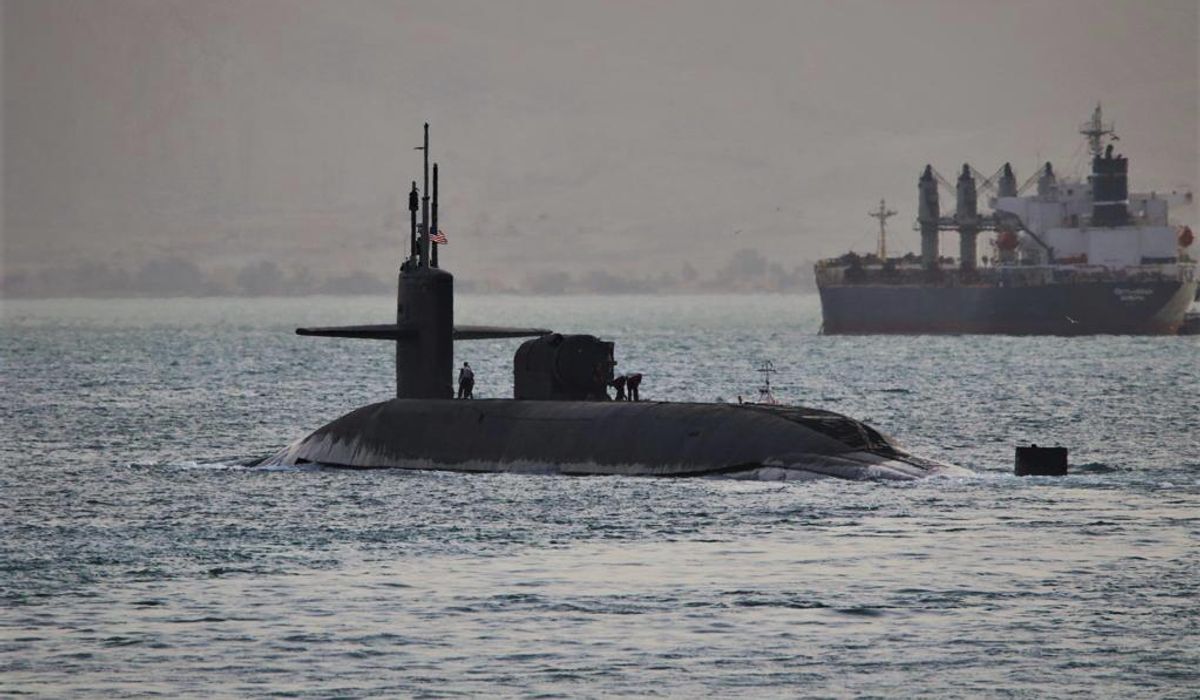
An American submarine sank an Iranian warship in international waters Wednesday as the Pentagon signaled that the war with Iran will accelerate with more intense airstrikes and the possible mobilization of a ground force comprised of Kurdish militant groups based in Iraq and Iran that are historically aligned with the United States.
The submarine attack was the first of its kind in decades.
U.S. Central Command added that it had “struck or sunk” over 20 Iranian warships since the conflict began last week.
Kurdish militia groups in Western Iran are expected to start a ground operation against Iranian forces within a week, according to reports, after receiving shipments from the U.S. of weapons smuggled through Iraq.
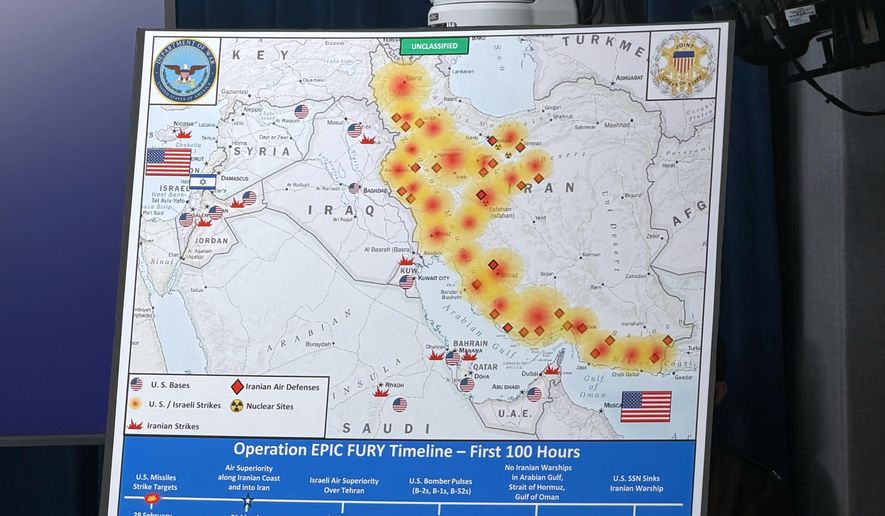
A Department of Defense map titled, …
more >
Israel also continued its aerial assault on Tehran Wednesday, with the Israeli Defense Forces announcing a “broad wave” of strikes against infrastructure targets in Iran.
Iranian media sources reported explosions in Tehran, hitting several buildings linked to Iran’s internal police and paramilitary organizations.
SEE ALSO: U.S., Israel coordinate strikes on Iran — but friendly fire, downed American jets show the risks
Israeli and U.S. strikes also apparently delayed the funeral proceedings for Ayatollah Ali Khamenei, Iran’s supreme leader, who was killed by Israeli strikes Saturday.
Additionally, Israel’s ground forces penetrated deeper into southern Lebanon as Hezbollah fighters backed by the Islamic republic lobbed dozens of rockets into Israeli territory. The fighting has killed more than 70 people and displaced an estimated 80,000 in Lebanon.
Meanwhile, Iran kept up its wide-ranging retaliatory attacks on Wednesday as well, continuously targeting Israel and Gulf states in the region.
NATO batteries in Turkey shot down a ballistic missile early Wednesday as it approached the NATO member’s airspace. The attack, which Iran has not claimed, constitutes a major escalation and could signal Tehran’s desire to drag Europe into the war.

Defense Secretary Pete Hegseth speaks during …
more >
Iran’s missile and drone attacks have made it prohibitively difficult for Americans in the Middle East to evacuate. The U.S. State Department is scrambling to assist U.S. citizens leave the region by chartering private and military aircraft, though Secretary of State Marco Rubio admitted that airspace closures have made the process harder.
“We have identified and continue to identify charter flights, military flight options, and expanded commercial flight options, meaning working with the airlines to send bigger airplanes with more seats,” he told reporters Tuesday
SEE ALSO: How Iran plans to win: Make the U.S. burn through missiles faster than it can replace them
The State Department confirmed Wednesday that it has assisted over 6,500 Americans in the region by offering “security guidance and travel assistance,” and that at least 17,500 have returned safely since the war began.
U.S. to intensify attacks on Iran
Secretary of Defense Pete Hegseth and Joint Chiefs Chairman Gen. Dan Caine insisted that the U.S. would not let up in its attacks on Iran and that the Pentagon would move more valuable assets to the region in the coming days.
The defense leaders noted that the number of retaliatory missile and drone strikes coming from Iran is dwindling by the day and that the U.S. has the capacity to intercept all attacks targeting its allies.
“Flying over their capital. Death and destruction from the sky all day long. We’re playing for keeps. Our warfighters have maximum authorities granted personally by the president and yours truly. Our rules of engagement are bold, precise, and designed to unleash American power, not shackle it,” Mr. Hegseth told reporters at a Pentagon briefing.
The comments follow President Trump’s assertions earlier this week that the U.S. has nearly infinite munitions to deploy against Iran and could theoretically fight “forever.” Security experts and lawmakers have expressed serious concern about how many missile interceptors are being used in the Iran war and how it will impact the U.S.’s already diminished stockpiles.
“We have expert craftsmen building these things one at a time,” Sen. Tim Sheehy, Montana Republican, said. “We need to look at industrialized production.”
Mr. Hegseth added that Gulf nations Saudi Arabia, Qatar, the United Arab Emirates, Bahrain and Kuwait are all working in close cooperation with U.S. forces in air defense operations. Those nations have all come under intense missile and drone attacks by Iran over the last four days.
U.S. attacks have also dealt serious blows to Iran’s Navy, Mr. Hegseth said, with the Pentagon using a submarine-launched torpedo to strike an Iranian warship on Wednesday, the first U.S. strike of its kind since World War II.
The ship had a crew of at least 180 people and reportedly sank in international waters in the Indian Ocean off the coast of Sri Lanka. The number of casualties from the strike remains unclear.
Iran’s retaliation reaches NATO
Iran’s wide-reaching retaliation against U.S. and Israeli partners in the Middle East reached NATO’s eastern border Wednesday, as Turkish authorities reported that NATO defenses destroyed an Iranian missile approaching Turkey’s airspace.
The Turkish Ministry of Defense did not clarify the missile’s intended target. Turkey does house some U.S. Air Force personnel at its Incirlik Air Base, located near where the drone was destroyed, but Ankara had refused to allow the base to be used to stage attacks against Iran.
The missile reportedly traveled through Iraq and Syria before being destroyed near Turkey’s southeastern province of Hatay. Turkish authorities reported that debris from the destroyed missile did not cause any casualties.
The attack comes after several days of consistent Iranian missile and drone attacks targeting U.S. bases and energy infrastructure in Gulf nations.
A confirmed attack on Turkey, a NATO member, would constitute a significant escalation in the Iran war. Such an action could potentially invoke NATO’s mutual defense clause, thereby involving the alliance’s 32 member states in the conflict.
Before the Turkey attack, the closest Iranian strikes got to NATO territory were in Cyprus, where Iranian drones hit the Royal Air Force base at Akrotiri.
NATO condemned the attack on Wednesday and maintained that the alliance’s defenses are “strong across all domains, including when it comes to air and missile defense.”
U.S. working with Kurdish groups
Iranian Kurdish militia groups have worked closely with Trump administration officials in recent days to lead a potential ground assault on Iranian forces in the western part of the country.
White House Press Secretary Karoline Leavitt confirmed on Wednesday that Mr. Trump spoke with the president of the Democratic Party of Iranian Kurdistan, Mustafa Hijri, on Tuesday to discuss how the organization could assist U.S. objectives in Iran.
Reports indicate that the CIA worked well ahead of the U.S.’s initial attacks on Iran to arm Kurdish organizations in the region. And five Kurdish opposition groups in Iraq announced a coalition last month aimed at overthrowing the Islamic republic.
The coalition includes Kurdistan Freedom Party, the Democratic Party of Iranian Kurdistan, the Kurdistan Free Life Party, the Organization of Iranian Kurdistan Struggle and the Komala of the Toilers of Kurdistan
Iran, seemingly in anticipation of U.S. support, launched a series of rocket attacks at Kurdish camps near the western border on Wednesday, killing one person and injuring three.
The specific objectives behind arming Kurdish groups in Iran and Iraq remain unclear. Some analysts expect the militia groups to engage IRGC troops and seize control of certain provinces in northeast Iran. Such an operation could further pressure Iran’s armed forces and encourage other Iranian dissident organizations to act.
• Mike Glenn and John T. Seward contributed to this story.