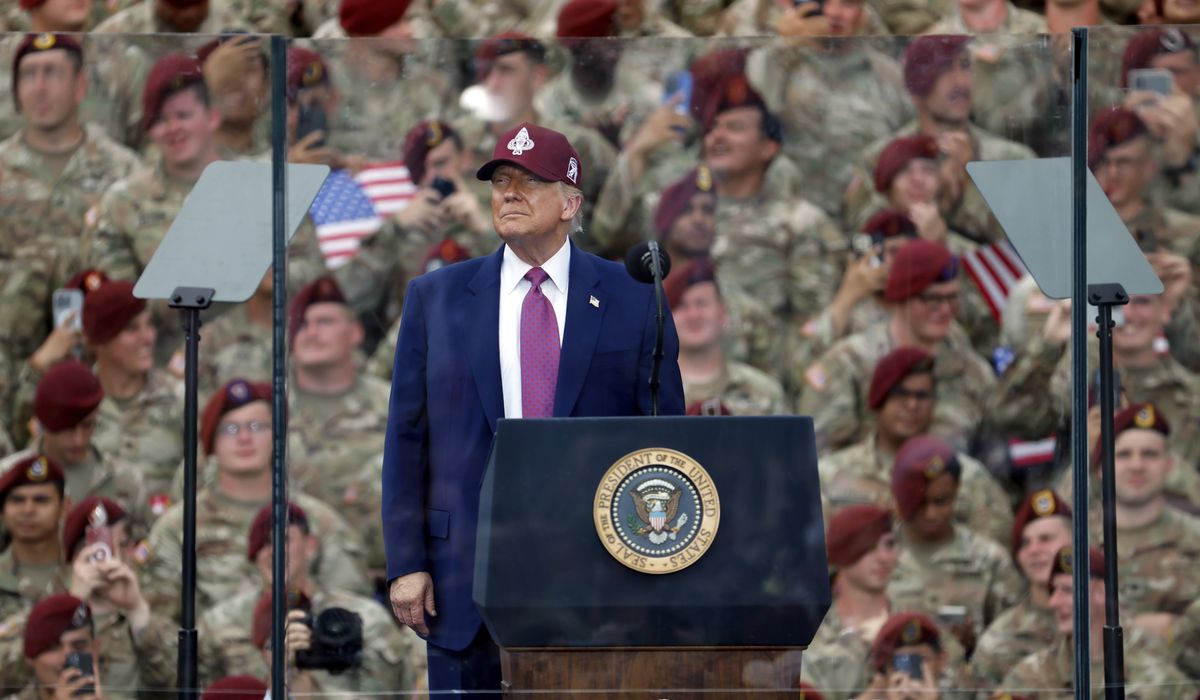

President Trump is celebrating America’s 250th anniversary in grand style and putting his stamp on everything from national park passes to U.S. currency, drawing scowls from his detractors.
And yet, Mr. Trump is not the first president to capitalize on America’s milestone birthdays, though he’s doing it in trademark Trump style.
President Ford was all over the bicentennial in 1976, reaping all the political benefits he could that election year amid a difficult campaign to stay in the White House.
President Coolidge put his mark on the 1926 celebration by having his visage grace a commemorative half-dollar coin.
So, it was not entirely out of the ordinary when a federal arts commission last month approved the design of a 24-karat gold commemorative coin bearing Mr. Trump’s image, which it said would be issued as part of America’s birthday celebration. The president’s image will also appear on national park passes as part of the birthday bash.
The Treasury also announced that it will put Mr. Trump’s signature on all new paper currency “in honor of the 250th anniversary” of the U.S.
Mr. Trump lined up major events for the 250th celebration, including a UFC fight on the White House lawn, an IndyCar race through downtown Washington, military parades and a national tour of the Declaration of Independence.
What’s more, the Trump Organization has filed several trademark applications related to the anniversary celebrations, including copyright protection for a “Trump 250” image intended for merchandise connected to the anniversary. Such items include bumper stickers, tote bags, drinkware, clothing and golf balls. Additional trademark applications include a logo featuring Mr. Trump’s name with “a design of five aircraft followed by converging contrails.”
“A number of presidents have set the broad tone for these celebrations, but it’s another thing to start specifying particular events or things that you want to see happen,” said Darrell West, a senior fellow for governance studies at Brookings. “Trump is very involved in the details in a way that many past presidents have not.”
Critics say he is exploiting the celebrations, pointing to a The New York Times report that Mr. Trump’s allies are offering perks, including access to the president, to donors who give at least $1 million to help finance the nation’s 250th birthday parties.
“Donald Trump and his henchmen have sabotaged what should be a unifying moment and appear intent on instead creating a highly divisive, corporate-funded, ideologically extremist exercise,” said Lisa Gilbert, co-president of Public Citizen, a progressive think tank.
“Once again, nothing is sacred to the Trump administration, not even the 250th anniversary of the Declaration of Independence. Everything is for sale to corporate and potentially foreign interests,” she said.
The White House has argued that Mr. Trump’s involvement is necessary to ensure America gets “the spectacular birthday it deserves.”
“The celebration of America’s 250th anniversary is going to display great patriotism in our nation’s capital and throughout the country,” a White House spokesperson said in a statement. “President Trump’s bold vision will be imprinted upon the fabric of America and be felt by generations to come.”
Still, it is common practice for presidents to seize upon an American birthday celebration and even exploit it for political gain.
Historian Craig Shirley said Mr. Trump’s efforts to be part of America’s 250th anniversary pale in comparison to how much President Ford inserted himself into America’s bicentennial in 1776.
At the time, Ford was in the midst of a brutal primary fight against Ronald Reagan to be the Republican presidential nominee that year.
“What Gerald Ford did was much, much worse. He was all over the 200th anniversary like white on rice,” Mr. Shirley said. “He injected himself as much as possible into the bicentennial because there was a primary campaign and then the general election. He draped the bicentennial all over himself.”
On July 4, 1976, Mr. Ford visited George Washington’s Revolutionary War camp at Valley Forge and Independence Hall in Philadelphia, watched the tall ships in New York City, attended naturalization ceremonies at Monticello, delivered a prime time address to the nation and viewed the Washington fireworks from the White House.
It pushed Mr. Ford front and center on America’s screens at a time when America had far fewer screens.
“It would be hard to imagine a greater political windfall for a beleaguered president than the exuberant celebration of the American Bicentennial this week,” The New York Times wrote at the time.
The bicentennial also gave Ford numerous opportunities to woo uncommitted delegates who may have been leaning towards Reagan. Ford invited uncommitted delegates to watch the fireworks in Washington, the tall ships in New York and even attend a dinner with Queen Elizabeth, who made a state visit to Washington as part of the festivities.
“Trump is celebrating America’s founding, and he’s doing a lot with all the celebrations, but it’s not political. It’s not political the way it was for Ford,” Mr. Shirley said.
Perhaps a more apt comparison to Mr. Trump would be President Coolidge, also a Republican, who drew criticism for using America’s 150th anniversary in 1926 to attack progressive ideology.
Attending events throughout the year, Mr. Coolidge would argue in anniversary speeches that the principles of the Declaration of Independence and Constitution were eternal and efforts to modify them by progressives would cost Americans their freedom.
He would often lambaste his liberal opponents by contrasting their ideology with that of the American Revolution. A July 7, 1926, editorial in The Nation, a progressive monthly magazine, criticized Mr. Coolidge for using the 150th anniversary for “self-congratulation” and demonizing his opponents.
In the most striking comparison between Mr. Trump and Coolidge, the Treasury issued a commemorative half dollar featuring the image of Coolidge and George Washington side by side. Coolidge is the only president to appear on a U.S. coin during his lifetime.
President Grant also capitalized on America’s centennial in 1876 to distract from the many scandals surrounding his administration, including one where officials conspired to steal millions in whiskey tax revenue and another where his secretary of war was found to have taken bribes from Native Americans.
Grant welcomed the Emperor of Brazil, issued numerous proclamations about the centennial, including one encouraging towns to prepare historical sketches for the celebration, and attended the first world’s fair in Philadelphia.
However, the centennial also highlighted Mr. Grant’s failures by contrasting his legacy with that of the founding fathers.