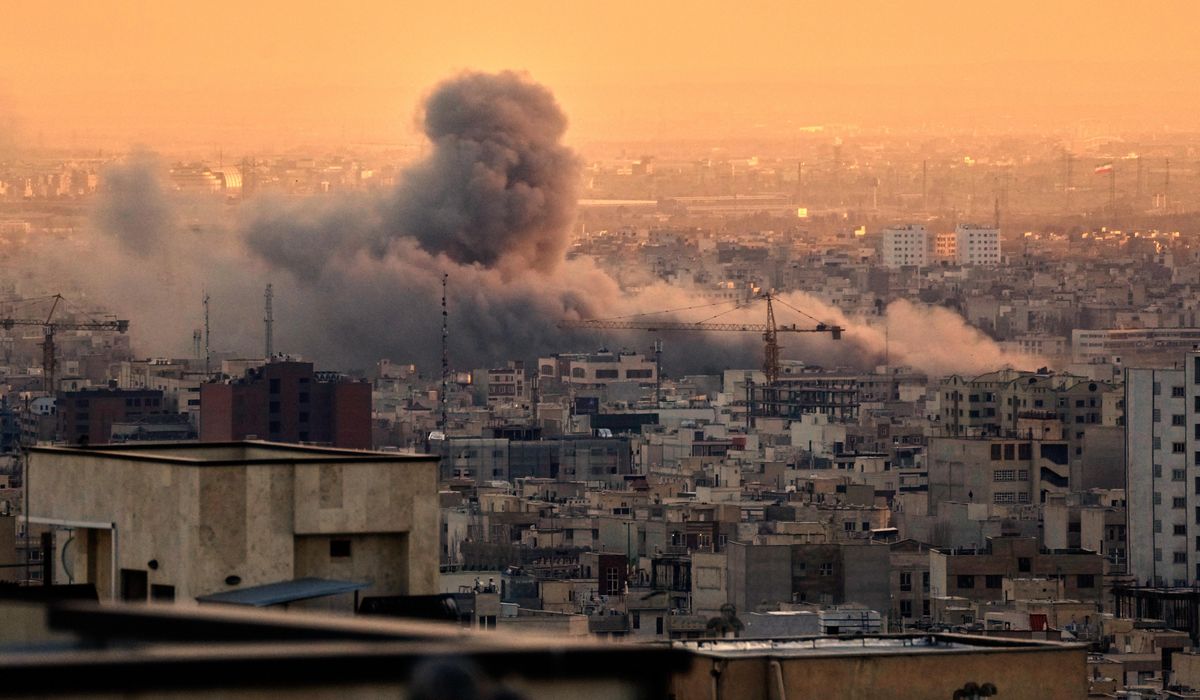
The U.S. has enough ammunition to fight “forever” while most of Iran’s military assets have been destroyed, President Trump said Tuesday, as the U.S.-Israeli campaign targeted a key meeting of Iranian leaders and the State Department scrambled to evacuate Americans trapped in the Middle East.
Clearly outgunned, Iran nevertheless on Tuesday ratcheted up retaliatory strikes and targeted U.S. diplomatic missions and key energy centers in the Gulf.
U.S. embassies in Kuwait and Saudi Arabia closed after apparent Iranian drone attacks, while U.S. diplomatic outposts in Iraq and Dubai also reportedly came under fire. Iran fired missile barrages against oil fields and refineries across the Gulf.
The escalating conflict is now taking a clear economic toll, with the U.S. stock market plunging and oil prices surging abroad.
Iran has tried to shut down maritime traffic through the vital Strait of Hormuz, but the Trump administration said it could dispatch military ships to escort oil tankers through the waterway.
Meanwhile, U.S. Central Command shared fresh video footage of strikes against Iranian ballistic missile launchers, Iranian military command and control centers, drone depots and other key locations. No additional American casualties were announced Tuesday. The U.S. death toll so far in the campaign is six.
Airstrikes also hit the offices of Iran’s Assembly of Experts in Qom on Tuesday, reportedly during a meeting to select the successor to former Supreme Leader Ayatollah Ali Khamenei, who was killed in the first round of U.S. and Israeli bombing last weekend. The strikes could significantly delay the selection of a new religious leader.
Mr. Trump, whose administration has rejected the idea that it is pushing all-out regime change in Tehran, said the Islamic republic’s next leader could come from inside the government, underscoring that the American goal is to destroy Iran’s military but leave a functioning government in place.
“It would seem to me that somebody from within maybe would be more appropriate,” Mr. Trump said in response to suggestions that perhaps leaders of external Iranian dissident groups could take charge.
The president also pushed back on assertions that Israel wanted to go to war with Iran and dragged the U.S. along.
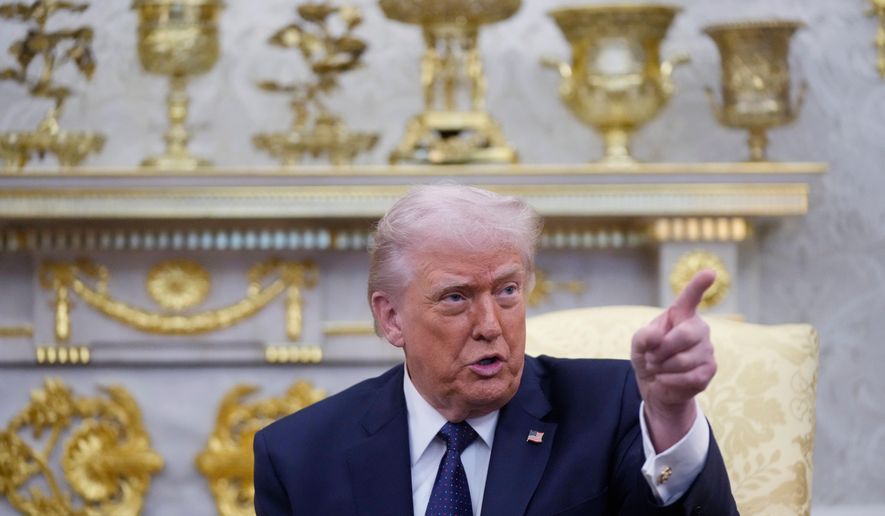
President Donald Trump speaks during a …
more >
“No, I might have forced their hand,” Mr. Trump said of Israel. “It was my opinion [Iran was] going to attack first.”
Across the region, anger with Iran’s retaliatory strategy has grown. Turkish Foreign Minister Hakan Fidan described Iran’s approach as, “If I go, I will take the region with me.” He said Tehran should have understood the U.S. was deadly serious about a major military operation and should have offered something significant during negotiations with Washington.
“I believe that if the Iranians had better understood the pressure President Trump was facing and given him something in advance, the pressure from Israel might not have been so effective,” he said.
U.S. munitions are “virtually unlimited”
Mr. Trump reaffirmed Tuesday that the U.S. has a “tremendous amount” of munitions ready to use against Iran.
During a White House meeting with German Chancellor Friedrich Merz, Mr. Trump complained that the Biden administration had put the U.S. in a difficult position by supplying Ukraine with a large amount of high-end munitions over the last four years.
The comments follow Mr. Trump’s Truth Social post on Monday in which he asserted that the U.S. has enough munitions to fight wars “forever.”
“Wars can be fought ‘forever’ and very successfully using just these supplies (which are better than other countries finest arms!),” he wrote. “At the highest end, we have a good supply, but not where we want to be.
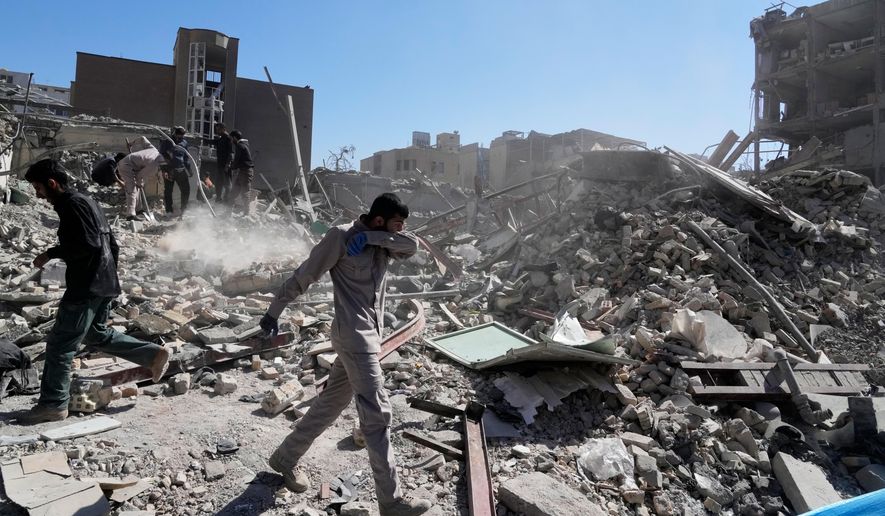
A group of men inspects the …
more >
Much additional high-grade weaponry is stored for us in outlying countries.”
Concern is growing among some national security insiders who say the Pentagon’s current expenditure of interceptors and cruise missiles against Iran could severely deplete necessary stockpiles, which could take months to replenish.
Six U.S. service members have been killed in the conflict so far, and Kuwaiti air defenses mistakenly shot down three U.S. fighter jets this week.
The rapid expenditure of munitions and the deaths of American service members have led critics to argue that U.S. goals in the region are too vague and that the operation will reduce combat readiness in the future.
“President Trump has unilaterally started a conflict that is rapidly spreading throughout the Middle East. The end state is unknown. Even administration officials cannot say clearly what objectives they are trying to achieve, nor what happens when those objectives are met,” said Rhode Island Sen. Jack Reed, his party’s ranking member on the Senate Armed Services Committee, at a hearing Tuesday.
Succession disrupted?
The attack on the offices of the Assembly of Experts in Qom, Iran, on Tuesday follows a similar strike earlier this week on the body’s offices in Tehran. It remains unclear if any members of the assembly were killed in either strike.
Iranian officials blamed Israel for the strike and sought to downplay its impact. The semiofficial Mehr news outlet declared that the building hit was old and no longer used for official meetings.
The Israeli Air Force also unleashed another wave of bombs on Tehran, striking at Iran’s internal security apparatus. Airstrikes reportedly hit several targets in Iran’s capital, including police stations and detention centers.
Israel announced that its strikes killed Daoud Ali Zadeh, a senior commander of Iran’s Quds Force, a key component of the Islamic Revolutionary Guard Corps.
Still, U.S. officials have insisted over the last 48 hours that Washington is far more interested in eliminating Iran’s ballistic missiles, nuclear program and navy than killing senior political leadership.
Elbridge Colby, the Pentagon’s top policy official, told lawmakers Tuesday that the strikes that killed Khamenei were “Israeli operations.” He reasserted that U.S. forces are focused on eliminating Iran’s ability to project power in the region and the world.
Mr. Trump had told reporters at the White House that his administration was considering several candidates to lead Iran. But, he said, “most of the people we had in mind are dead.”
Gulf attacks continue
Amid Israeli strikes, Iran has continued its wide-scale retaliation strikes on Gulf nations, including Saudi Arabia, Qatar, Oman, Kuwait and the United Arab Emirates.
The Saudi Defense Ministry announced that two Iranian drones struck the U.S. Embassy building in Riyadh in the early morning hours on Tuesday, causing minor damage and starting a small fire. Two more drones struck the broader embassy compound shortly after. There were no casualties.
The State Department warned of impending Iranian drone and missile attacks targeting the Saudi Arabian city of Dhahran, which houses the Saudi-owned oil giant Aramco.
Separately, an Iranian drone attack hit the U.S. Embassy in Kuwait, forcing it to close.
The attack prompted a swift response from Kuwait, which said the attack was a “blatant violation of all international norms and laws,” and reaffirmed its right “to safeguard its security, protect its territory, and ensure the safety of its citizens and residents.”
In response to the attacks on diplomatic missions in the Gulf, the State Department ordered nonessential government workers and their families to evacuate six Middle East nations: Bahrain, Iraq, Jordan, Kuwait, Qatar and the United Arab Emirates.
The expansion of the Iran war has already had a devastating effect on global markets. The S&P 500 dropped by as much as 2.5% and the Dow Jones Industrial Average fell more than 1,200 points. Markets have clawed back some losses as the day went on; however, the S&P shaved its losses to just under 1% and the Dow was down around 400 points as of Tuesday afternoon.
• Tom Howell Jr., Mike Glenn and Jeff Mordock contributed to this report.