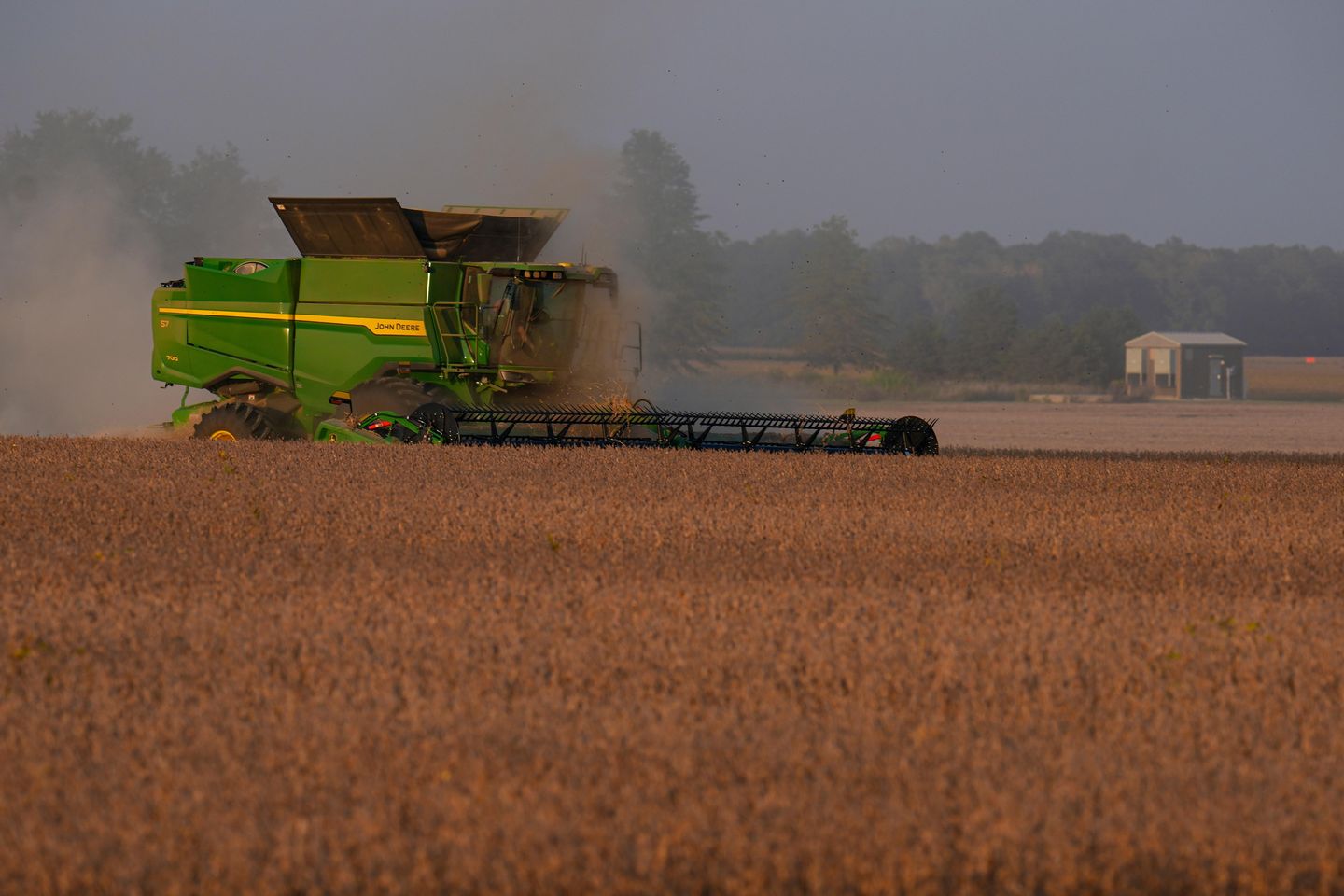
President Trump has announced that the federal government will guarantee loans for food suppliers and farmers in a move to boost an American agricultural industry battered by the Iran war, tariffs and other market shocks.
The loan guarantees will cover vegetable and grain seed farmers; cattle, pig, poultry and egg producers; and grocery wholesalers, the White House said Friday.
The Small Business Administration will administer the guarantees.
Mr. Trump also said he will loosen regulations on farm equipment to cut costs, plus highlighted action by the Environmental Protection Agency to boost renewable fuels from agricultural products.
Further, the president said he would allow higher-ethanol gasoline, known as E15, to be sold permanently.
E15 is popular in farm-belt states because corn is a key ingredient in ethanol, with about 40% of the crop used to make biofuel. Currently, E15 is sold only in the winter out of fear of increased smog during the summer months.
“We are lifting up our hardworking farmers and ranchers and growers, and we are putting more money in American pockets. We are going to prove the golden age of American agriculture is right here and right now,” Mr. Trump said.
The president made the announcement before nearly 1,000 farmers on the South Lawn of the White House to celebrate National Agriculture Day.
American farmers have overwhelmingly supported Mr. Trump. In 2024, he won 444 counties across the country labeled as farm-dependent by 78%.
Democrats slammed Mr. Trump’s overtures to the farmers, saying his policies are why they need the government aid.
“Trump claims he ’loves farmers’ and would ’never do anything to hurt our farmers’ — yet he’s handing out massive kickbacks to billionaires and big corporations, while farmers are shouldering lost markets, rising costs, and mounting uncertainty,” the Democratic National Committee said in a memo Friday.
Being a farmer is hard enough, given Mother Nature’s whims and fluctuating profit margins.
Yet growers were walloped by Biden-era inflation in recent years before President Trump made tariffs a central plank of his second term, raising the cost of imported materials such as fertilizer and steel for tractors and machinery.
Now the Iran war threatens additional economic damage.
The American Farm Bureau Federation and dozens of other producer groups sounded the alarm in a letter this month to Mr. Trump.
They said a series of weather challenges, economic pressure and geopolitical shocks posed real challenges for rural America.
“As planting season began in earnest across much of the U.S., the closure of the Strait of Hormuz sent fuel and fertilizer prices skyrocketing — further straining a farm economy that already had its back against the wall due to record inflation, trade uncertainty, rapidly declining crop prices and catastrophic natural disasters,” the groups said.
The coalition asked Mr. Trump to consider a new round of farmer relief in the defense supplemental funding package he sent to Congress in recent weeks.
“Without timely assistance, continued losses risk accelerating farm closures, reducing domestic production capacity and weakening the ability of farmers and ranchers across this great nation to provide food, clothes and fuel for the American people,” the letter said.
Mr. Trump offered farmers a financial lifeline earlier this term.
In December, he unveiled a $12 billion bailout package for farmers hurt by high prices and trade wars with China and other nations. The package included $11 billion in one-time payments to crop farmers under the Department of Agriculture’s newly designed Farmer Bridge Assistance program.
The program helps row crop growers recover from years of trade actions by foreign governments, inflation and other disruptions. The remaining $1 billion helps farmers not covered by the bridge program.
Mr. Trump also reached an agreement with China that would increase soybean purchases from U.S. growers after the Chinese, a major purchaser, paused shipments for much of 2025 because of trade tensions.
Speaking to farmers on Friday, Mr. Trump said he personally got Chinese President Xi Jinping to increase planned soy purchases during talks last year.