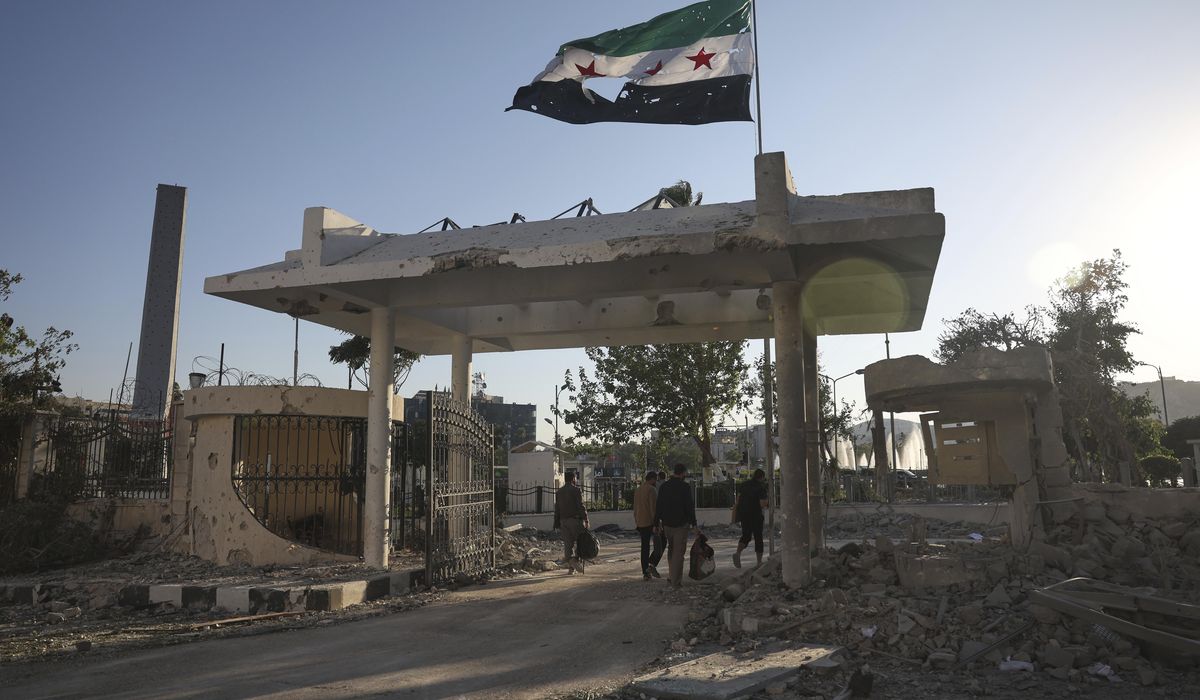

QUNEITRA, Syria — Nearly a year after this border province became a focal point of Israel’s response to the fall of Bashar Assad, what the Netanyahu administration then described as “temporary” security measures have hardened into a sustained military presence on Syrian soil — complicating U.S. President Trump’s efforts to turn the fragile new government in Damascus into a reliable American ally.
At their Mar-a-Lago meeting Monday, Mr. Trump openly pressured Israeli Prime Minister Benjamin Netanyahu to give Syria’s government “another chance,” marking a rare public rift between the two leaders over Israeli military operations that Trump warned could destabilize the country he has invested heavily in supporting.
“I hope he’s going to get along with Syria because the new president … is working very hard to do a good job,” Mr. Trump told reporters, referring to Syrian President Ahmed al-Sharaa. “He’s a tough cookie. You’re not going to get a choir boy to lead Syria. I dropped the sanctions on Syria because otherwise they wouldn’t have had a chance. We want to see Syria survive.”
Damascus attaches little importance to Mr. Trump’s public statements, viewing them as diplomatic theater rather than binding pressure, according to Dr. Ahmad al-Kannani, a Damascus-based political analyst. “These statements were preceded by U.S. pressure exerted by the American envoy to Syria, Thomas Barrack, on the Israeli administration to implement the security agreement, yet these efforts led to no tangible results,” Mr. al-Kannani said.
He noted that Israel has escalated demands after each high-profile Syrian diplomatic engagement. Following Mr. al-Sharaa’s return from the U.N. General Assembly, Israel called for opening a humanitarian corridor into the Syrian city of As-Suwayda.
After his Washington visit, Israel demanded a comprehensive peace agreement in exchange for limited withdrawal. “Today, negotiations are completely suspended,” Mr. al-Kannani said. “Israel’s insistence on comprehensive agreements is not a viable option within Syria’s political and popular calculations, as such agreements are based on the principle of imposition by force.”
The pressure on Mr. Netanyahu reflects a bind partly of Mr. Trump’s own making.
In 2019, during his first term, Mr. Trump became the first world leader to recognize Israeli sovereignty over the Golan Heights, breaking with decades of international consensus that the Syrian territory occupied since 1967 remained under illegal annexation.
That decision now shapes the predicament he faces: Mr. Netanyahu is citing security concerns to justify pushing even further into Syria, while Mr. Trump tries to stabilize Mr. al-Sharaa’s government as a partner against extremist groups.
Days before the Mar-a-Lago meeting, Israeli Defense Minister Israel Katz made clear Israel’s intentions.
Speaking Dec. 23 at a public ceremony in the West Bank settlement of Beit El, Mr. Katz dismissed U.S.-brokered diplomatic efforts to reach an arrangement between Israel and Syria.
“We don’t trust anyone … no agreement,” Mr. Katz said. “We will not withdraw even by a millimeter in Syria.”
Israel’s impact
The Soufan Center, a research organization focused on global security, reported that Israeli operations are “undermining the new government and interfering with U.S. policy” toward Syria.
Syria’s Foreign Ministry has emphasized international documentation of violations rather than direct escalation. On Monday, Foreign Minister Asaad Hassan al-Shaibani received Major General Patrick Gauchat, head of the United Nations Truce Supervision Organization, according to an official statement posted on the Syrian Foreign Ministry website.
The statement said discussions emphasized “the role of the mission in documenting Israeli violations in southern Syria,” and explored enhancing cooperation and coordination “in a manner that contributes to supporting stability and maintaining calm in the region, within the framework of respect for the sovereignty of the Syrian Arab Republic and its territorial integrity.”
The meeting offered Damascus a way to reinforce the central legal claim of the post-Assad transition: that Syria’s sovereignty and territorial integrity are prerequisites for stabilization — and that outside military expansion in the south undermines the state’s ability to reassert authority.
When Israeli tanks first moved into the Quneitra governorate in January, combing key infrastructure areas before withdrawing, Seham Alali, a clerk at Al-Golan National Hospital, described the incursions as feeling “like another occupation, one that risks displacing us all over again.”
Twelve months later, those fears have deepened. Israel moved into the buffer zone in southwestern Syria in December 2024 and later took control of the peak of Mount Hermon. On Dec. 8, Israeli forces launched a military campaign targeting sites across Syria and advancing into Quneitra under the stated logic of denying space to weapons stockpiles and hostile networks.
Israeli activity along the frontier has shifted from episodic strikes to sustained ground operations — checkpoints, patrols, raids, detentions and earthworks that shape daily life. On Christmas Day, Israeli forces fired on protesters demonstrating against the destruction of structures in two Quneitra villages, injuring three people, according to regional media reports. Two days later, Israeli forces targeted Tell al-Ahmar in eastern Quneitra countryside with machine gun fire.
Between Dec. 9, 2024, and May 31, 2025, the Armed Conflict Location and Event Data project recorded 34 security incidents in the Quneitra governorate. Satellite imagery obtained by BBC Verify in January showed new Israeli construction within the demilitarized buffer zone, including trenches and fortifications, indicating preparations for a long-term presence.
The Institute for the Study of War has cautioned that prolonged foreign military presence inside Syria without a political framework risks entrenching instability and hollowing out state authority.
Mr. Netanyahu declared on Dec. 8 that he had “directed the IDF to seize the buffer zone and the commanding positions nearby,” saying the 1974 disengagement agreement had collapsed.
Undercutting Damascus
The Israeli posture constraints Damascus’s ability to consolidate authority in the south even as Assad loyalists exploit security gaps elsewhere. On Dec. 26, regime remnants killed fourteen police in an ambush in Tartus, Syria’s Interior Ministry said. Interior Minister Mohammed Abdul Rahman vowed the government would crack down on “anyone who dares to undermine Syria’s security or endanger the lives of its citizens.”
Earlier in the year, fighters linked to the former regime attacked security forces in parts of Latakia and Tartus governorates, presenting one of the most serious challenges yet to the new government’s authority.
Syria’s coastal provinces — home to the Alawite minority sect to which the al-Assad family belongs — remain flashpoints.
Syrian analyst Jaafar Khaddour said Israeli security concerns do not fully explain the scope of operations.
“Israel views a weak Syria as ’useful,’ and it continuously formulates general programs of weakness until it achieves what it wants,” he said, adding that Israel’s deeper concern is Turkey building Syrian military capabilities rather than concerns about Iranian networks or residual extremist elements.
Israeli analysts acknowledge the tension between Mr. Trump’s diplomatic push and Netanyahu’s military caution, but differ sharply on whether engagement is viable.
The International Institute for Counter-Terrorism, an Israeli research center based at Reichman University, has assessed the al-Sharaa government as pragmatic but institutionally weak, warning that success depends less on intent than on the capacity to control armed actors and prevent extremist reconstitution.
Mr. al-Sharaa became the first Syrian head of state to attend a U.N. General Assembly session in almost six decades in September. In November, he became the first Syrian leader to visit the White House, where Mr. Trump held talks and announced the suspension of sanctions against Damascus for six months.
Nir Boms, a Middle East expert who has worked on Israel-Syria policy, represents those advocating engagement. “When the prime minister came last month to the Golan Heights after the [al-]Sharaa meeting, it was basically: ’Listen, Trump thinks that al-Sharaa is a good guy … and he’s going to make Syria great again. But we are looking at this from the ground,’” Mr. Boms said.
Mr. Boms, who said he “belongs to the camp that actually believes in engagement,” acknowledged Israel needs to see “genuine and serious effort by Sharaa and his people to stabilize the country and distance radical forces” before pulling back. “The track record means Syria respects minorities, but it’s not able to prevent or sometimes to participate in the massacre of the Alawites and the Druze,” Mr. Boms said. “That’s not a good signal for us.”
But he added: “I think Israel should do it [give al-Sharaa a chance and pull back]. But I’m just trying to explain to you why Israel is careful.”
Lt. Col. Sarit Zehavi, founder of the Alma Research Center, represents a more skeptical view prevalent in Israel’s defense establishment. “Keeping Syria weak militarily and making sure that the new Syrian army is not having advanced weapons? Of course, I agree,” she said in an interview.
She said the 1974 disengagement framework is “irrelevant” and argued Israeli forces entered the buffer zone because “if we were not there, [it] could have become an area where everybody is operating, including Iran’s proxies and including jihadist Sunni players.”
She identified Turkey’s military industrial capabilities as the primary Israeli concern. “The main fear is that Turkish weapons will eventually threaten us from this border,” Zehavi said. “The Turkish ideology, as we see today, is to create hegemony in Syria after they assisted al-Sharaa to take over Syria.”
Eyes on Syria
Regional Arab states have grown increasingly vocal about Israeli intentions. Saudi-owned media have framed Israel’s expanding military posture as undermining regional stabilization efforts. On Dec. 18, Asharq Al-Awsat warned that Israeli moves beyond the 1974 disengagement line risk “reproducing chaos in southern Syria.” On Dec. 22, the outlet described Israeli activity in Quneitra and Daraa as “field expansion that goes beyond security necessity.”
The public commentary built toward a more direct statement. A Saudi royal official told Israel’s Kan broadcaster on Dec. 25 that Riyadh has become convinced “Israel does not want a stable state in Syria, but rather wants it divided,” arguing that Israeli behavior toward Syria, Lebanon, and the West Bank is undermining normalization efforts beyond the longstanding Saudi demand for progress on Palestinian statehood.
Syria has made fragile progress in its first year post-Assad despite persistent instability.
Beyond the United Nations and White House visits, the country secured sanctions relief and multibillion-dollar infrastructure investments. In May, Mr. Trump lifted all sanctions on Syria, declaring it was time for the country to “move forward.” The European Union followed suit days later. More than one million Syrian refugees have returned home since Assad’s fall, according to U.N. figures.
On Monday, the government unveiled redesigned national currency at a Damascus ceremony, replacing portrait-style banknotes with imagery built around natural and economic symbols — wheat, olives, cotton, citrus, the Damascene rose — alongside ornaments inspired by Damascus Islamic art. The rollout, which removes two zeros from the pound, represents what al-Sharaa called “the end of an era and the start of a new stage for Syria,” with officials framing the shift away from venerating individuals on currency as a confidence-building sovereignty marker.
“Under Assad, the country did not simply hit rock bottom — it kept digging,” said Nader Kabbani of the Middle East Council on Global Affairs. “The transition has been just as remarkable and unexpected.”
Syrian authorities have signaled a break from Assad-era policies. In January, Damascus seized a weapons shipment destined for Hezbollah forces in Lebanon near the Sarghaya border area, including assault rifles, rocket-propelled grenades and ammunition, according to Syria’s state-run SANA news agency. A senior Syrian official said in January, on condition of anonymity, that the seizure demonstrated Syria’s commitment to limiting Iran’s influence.
Israel has occupied Syria’s Golan Heights since 1967, formally annexing the territory in 1981 in a move the U.N. Security Council unanimously declared “null and void.” Mr. Trump’s 2019 recognition made the United States the first and only country to break with that international consensus.
Since Assad’s fall, Israeli incursions have included detention of civilians, harassment of residents, and construction of new military positions — representing expansion into internationally recognized Syrian territory rather than defensive measures along a recognized border.
Hanging in balance
Mr. al-Kannani said Damascus views Israeli expansion and pro-Assad insurgency as interconnected pressures that undermine state consolidation. “The escalating Israeli policies in southern Syria — marked by incursions and the establishment of parallel entities to the Syrian state in As-Suwayda — confirm that Israel is pursuing a project aimed at seizing more Syrian territory,” he said, noting Israel seeks recognition for nine new military bases extending from western Damascus to southwestern Daraa.
He characterized Israeli strategy as creating “a military, security, and political reality in Syria based on enforced presence and the support of a parallel entity in As-Suwayda, with political and social dimensions designed to gain leverage in any potential negotiations with Damascus.”
On the question of whether Israeli presence remains temporary, Mr. al-Kannani was blunt. “I do not believe that the Israeli presence is temporary, especially since Israeli Defense Minister Israel Katz stated on December 23 that his forces would not withdraw even a millimeter from Syria,” he said. “These statements reflect Israel’s true ambitions in Syria and undermine any efforts toward a negotiation process.”
Damascus continues to emphasize sovereignty and territorial integrity while pursuing international documentation of violations rather than military escalation. “In light of these settlement-oriented policies and ongoing raids and arrests, Israel seems intent on sending a message that no agreement is possible in the near future,” Mr. al-Kannani said. “Meanwhile, Damascus continues to rely on U.S. efforts to pressure Israel, particularly given the extension of the UNDOF mission in Syria and the existence of a regional and international climate supportive of Israel’s withdrawal from the positions it advanced after December 8.”
“We have an understanding regarding Syria,” Mr. Trump said Monday, declining to elaborate but adding: “I’m sure that Israel and him will get along. I will try and make it so that they do get along.”
Mr. Netanyahu responded cautiously: “Our interest is to have a peaceful border with Syria. We also want to secure our Druze friends.”