Donald Trump just sent Nicolas Maduro a Christmas message, of a sort. And that message is not many happy returns of the day.
Earlier today, the US Navy boarded a tanker carrying Venezuelan oil in international waters. Unlike the first seizure, Marc Caputo reports for Axios, this ship had no specific sanctions applied to it. This escalates the standoff over Maduro’s illegal regime and the oil revenue he desperately needs to cling to power:
The U.S. military early Saturday boarded a tanker that is not under U.S. sanctions as it shipped Venezuelan oil in hopes of escaping a blockade imposed by President Trump, according to two sources familiar with the action.
Why it matters: The show of force makes it clear the Trump administration considers almost all oil tankers carrying Venezuelan crude to be subject to search and possible seizure — whether the vessel is under sanction or not.
Maduro had sent two tankers out on Thursday, with at least one of them under naval escort. Neither of those vessels were under specific sanctions, either. Perhaps Maduro expected Trump to refrain from capturing ships that had not yet been sanctioned, but today’s action made it clear that Trump intends to shut down Maduro’s oil sales entirely.
“This is a message to Maduro,” one of Caputo’s sources informed him, and then added:
“Even if we don’t seize the oil, it’s telling everyone who decides to play this game that we’re going to interdict you at will,” the source said. “Who is going to want to take that risk?”
In other words, the blockade is not just real, it’s potentially spectacular. Those purchasing and transporting the oil in sanctioned sales cannot afford losses in the tens of millions each time their tankers depart. The oil seized by the US in the first interdiction had an estimated value of $80 million, and that is apart from the ship itself. The US has not yet announced whether they would keep the oil from this seizure, but given the attempt to get around American sanctions on oil trade, the recipients may find themselves empty handed in this case too.
The blockade has impacted more than just oil trade, the New York Times reported earlier today:
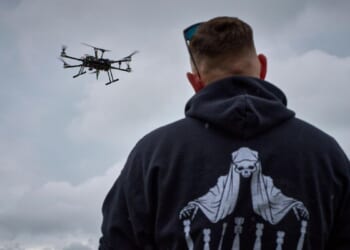
At least some of the U.S. warships that have deployed to the Caribbean in recent months have been jamming GPS signals in their vicinity, according to an analysis of data provided by Stanford University and a U.S. official who spoke on the condition of anonymity to discuss operational matters.
The Trump administration says the warships, which include the Navy’s most modern aircraft carrier, the U.S.S. Gerald R. Ford, are targeting drug trafficking to the United States orchestrated by the Venezuelan government.
In response to U.S. military pressure, the armed forces of President Nicolás Maduro of Venezuela have jammed the GPS signals around the country’s critical infrastructure, including military bases, oil refineries and power plants, according to an analysis by Spire Global, a satellite data firm.
Signals experts said both militaries appeared to be trying to protect assets against attacks by drones and precision munitions, which can be guided by GPS or similar positioning systems.
That will also likely impact narco-trafficking operations as well. Navigation in the open seas relies heavily on modern GPS systems; the cartels won’t have much luck with sextants and compasses alone, especially in the smaller boats they use.
Some wonder why Trump has chosen now to turn the screws this hard on Maduro. Fox News reminds readers today that it goes beyond enmity to Chavistas. Maduro has links to Hezbollah, including on Margarita Island, a one-time tourist destination that has become Iran’s proxy base of operations in the Western Hemisphere:
From a distance, Margarita Island looks like a Caribbean escape. Palm-lined beaches, duty-free shops, and resort towns sell the image of a tropical playground just off Venezuela’s northeastern coast. But U.S. officials say the Venezuelan outpost has become something else entirely: Hezbollah’s most important base of operations in the Western Hemisphere, strengthened by Iran’s growing footprint and the Maduro regime’s protection.
That threat, U.S. officials warn, reflects a broader security challenge emerging from the region. “The single most serious threat to the United States from the Western Hemisphere is from transnational terrorist criminal groups primarily focused on narcotrafficking,” Secretary of State Marco Rubio said at an end-of-year press conference at the State Department on Friday.
“Margarita Island might be of significance to the U.S. because of its location and the security dynamics around it,” Melissa Ford Maldonado, director of the Western Hemisphere Initiative at the America First Policy Institute, told Fox News Digital. “It is close to Trinidad and Tobago and Grenada, in an oil-rich part of the Caribbean along key maritime routes, and it has long had a reputation for being a major drug-trafficking hub, possibly because it’s off the mainland, and there’s not a lot of law enforcement there.”
This is not just a Fox News fever dream either. The Atlantic Council warned about this connection five years ago, detailing the acute terror threat it created even at that time while stressing the need for action to end it:
Throughout the years, Hezbollah’s ESO has morphed from merely a terrorist network in Latin America to engage in the region’s most lucrative illicit enterprise: narcotics. Of the more than two thousand individuals and entities around the world designated by the US government as foreign narcotics kingpins, almost two hundred are affiliated with or connected to Hezbollah.6 Its growing involvement in massive money-laundering schemes and multi-ton shipments of cocaine led the Drug Enforcement Administration (DEA) to name a subunit of Hezbollah’s ESO that is sometimes referred to as the “Business Affairs Component,” or BAC.7
Hezbollah’s involvement in drug trafficking is not new. Its criminal activities were established by the same founder as the ESO, Imad Mugniyeh, the deceased Hezbollah leader who is also implicated in the AMIA terrorist attack in Argentina. Hezbollah’s transnational crime portfolio is currently led by the secretary general’s cousin and Hezbollah’s envoy to Iran, Abdallah Safieddine, who shares this portfolio with Adham Hussein Tabaja. A prominent Hezbollah member who owns its media propaganda arm, Tabaja has set up many investment mechanisms and cash- and credit-intensive businesses to launder Hezbollah’s illicit proceeds. The most notable is Al-Inmaa Engineering and Contracting, based in Lebanon and Iraq, whose financial manager, Jihad Muhammad Qansu, has a Venezuelan passport. Together, Tabaja and Safieddine are tied to a vast transnational criminal network that includes an array of businesses in Latin America—namely in textiles, beef, charcoal, electronics, tourism, real estate, and construction—used to launder Hezbollah’s illicit funds. In October 2018, the Justice Department elevated Hezbollah’s status in the United States by listing it as one of the top five transnational criminal organizations (TCO). Naming Hezbollah alongside three major Mexican cartels and the Central American gang MS-13 was a wake-up call for Latin America to realize that, in today’s age, Hezbollah is equal to the cartels in organized crime and terror.
Bookmark that for later debates over this get-tough policy with Maduro. This goes well beyond the usual dealings with Havana-backed Marxist dictators. The US needs to root out Iran’s terror operations in the Western hemisphere, and do it with the kind of force that will have other wannabes in Latin America think twice about partnering with the mullahs in Tehran.
Editor’s Note: Thanks to President Trump and his administration’s bold leadership, we are respected on the world stage, and our enemies are being put on notice.
Help us continue to report on the administration’s peace through strength foreign policy and its successes. Join Hot Air VIP and use promo code MERRY to get 74% off your membership!