When Hamas launched a terrorist attack of unprecedented scale and brutality against Israel, killing over 1,200 innocent men, women, we hoped our domestic antisemites in America might crawl back under their rocks.
They didn’t.
Instead, pro-Hamas, anti-Jewish protests erupted throughout America. Some of the worst behavior occurred on college campuses. The campus was once thought to be a bastion of free speech and civil rights. Not anymore.
At UCLA, antisemites set up “Zionist check points,” subjecting students to interrogation about their religion if they wanted to pass. They set up a “Jew Exclusion Zone,” seemingly unaware of the historical echoes involved in that sort of thing. Perhaps they were fully aware of the history. Either way, the response the UCLA administration was feeble and embarrassing. UCLA police effectively assisted the protestors in enforcing the requirement.
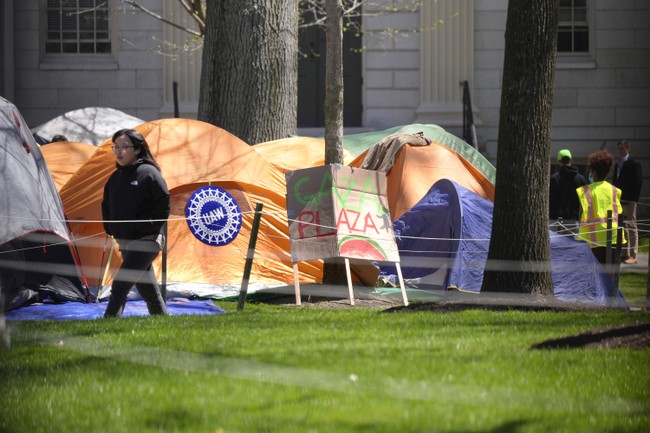
By the summer of 2024, groups that hate Jews and oppose Israel’s right to exist had established a “Gaza Solidarity Encampment” on Columbia University’s South Lawn. They took over and barricaded Hamilton Hall on the campus and intimidated Jewish students yelling at them calls for “intifada” and “stopping the genocide in Gaza.” Jewish students did not feel safe on campus displaying their kippahs or Stars of David and could not physically attend classes or lectures.
Columbia and UCLA were not the only incubators of this wicked antisemitic thuggery. All across the nation, especially at the so-called elite institutions, open and notorious antisemitism was uncorked on campus, and academic deans did nothing.
A 2025 Department of Education notice to Harvard cataloged what was happening on Harvard square. “Images were widely circulated among the Harvard community that trafficked in obvious anti-Semitic tropes, including one that showed a dollar sign inside a Star of David. The campus was vandalized with anti-Semitic stickers, including one that showed the Israeli flag with a swastika in place of the Star of David.”
Harvard administrations made sure to downgrade any discipline imposed on the perpetrators of Harvard’s nostalgia for the 1930s.
As the Federal District Court said later that summer in an August 13, 2024 opinion requiring UCLA to act to protect the Civil Rights of its Jewish students and faculty, “Jewish students were excluded from portions of the UCLA campus because they refused to denounce their faith. This fact is so unimaginable and so abhorrent to our constitutional guarantee of religious freedom that it bears repeating, Jewish students were excluded from portions of the UCLA campus because they refused to denounce their faith.”
This is the stuff of other countries and earlier centuries arriving on America’s elite campuses.
Here’s a pretty reliable test: the more prestigious a university is, the more of a problem of antisemitism they seem to have on campus. Harvard, Yale, Columbia, UCLA, once places of high esteem are now nests of racism, antisemitism and good old-fashioned intolerance.
If your kid is looking at colleges, avoid the Ivys. Consider a school down south with a huge football stadium. These days the education is superior, and so are the classmates. At least they won’t be assaulted because they are Jewish.
The U.S. House Education and Workforce Committee held a hearing with the presidents of Harvard, MIT, and the University of Pennsylvania – schools you were told you should aspire to attend – regarding the rampant antisemitic conduct on campus. They were pressed about what they were doing to stop it.
Turns out, not much. All three seemed to believe the free speech rights of the anti-Israel faction outweighed the civil and constitutional rights of Jewish students and faculty on campus.
This is why in 2024, as a Commissioner on the U.S. Commission on Civil Rights (USCCR), I asked twelve prominent colleges for information regarding antisemitic protests on campus. I wanted a catalog of the protests as well as any measures or actions taken against individuals or groups who violated the civil rights of Jewish students.
Not a single school or administrator responded to the substance of my request. Not even UCLA who, you might think, would want to explain how they fought the “Jew exclusion zones” on campus.
If you didn’t know any better, you would think that the Civil Rights Commission has an investigation of the Trump Administration. Not true.
Here’s the truth. On October 2, 2024, the four Republican commissioners on the USCCR — as a result of an NBC News article “Five Jewish college students report being assaulted in the last month as Oct. 7 anniversary approaches” — discovered that 23 bipartisan members of Congress led by Rep. Jake Auchincloss (D) and Rep. Kevin Kiley (R) had written to Commission Chair Rochelle Garza. They asked the Civil Rights Commission to convene a briefing on “the alarming rise in antisemitism on college and university campuses.” The news article stated that a commission spokesperson said the Congressional request was under review.
It turns out the Congressional request was being hidden from most of the Commissioners, especially the Republican ones.
In January 2025, the Commission finally approved an inquiry into campus anti-Semitism, not Donald Trump. Some on the Civil Rights Commission are taking the problem more seriously than others.
At the February meeting, I proposed the need for the USCCR to be prepared to exercise its statutory subpoena powers against any university that fails to respond to the USCCR’s document requests. My amendment to invoke the Commission’s little used subpoena power was agreed to.
Yet, less than three weeks later, Chair Rochelle Garza sought approval to redirect subpoenas away from campus yard and toward Donald Trump. Naturally Garza’s interest in the President was different when he was named Joe Biden. Then the news stories commenced that the Commission was investigating the administration.
At the July 18, 2025 Business Meeting, the Commissioners approved planning documents that would govern USCCR’s investigation into instances of antisemitism on college campuses — ten months after Congress’s first requested that USCCR do so, and almost two years since the problem started. A briefing in D.C. at USCCR headquarters was scheduled for Friday, November 21, 2025 and a single “Listening Session” (versus a field hearing) at an undetermined university was scheduled for Friday, February 20, 2026.
The targeted colleges were also limited to a “select sample of ten universities.” The planning documents — developed based on staff input — further limited the scope and scale of the USCCR inquiry compared to the original intent of the letter from Congress and the concerns expressed by Commissioners when they first discussed looking at the issue.
The Trump Administration is not the target of an antisemitism inquiry, colleges are.
This is what happens when federal bureaucrats get involved.
One of the core missions of the United States Commission on Civil Rights is to ensure that constitutional guarantees of religious freedom are safeguarded. The Commission should have focused on the elite universities who were facilitating the antisemitism. Instead, the USCCR investigation into the events has been delayed, stalled, narrowed and untilmately redirected in the media to Donald Trump, the single person who has been most committed to stamping out campus antisemitism.