President Trump on Sunday announced the U.S. will attempt to cut off another source of revenue for the Iranian regime by blockading the Strait of Hormuz after ceasefire talks in Pakistan ended without a deal.
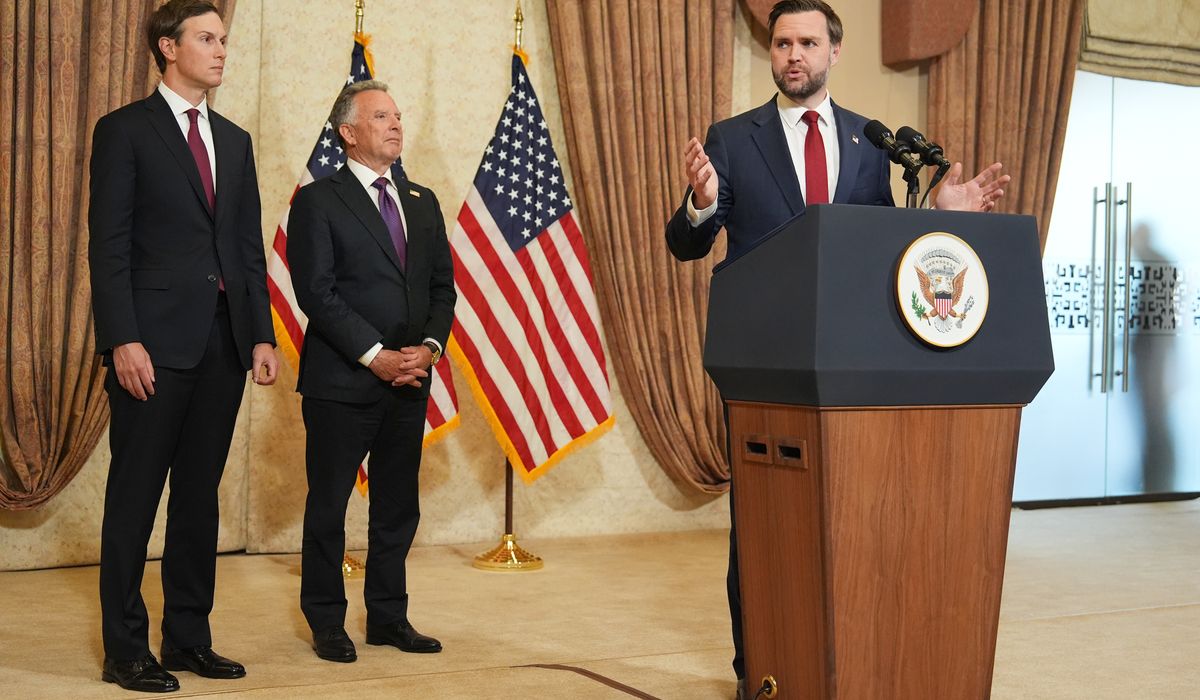
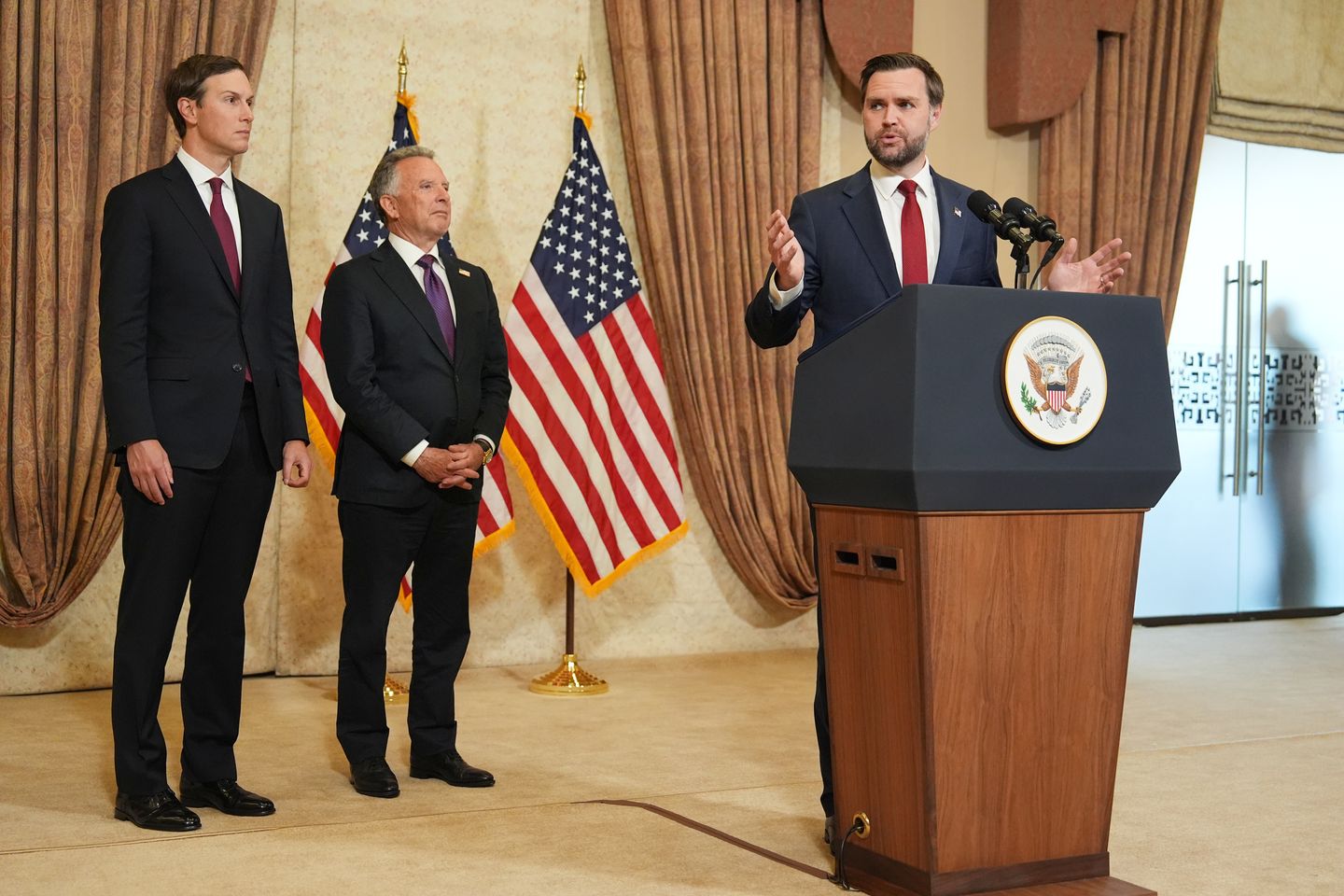
Vice President J.D. Vance, who led the U.S. delegation in a marathon 21-hour negotiation in Islamabad, cited “substantive discussions” in brief remarks to the press earlier in the day, but he said Iran had “chosen not to accept our terms.”
Iran’s military and proxy groups have threatened to sink cargo ships and tankers connected to the U.S. and its allies, but has offered safe passage — at a price — through the narrow waterway off its western coast to favored nations, including China.
Mr. Trump said the U.S. Navy will blockade the strait and “interdict every vessel in International Waters that has paid a toll to Iran.”
“Effective immediately, the United States Navy, the Finest in the World, will begin the process of BLOCKADING any and all Ships trying to enter, or leave, the Strait of Hormuz,” Trump said in a post to his social media platform Truth Social midday Sunday. “Other Countries will be involved with this Blockade. Iran will not be allowed to profit off this Illegal Act of EXTORTION.”
In addition to China, Russia, India and other nations reportedly have paid millions in tolls to Iran as questions arose over the weekend about whether Tehran is getting military help in addition to financial support from the nations allowed to transit the gulf.
SEE ALSO: Navy, allies begin mine-clearing operations in Strait of Hormuz as blockade takes shape
“Well, if China does that China is going to have big problems,” Mr. Trump said in response to a reporter’s question as he departed the White House.
A spokesman for the Chinese Embassy in Washington said Beijing is not supplying any arms to Iran.
Mr. Trump’s pivot on the strait represents the president’s bid to use the waterway the same way Tehran has, as a leverage point in negotiations to end the war that began with U.S.-Israeli air strikes across Iran on Feb. 28.
As much as 20% of the world’s petroleum is transported through the strait each year.
“At some point, we will reach an ‘ALL BEING ALLOWED TO GO IN, ALL BEING ALLOWED TO GO OUT’ basis,” Mr. Trump said of the naval blockade. “But Iran has not allowed that to happen.”
The blockade will rely on two U.S. Navy aircraft carriers and their associated warships, known as carrier strike groups, that previously deployed to the region during the U.S.-Israel campaign on Iran.
SEE ALSO: Trump warns China not to supply arms to Iran
“We will also begin destroying the mines the Iranians laid in the Straits. Any Iranian who fires at us, or at peaceful vessels, will be BLOWN TO HELL!” Mr. Trump wrote on social media on Sunday. “Iran knows, better than anyone, how to END this situation which has already devastated their Country.”
The USS Gerald R. Ford and USS Abraham Lincoln are maintaining a presence near the Persian Gulf, each accompanied by a strike group that includes three U.S. Navy guided-missile destroyers. Additional U.S. Navy ships are also in the area according to marine traffic logs.
Two U.S. Navy destroyers “transited the Strait of Hormuz and operated in the Arabian Gulf as part of a broader mission to ensure the strait is fully clear of sea mines previously laid by Iran’s Islamic Revolutionary Guards Corps,” U.S. Central Command wrote in a statement.
Clearing the strait of mines may include some of the most recently developed autonomous military assets in the world. The United Kingdom is preparing to deploy a ship with a fleet of autonomous mine-hunting drones, according to reporting by The Sunday Times in London.
The British Royal Navy ship was retrofitted to act as a “mothership” for hundreds of undersurface drones.
Fewer details are known about the U.S. Navy’s use of autonomous drones for clearing the Strait of Hormuz, but “underwater drones” are being used in those operations, according to CENTCOM.
Adm. Brad Cooper, commander of U.S. Central Command, said the move by the destroyers “began the process of establishing a new passage” through the strait and the U.S. “will share this safe pathway with the maritime industry soon to encourage the free flow of commerce,” according to the CENTCOM statement.
The blockade comes after Mr. Vance said negotiations collapsed early Sunday morning over what he described as Iran’s refusal to abandon its path to a nuclear weapon. Iranian officials blamed the U.S. without citing specific negotiation points.
The key point, according to U.S. officials and Mr. Trump, is Iran’s pursuit of continued production of nuclear materials or weapons. Mr. Trump said Iran was “very unyielding” on the point of nuclear weapons.
“I have always said, right from the beginning, and many years ago, IRAN WILL NEVER HAVE A NUCLEAR WEAPON!” he posted on social media.
The 14-day ceasefire is set to expire on April 22, with neither side addressing next steps publicly. Iran’s parliament speaker Mohammad Bagher Qalibaf, who led Iran in the negotiations, said it was time for the United States “to decide whether it can gain our trust or not.”
“There is only one thing that matters,” Mr. Trump said of the diplomatic meeting on Sunday. “IRAN IS UNWILLING TO GIVE UP ITS NUCLEAR AMBITIONS!” The president outlined that the negotiated points both sides agreed to are far secondary to “allowing Nuclear Power to be in the hands of such volatile, difficult, unpredictable people.”
Pakistani Foreign Minister Ishaq Dar said his country will try to facilitate a new dialogue between Iran and the U.S. in the coming days.
“It is imperative that the parties continue to uphold their commitment to ceasefire,” Mr. Dar said.
Neither side, the U.S. nor Iran, has made an announcement on whether talks would resume in the future. Both countries ended the historic round of face-to-face talks without reaching any agreement and the fate of the fragile, two-week ceasefire still remains unclear.
“The simple fact is that we need to see an affirmative commitment that they will not seek a nuclear weapon, and they will not seek the tools that would enable them to quickly achieve a nuclear weapon,” Mr. Vance told reporters. “That is the core goal of the President of the United States. And that’s what we’ve tried to achieve through these negotiations.”
The vice president said he spoke with President Trump often during the negotiations as well as coordinating with Secretary of State Marco Rubio, Treasury Secretary Scott Bessent and Adm. Cooper. The two U.S. Navy destroyers began moving through the Strait of Hormuz before negotiations concluded.
Since the ceasefire between Iran and the U.S. was announced, leaders in the Trump administration have been quick to say Iranian military and arms capacity have been all but wiped out during weeks of fighting. But there is some acknowledgment that Tehran retains capabilities to possibly strike back or defend itself.
Gen. Dan Caine, chairman of the Joint Chiefs of Staff, said last week that the U.S. military hit more than 13,000 targets. He listed high percentages for attacks or destruction to Iran’s air defenses, navy and weapons factories.
However, the totals stop short of completely eradicating Iran’s military capabilities as monitored by analysts, calling into question Mr. Trump’s description of Iran as being “decimated.”
Mr. Trump said Sunday that the U.S. was prepared to continue its joint campaign with Israel, saying troops are “LOCKED AND LOADED” to “finish up” if Iran does not concede its ambition for a nuclear weapon.
• Bill Gertz contributed to this report.