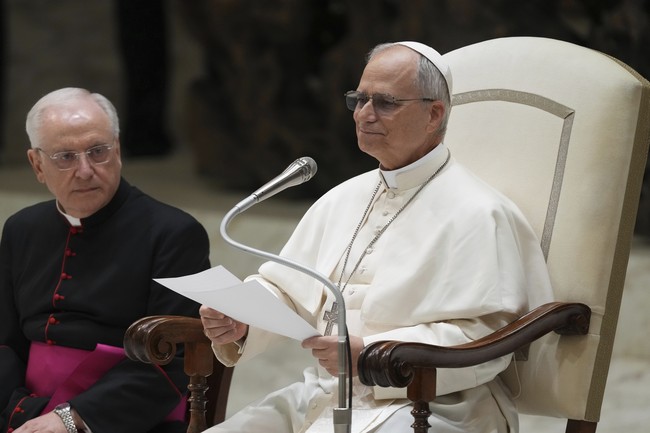
Pope Leo XIV spoke a little more forcefully in his call for a ceasefire in the Iran war during his Sunday Angelus address in Vatican City, urging leaders involved in the fighting to halt the violence and return to dialogue.
The Pope warned that continued strikes will only deepen suffering across the region, speaking of damaged homes, destroyed schools, and hospitals caught in the crossfire. His appeal focused on the moral weight carried by leaders who command armies and launch attacks.
Pope Leo XIV framed the crisis in terms of the suffering caused by active combat, centering his message on those conducting the war to stop firing so negotiations could begin. What didn’t the pope talk about? He avoided direct mention of the Iranian regime’s long role in building militant networks across the Middle East, funding and arming groups such as Hezbollah, Hamas, and the Houthis for over 40 years in operations that have killed Americans, Israelis, and innocent people throughout the world.
The pattern began after the Islamic Republic formed in 1979, after the formation of the Revolutionary Guard Corps, which then trained and equipped proxy forces outside Iran’s borders. Hezbollah emerged in Lebanon during the early 1980s and was backed by the Iranian leadership. Over time, the group grew into a powerful regional force that operates across Lebanon and Syria while maintaining strong ties to Tehran.
Iranian support for militant groups has reached far beyond Lebanon: Hamas in Gaza has received funding, weapons, and training tied to Iran’s military structure. The Houthis in Yemen have also benefited from Iranian missile and drone technology.
Those weapons have targeted ships moving through the Red Sea and struck neighboring countries, increasing regional tensions, while those groups expanded their reach.
Cardinal Pietro Parolin, the Vatican secretary of state, also spoke about the conflict with officials from the U.S. and Israel, pushing for diplomatic solutions, rejecting claims that recent military action qualifies as a preventive war, and emphasizing the need for negotiations that might reduce further escalation.
“Justice has given way to force; the force of law has been replaced by the law of force,” Cardinal Parolin said, “with the conviction that peace can arise only after the enemy has been annihilated.”
Cardinal Parolin stopped short of directly mentioning the United States or Israel by name but emphasized that under the United Nations Charter, force must be considered only as a last and most grave resort after all political and diplomatic options have been exhausted, and only “after carefully assessing the limits of necessity and proportionality.”
The Trump administration argues that Iran’s support for armed groups created the conditions for the present conflict, and focuses American policy on weakening those networks and stopping Tehran’s efforts to expand influence beyond the Middle East. Officials in Washington view Iran’s nuclear ambitions and proxy forces as direct threats to American allies and global energy routes.
The Vatican holds moral authority among over a billion Catholics worldwide. When the pope speaks about war and peace, believers often look to those words for clarity and guidance, while expecting moral leadership to name every force that drives violence rather than focusing on the responses that follow.
Iran’s record in the region spans decades, with militants connected to Tehran carrying out the 1983 bombing of the U.S. Marine barracks in Beirut, killing 241 American service members. Iranian-backed militias later targeted American forces during the Iraq War and operated across Syria during that country’s civil war. The Houthis have launched missiles and drones at ships and cities with equipment tied to Iranian supply lines.
That’s the Iranian history of terror and conflict that Iran brings to the table that Pope Leo XIV isn’t talking about.
Calls for peace carry greater weight when they address the entire chain of events that led to the war, and Iran’s support for militant groups stands as one of the major forces that shaped the current crisis.
Church leaders can still encourage dialogue and humanitarian relief while naming the structures that sustain violence. An honest discussion of those structures strengthens efforts to achieve real regional stability.
That said, focusing on one side of any conflict isn’t a true basis for negotiations. If you browbeat Tom for stealing Sam’s lunch money without considering Sam’s role in actions that built instability and pressure in the cafeteria for the past several months, why bother?
If you value coverage that looks deeper into global conflicts and leadership decisions, join PJ Media VIP and use promo code FIGHT to save 60% on a subscription and gain full access to exclusive analysis and commentary.