It was March 1945, and a Japanese bomber strike had turned the USS Franklin aircraft carrier’s flight deck into a blazing inferno. A middle-aged man with a cross on his helmet was organizing firefighting crews, tending to the wounded, and finding sailors skilled in bomb disabling all at once. As Sam Rhodes worked feverishly on pitching a bomb overboard, as directed by the man with the cross, he thought, “Well… if I go up with a bomb, at least I go with a priest.”
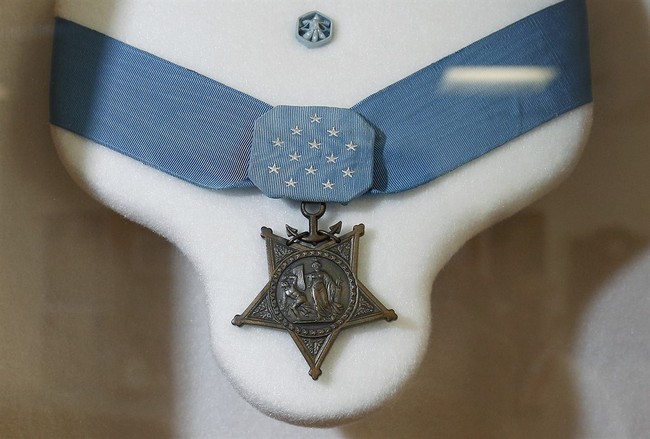
Today is Medal of Honor Day, commemorating those who received America’s highest military honor. I highly recommend reading the stories of men who recently received the Medal of Honor from President Donald Trump. But in this piece, I’m going to focus on a Catholic Navy chaplain later described by his non-religious captain as “the bravest man I have ever seen.”
Medal of Honor Day: Navy chaplain Fr. Joseph O’Callahan (image from The American TFP) pic.twitter.com/jcIxpcpzsQ
— Catherine Salgado (@CatSalgado32) March 25, 2026
Besides being Medal of Honor Day, today is the traditional feast of the Annunciation, when the Virgin Mary agreed to be the mother of Jesus Christ and God became flesh. So it seems doubly appropriate to recognize the heroism of a religious leader on this holiday.
Fr. Joseph Timothy O’Callahan, U.S. Navy chaplain, was eating in the wardroom on March 19, 1945 (the feast day of his namesake St. Joseph), when the semi-armor piercing shells hit the Franklin’s flight deck. At the time, dozens of planes were either in the hangar or actually on the flight deck, their tanks filled with fuel. Or, in other words, they were now part of the reason the enemy strike turned the Franklin into an inferno.
Fr. Joe did not hide in another part of the carrier; he raced straight to the heart of the catastrophe. The aircraft carrier was being “rocked by incessant explosions” and the priest was “braving the perilous barriers of flame and twisted metal,” first finding his way “through smoke-filled corridors” then to the flight deck where “debris and fragments [were] raining down and fires raging in ever-increasing fury,” as the Congressional Medal of Honor Society (CMOHS) described the hellish scene.
For Our VIPs: ‘Liberty or Death’: The Spirit of Revolution and America’s 250th Birthday
No amount of danger could deter Fr. Joe. He ministered to the wounded, giving them Extreme Unction, and tracked down those who were not too injured or too much in shock to help. In a series of split-second decisions he looked into younger men’s faces and determined if they were capable of following orders at the moment. “There were many who listened but did not hear, who looked you in the eye but did not see,” the priest later remembered, according to historian Tara Ross. “They were conscious but they didn’t know it. They were for the time stunned….Later these boys would help, but for the moment their systems had to become readjusted to the mere fact of being alive.”
Then there were some who were reluctant to do what Fr. Joe urged them to do because they were not experts in the tasks he unofficially unassigned. Fr. Joe helped inspire others to action by taking on some of the tasks himself, despite his “creaking bones” and lack of training. “You shouldn’t ask lads to do what you yourself are not willing to do,” the priest explained simply.
Corporal Mike Sansone refused to help with the hoses the first two times Fr. Joe asked, Ross wrote. “I was part of the aviation group and I wasn’t trained in firefighting,” Sansone said. “He had a very calm presence about him and he insisted, and I finally agreed to go.”
Water Tender Petty Officer 3rd Class Sam Rhodes was similarly reluctant when Fr. Joe required his services. “You couldn’t miss the white cross on his helmet,” Rhodes recalled of the priest. “[H]e was organizing fire crews like you wouldn’t believe.” Rhodes agreed to help roll a bomb off the flight deck and into the ocean. That’s when he half-humorously, half-seriously reflected, “If I go up with the bomb at least I’ll go with a priest.”
The USS Franklin survived and even made it back to New York on her own power. On May 17, during an awards ceremony on the damaged but resilient ship’s deck, the captain, Leslie Gehres, tracked down Mrs. O’Callahan, Fr. Joe’s mother. “I’m not a religious man,” Gehres told her, “But I watched your son that day and I thought if faith can do this for a man, there must be something to it. Your son is the bravest man I have ever seen.”
In 1946, Fr. Joseph O’Callahan received the Medal of Honor. As CMOHS put it, he had “inspired the gallant officers and men of the Franklin to fight heroically and with profound faith in the face of almost certain death.”
Editor’s Note: Support and follow PJ Media’s coverage of patriotic holidays and other key news in this 250th year of America’s existence. Join PJ Media VIP and use promo code FIGHT to get 60% off your membership.