Early morning, Palm Sunday, April 9, 1865: The rebel yell of the ragged, half-starved Army of Northern Virginia rang out for the last time. Sheridan’s Union cavalry had swung around Appomattox Court House to the southwest and captured the trains carrying the food and supplies Lee so desperately needed, but it was, after all, just cavalry, and if the Confederates could break through them, recapture the supplies, and then head south to link up with Johnston’s Army, the cause might still survive.
Over the cavalry, the Rebels prevailed, but as the Union troopers withdrew and they crested the ridge, they could see solid lines of Union infantry arriving in the distance beyond them. The trap was closed.
Two days before, Lee had received the following letter:
General R.E. Lee
Commanding C.S.A.
The results of last week must convince you of the hopelessness of further resistance on the part of the Army of Northern Virginia in this struggle. I feel that it is so, and regard it as my duty to shift from myself the responsibility of any further effusion of blood, by asking of you the surrender of that portion of the Confederate States army known as the Army of Northern Virginia.
U.S. Grant
Lieut. General
Lee responded by asking what the conditions would be, to which Grant replied that “…the men and officers surrendered shall be disqualified for taking up arms again against the Government of United States until properly exchanged.”
Lee replied that he would be willing to meet, not to surrender, but merely to discuss the overall terms of peace with the Confederacy. Grant, suffering from a severe migraine, simply replied that he had no authority for such a discussion, saying to an aide through the pain, “It looks as if Lee still means to fight.”
Now that the trap was closed, Lee faced the inevitable: “There is nothing left for me to do but to go and see General Grant. I would rather die a thousand deaths.”
He asked his old “warhorse,” Gen. James “Petey” Longstreet, if Grant’s terms would be harsh, but “Petey” had been an old friend of Grant back in their West Point days, and told Lee he thought not.
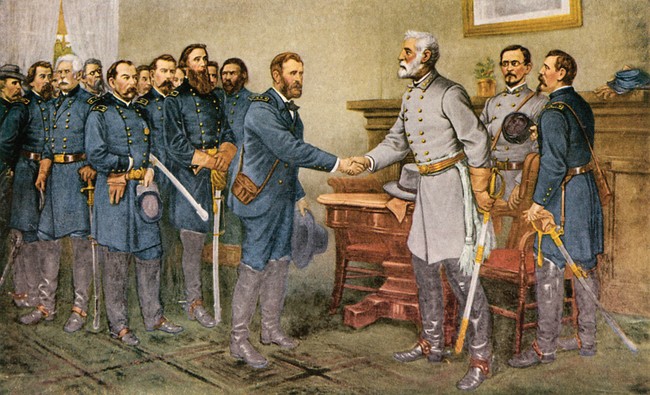
Upon receiving Lee’s request for an interview to ascertain the details of surrender, Grant’s headache instantly vanished. A cease-fire was arranged so the two could meet, and at last the guns fell silent. A stately farmhouse owned by Wilmer McLean was selected. Ironically, he had moved out to Appomattox to get away from the war, since one of the first cannon shots at Bull Run had gone through his living room. Grant and his officers arrived half an hour after Lee. Grant wore a private’s blouse with nothing to distinguish his status but the three star epaulettes. His boots and pants were muddy, since he was fresh from reconnoitering his lines. Lee, on the other hand, was resplendent in his dress uniform, with sash and bejeweled sword.
After handshakes and small talk, it was Lee who politely suggested they get to the matter and asked Grant to write out the terms so that they may be formally accepted. Grant began to write the draft, which read in pertinent part: “The officers to give their individual paroles not to take up arms until properly exchanged, and each company or regimental commander sign a like parole for the men of their commands. The arms, artillery and public property to be parked and stacked, and turned over to the officer appointed by me to receive them…”
Then Grant eyed the bejeweled sword Lee had by his side, evidently brought to perform the humiliating act of handing it over to the victor, and continued to write, “This will not embrace the side-arms of the officers, nor their private horses and baggage. This done, each officer and man will be allowed to return to their homes, not to be disturbed by the United States authority so long as they observe their paroles and the laws in force where they may reside.”
That was it – ALL of it. Stack arms and colors, swear parole, and go home. Full amnesty.
As he was being introduced to Grant’s staff, Lee seemed perplexed by the swarthy appearance of Lt. Colonel Ely Parker, a Seneca Indian, who had written out the formal version. Perhaps he at first wondered if Grant had a black officer on his staff, but then realized he was Native American. Parker later wrote, “Lee stared at me for a moment. He extended his hand. ‘I’m glad to see one real American here.’ I shook his hand and said, ‘We are all Americans.’”
Afterward, Grant heard celebratory gunfire among his troops and immediately ordered a halt to it. His feeling upon the matter are in his memoirs: “I felt like anything rather than rejoicing at the downfall of a foe who had fought so long and valiantly, and had suffered so much for a cause, though that cause was, I believe, one of the worst for which a people ever fought, and one for which there was the least excuse.”
The officer in charge of the surrender ceremony was Joshua Lawrence Chamberlain, now a brigadier general, and the hero of Little Round Top at Gettysburg. Confederate Gen. John B. Gordon was upon a horse, leading the defeated men to the place where arms and colors were to be stacked, with a dejected countenance. As he passed by Chamberlain, a bugle rang out — for Chamberlain had given the order “CARRY ARMS!” as a show of honor receiving honor. Gordon instantly straightened up, wheeled his horse to face Chamberlain, slightly reared the horse, and at the same time lowered his sword point. Gordon then ordered his troops to “Carry Arms.” Thus, a man who was on the receiving end of five Yankee bullets at Antietam returned a salute to a Yankee general who had himself been shot six times in the war. Both men, by the way, were at one point not expected to live, but evidently God had other plans.
Grant and Chamberlain were carrying out the wishes of their commander in chief, who told Grant to “Let ‘em up easy,” a wrestling term for when the match was over, and the victor helped the vanquished to his feet. Without such an attitude, the nation might well have been condemned to decades of bloody guerrilla war.
The silence of the guns that Palm Sunday speaks to us that healing the most grievous wounds we inflict upon one another can be possible if we remember we are all Americans.
Editor’s Note: Do you enjoy PJ Media’s conservative reporting that takes on the radical left and woke media? Support our work so that we can continue to bring you the truth. Join PJ Media VIP and use the promo code FIGHT to get 60% off your VIP membership!