It’s been more than a decade and a half since I first wrote that the California bullet train to nowhere would be a disaster.
I write that not just to toot my own horn. It was an easy prediction to make, even for my much younger and less cynical self.
No, I’m noting the timeline because after so many years of failure, California’s leaders still refuse to pull the plug on what is one of the most blatant boondoggles in American politics.
On Sunday, CBS News’ “60 Minutes” put a spotlight on the disastrous California High Speed Rail project, which both massively overshot initial budget projections (who could have guessed that, right?) and has made little progress since it officially began in 2015.
I’m pleasantly surprised that CBS News bothered to cover this issue. It seems the new management is making some positive changes there.
Their report about California’s “ghost train” was damning.
“America’s hopes for its first high-speed rail were kindled in 2008, when California voters approved a ballot measure for a train connecting Los Angeles to San Francisco in less than three hours,” a write up of the show said. “The estimated price tag: $33 billion. Completion date: 2020. It would cut pollution; revitalize local economies, clear gridlock.”
It’s now 2026. No track has been laid. The theoretical route is planned to connect Bakersfield to Merced—I don’t blame you if those names only seem vaguely familiar—and the projected cost is $126 billion.
The report noted that the cost is higher than the amount of money Amtrak has received from the government since it was launched in 1971. And our national train service has hardly been known for its fiscal prudence.
As more than a few noted on X, this staggering amount of money could subsidize air travel between San Francisco and Los Angeles for a very long time.
This gets to one of the early warning signs for the entire project. Air travel between the two metropolises was already possible and reasonably inexpensive. The bullet train, even if it magically apparated tomorrow, would still be slower and wouldn’t be much cheaper unless it was heavily subsidized by the state.
The bullet train was a redundancy of luxury from the beginning. It was sold in a way to tickle the fancy of your average California progressive who dreamed of a beautiful, green, carless future where the seas would stop rising and carbon emissions would be a thing of the past. It married that pie-in-the sky outlook with the grubbier and more consequential side of Democrat machine politics. It promised to be a bonanza for highly-paid bureaucrats, public-sector union workers, and well-connected contractors.
And so, it was. In that sense, the “ghost train” has been a tremendous success.
Rep. Vince Fong, a Republican from Bakersfield who is on the House Transportation Committee, said in his interview with 60 Minutes that the project needs to stop.
“I think that the California High-Speed Rail nightmare is the probably quintessential example of government waste and mismanagement,” he said.
I agree.
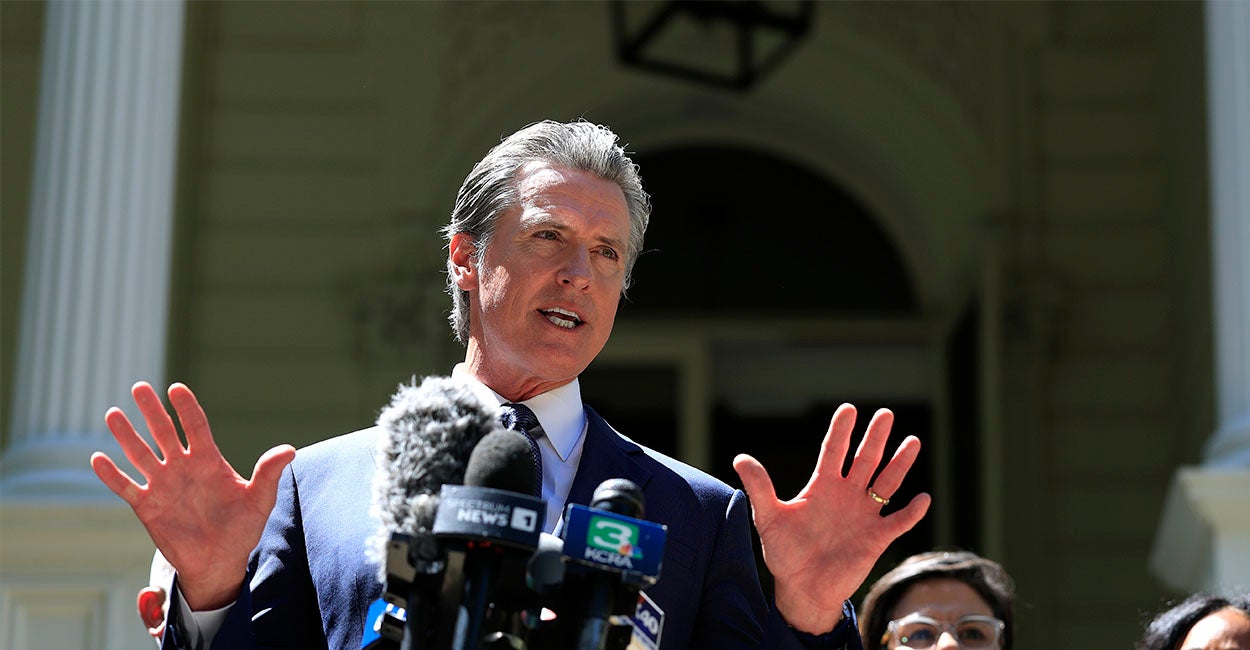
And at one point California Gov. Gavin Newsom also agreed.
“We were selling a $32 billion project then, and we were going to get roughly one-third from the federal government and the private sector,” Newsom said in 2014 when he was still the lieutenant governor. “We’re not even close to the timeline (for the project), we’re not close to the total cost estimates, and the private sector money and the federal dollars are questionable.”
He concluded that the facts appeared “overwhelming that this project is not going to materialize in our lifetime.”
In 2019, Newsom scaled the project back but has done little to halt it. He even sued the Trump administration in 2025 to keep billions of dollars in federal aid flowing to the doomed project.
“Trump’s termination of federal grants for California high-speed rail reeks of politics. It’s yet another political stunt to punish California,” he said in a statement about the lawsuit. “In reality, this is just a heartless attack on the Central Valley that will put real jobs and livelihoods on the line. We’re suing to stop Trump from derailing America’s only high-speed rail actively under construction.”
There’s a lot to parse out there. Apparently, pulling the plug on funding for something that is more than five years past its deadline is “politics.” Even more infuriating is how Newsom framed this in terms of jobs in the Central Valley. It apparently doesn’t matter what those jobs are or if they are accomplishing anything.
Are you seeing why Democrats mostly shrug when they hear about, for instance, the massive Somali fraud ring in Minnesota and the even more massive scams currently being uncovered in California?
Whatever sticker they put on a program to sell it to the public means a lot less than the spoils delivered to their loyal supporters. So, keep the money flowing and the questions at a minimum.
I actually appreciated this statement by Ray LaHood, the former transportation secretary under President Barack Obama who is now the co-chair of the U.S. High Speed Rail Commission.
He said that while the bullet train’s problems have been covered “extensively,” what’s new “is that the California State Legislature and Governor Gavin Newsom passed a $20 billion investment in the project last fall. This steady, long-term funding—delivered in $1 billion a year allocations—is a gamechanger.”
The answer to this mess is to just keep throwing money into the pit, but do it faster.
I’ll let the reader decide if that sounds like a recipe for success.