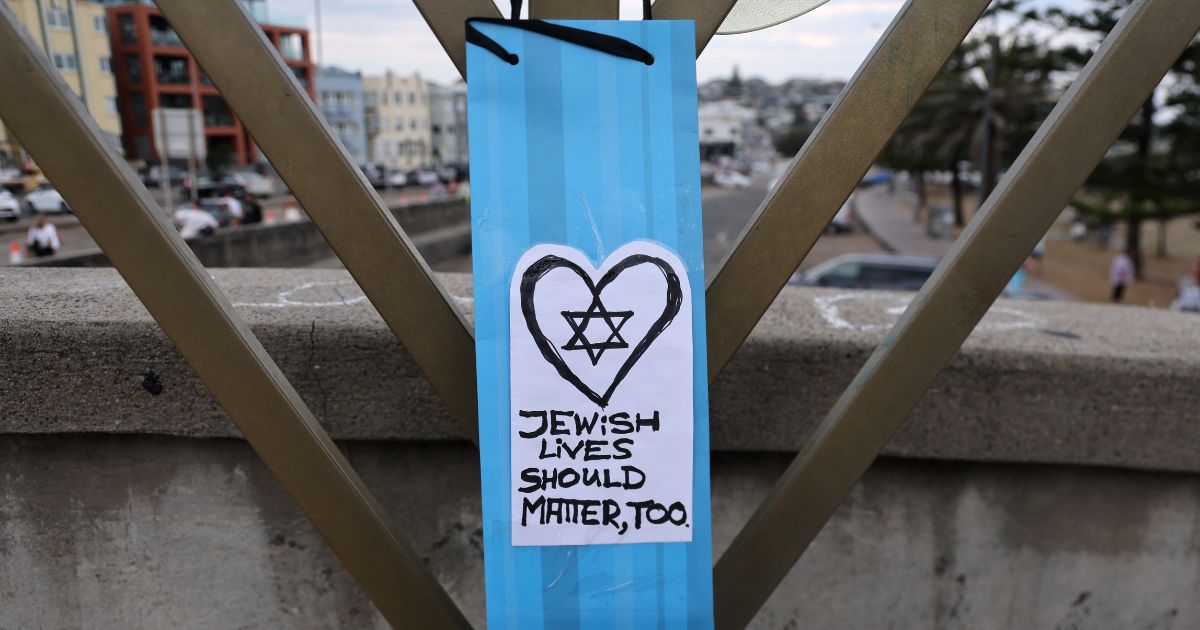
Bondi Beach should have been a place of light.
On that warm December evening, Jews gathered along Sydney’s shoreline for Chanukah by the Sea, a public Hanukkah celebration marked by prayer, music, and remembrance. Children clutched candles. Rabbis offered blessings. Holocaust survivors stood as living witnesses to resilience.
What followed was not merely an act of violence, but a devastating failure of imagination by Western security establishments that still refuse to confront how transnational Islamist networks radicalize across borders, cultures, and identities.
The accused attackers are a father and son of Indian Muslim origin, now central to Australia’s most serious anti-Semitic terror investigation.
They did not emerge from a vacuum. They were not driven by poverty, exclusion, or race. They were animated by ideology, shaped by networks, and enabled by a long-standing Western reluctance to interrogate so-called “non-violent” Islamist movements that repeatedly appear upstream of jihadist violence.
Authorities allege the Bondi Beach massacre was inspired by ISIS ideology.
The symbolism alone — targeting Jews during Chanukah by the Sea — leaves little doubt about motive. Yet focusing exclusively on ISIS branding offers a comforting but incomplete explanation. It allows policymakers to treat such attacks as sudden eruptions, rather than the end result of a long radicalization process.
The more difficult question remains unanswered: How do individuals living for decades in liberal democracies come to see mass murder as a religious duty?
The answer lies not only with designated terrorist organizations, but with the ideological ecosystems that normalize absolutism, grievance, and separation from pluralistic society long before violence occurs.
These environments rarely make headlines, because they operate below the threshold of criminality. But they matter. And they recur.
One such movement, consistently overlooked by Western governments, is Tablighi Jamaat.
Tablighi Jamaat presents itself as a quietist Islamic missionary movement devoted to personal piety. It is not formally designated a terrorist organization, and its defenders lean heavily on that distinction.
Yet counterterrorism history tells a far more troubling story. Tablighi Jamaat is not banned in Australia or the West. But legality does not negate ideological influence.
During the height of ISIS recruitment between 2014 and 2019, intelligence services across Europe, South Asia, and Southeast Asia documented disproportionate numbers of ISIS recruits who had passed through Tablighi Jamaat environments. This was not because the movement openly endorsed violence — it did not — but because it created ideological and social conditions that jihadist recruiters knew how to exploit.
Tablighi Jamaat promotes rigid Deobandi interpretations of Islam, rejection of Western civic identity, withdrawal from pluralistic society, and deference to insular religious authority over secular law.
That worldview does not pull the trigger, but it conditions the mind for those who will. It is the difference between radicalization as an event and radicalization as a process.
Understanding that process requires acknowledging the movement’s undeniable global reach.
Tablighi Jamaat was founded in 1926 in the Mewat region of India (then British India), near Delhi, by Maulana Muhammad Ilyas Kandhlawi, a Deobandi Islamic scholar.
TJ’s operational leadership consolidated over time in Pakistan, with vast infrastructure in Bangladesh and entrenched presences across Europe, Australia, North America, and Africa. Its global nerve center at Raiwind, Pakistan, and its massive annual gatherings, some drawing millions, provide unparalleled reach, anonymity, and mobility.
The movement recruits across race and ethnicity, including Western converts, making it uniquely effective inside diaspora communities.
In Bangladesh, this ecosystem is further reinforced by the presence of Jamaat-e-Islami, a political Islamist movement that has long shaped religious discourse and activism, creating ideological adjacency between missionary revivalism and overtly political Islamism.
This transnational structure is precisely why jihadist groups have long viewed Tablighi Jamaat spaces as ideal recruiting pools. The West’s persistent error has been to equate “non-violent” with “non-threatening.” History has repeatedly proven otherwise.
The Bondi Beach massacre also shatters another comforting illusion: that Islamist extremism is confined to certain nationalities or conflict zones.
Indian Islamism or Islamism originating in the West, particularly currents influenced by Salafi ideology, has long intersected with Pakistani and Bangladeshi networks through movements like Tablighi Jamaat.
These ideological pipelines do not stop at borders, nor do they dissolve when individuals migrate to Western democracies.
Treating radicalization as geographically contained is not merely inaccurate; it is dangerous.
This is not an indictment of India, Muslims, or immigration. It is an indictment of ideological denial; the belief that Islamist extremism announces itself only at the moment of violence, rather than developing quietly over years.
One constant runs through these movements, regardless of geography: anti-Semitism. It is not incidental — it is doctrinal.
Across ISIS, al-Qaida, Hamas, and their ideological feeders, Jews are framed not as political adversaries, but as cosmic enemies. That framing allows ordinary men — fathers, sons, neighbors — to rationalize slaughter as a sacred duty.
Western societies often misdiagnose anti-Semitic jihad as “foreign conflicts spilling over.” In reality, anti-Semitism is the emotional accelerant of global jihad.
Bondi Beach was not random. Chanukah by the Sea was chosen deliberately.
Australia, like the United States and much of Europe, has relied on an outdated counterterrorism framework that draws a bright line between “violent extremists” and “non-violent Islamists.”
That line exists largely to avoid political discomfort, not because it reflects reality.
Non-violent Islamist movements shape identity, grievance, and loyalty. Violent groups merely harvest what has already been planted.
Until Western governments are willing to scrutinize transnational missionary networks, track ideological convergence rather than weapons alone, and acknowledge gateway movements without fear of offense, mass-casualty attacks will continue to arrive “unexpectedly.”
The blood spilled at Chanukah by the Sea demands more than condolences. It demands courage: the courage to say that faith is not the problem, but ideology is. The courage to admit that some movements function as radicalization corridors, even without firing a shot. The courage to protect Jewish communities not after attacks, but before them.
If the West continues to treat ideological blindness as tolerance, it will keep learning the truth the same way it did in Bondi — after the candles are extinguished and the bodies are counted.
The views expressed in this opinion article are those of their author and are not necessarily either shared or endorsed by the owners of this website. If you are interested in contributing an Op-Ed to The Western Journal, you can learn about our submission guidelines and process here.

Advertise with The Western Journal and reach millions of highly engaged readers, while supporting our work. Advertise Today.