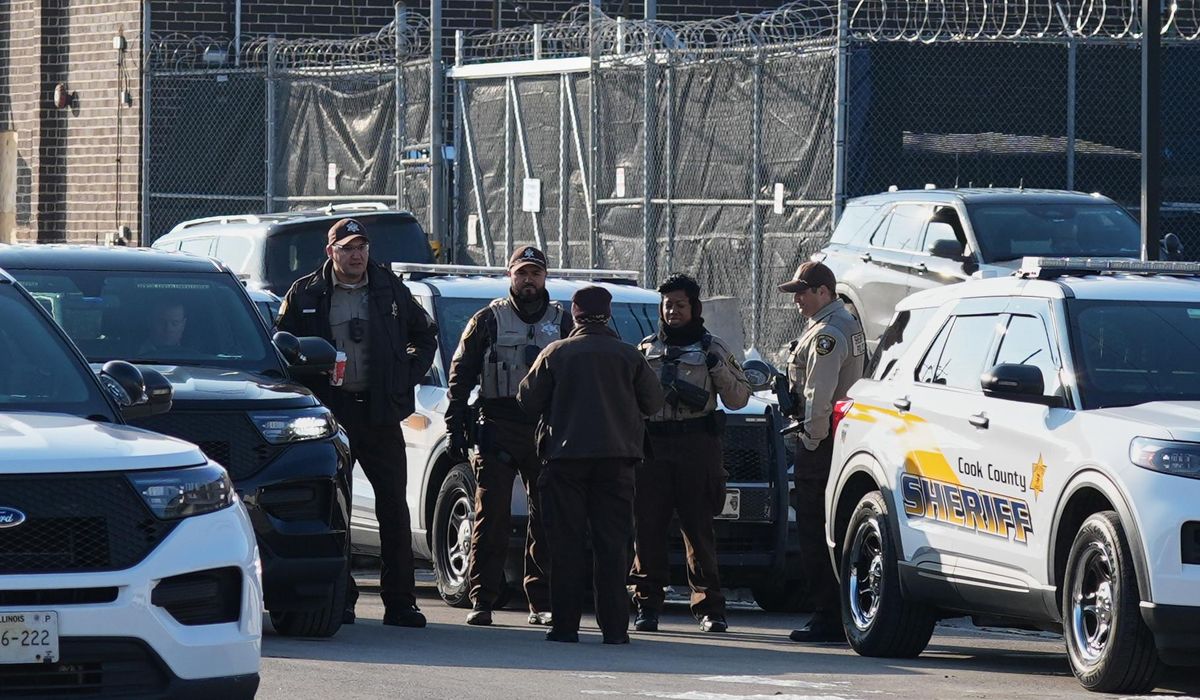
The Supreme Court ruled Tuesday that President Trump overstepped his powers in trying to federalize and send the National Guard to Chicago.
The decision marks a significant reversal for Mr. Trump and could undercut his other deployments, including the troops that have been stationed in Los Angeles for six months, in response to anti-ICE violence.
In an unsigned opinion, the high court said the law governing the president’s powers to deploy guard troops can only be triggered when the existing military forces aren’t sufficient. And because the military has no legally discernible role in quelling the protests in Chicago or assisting in protecting federal buildings there, Mr. Trump has no cause to call out the guard.
“Thus, at least in this posture, the Government has not carried its burden to show that [the law] permits the President to federalize the Guard in the exercise of inherent authority to protect federal personnel and property in Illinois,” the court said.
Justices Clarence Thomas, Samuel A. Alito Jr. and Neil M. Gorsuch noted their dissent. They said the majority introduced new legal issues that weren’t raised in the lower courts.
And they urged caution in second-guessing Mr. Trump’s decision-making in a matter of public safety and security.
“Whatever one may think about the current administration’s enforcement of the immigration laws or the way ICE has conducted its operations, the protection of federal officers from potentially lethal attacks should not be thwarted,” Justice Alito wrote.
Courts across the nation had been awaiting the justices’ action, with troop deployments in Oregon, Illinois and California all potentially resting on the decision.
The troops have been allowed to deploy to Los Angeles, where several hundred still remain, but they were blocked from Portland and Chicago while the justices ruminated.
Mr. Trump was acting under a law that allows the president to federalize and deploy National Guard troops in cases of invasion by a foreign nation, rebellion against the authority of the U.S. government or when “the president is unable with the regular forces to execute the laws of the United States.”
After an initial round of briefing at the high court, the justices asked both sides to delve into the meaning of “regular forces” and whether that specifically meant military, or civilian law enforcement.
Illinois argued that it meant the regular military. The state suggested Mr. Trump would need to try to deploy active-duty troops first, and only if they were unable to manage things could he turn to the guard. And Illinois said the Posse Comitatus Act would limit his ability to deploy those active-duty troops.
The administration disagreed, saying guard troops are “better suited” than active-duty troops to deploy to cities, so the law must have intended for regular forces to include civilian law enforcement.
The high court majority sided with Illinois.
“Because the statute requires an assessment of the military’s ability to execute the laws, it likely applies only where the military could legally execute the laws. Such circumstances are exceptional,” the court said.
The Posse Comitatus Act prohibits the president from deploying the military domestically to execute the law. And if the regular military can’t be used, the guard can’t be called in as a substitute, the court said.
Justice Brett M. Kavanaugh sided with the majority in ruling against Mr. Trump but for different reasons.
He said he was troubled by the idea that the president can’t deploy the guard at all unless he’s first used the regular military.
But he said in this case, Mr. Trump didn’t prove that the regular civilian law enforcement was insufficient to maintain order.
That largely tracks with federal district courts, which looked at the situation in Los Angeles, Portland and Chicago and found that while there were some violent flare-ups, on the whole, federal, state and local authorities were able to contain things.
Tuesday’s ruling marks a stark reversal of fortune for Mr. Trump, who had been on a winning streak before the justices, with rulings allowing him to carry out firings of major federal officers, to flex broad deportation powers for illegal immigrants and to withhold some government spending.