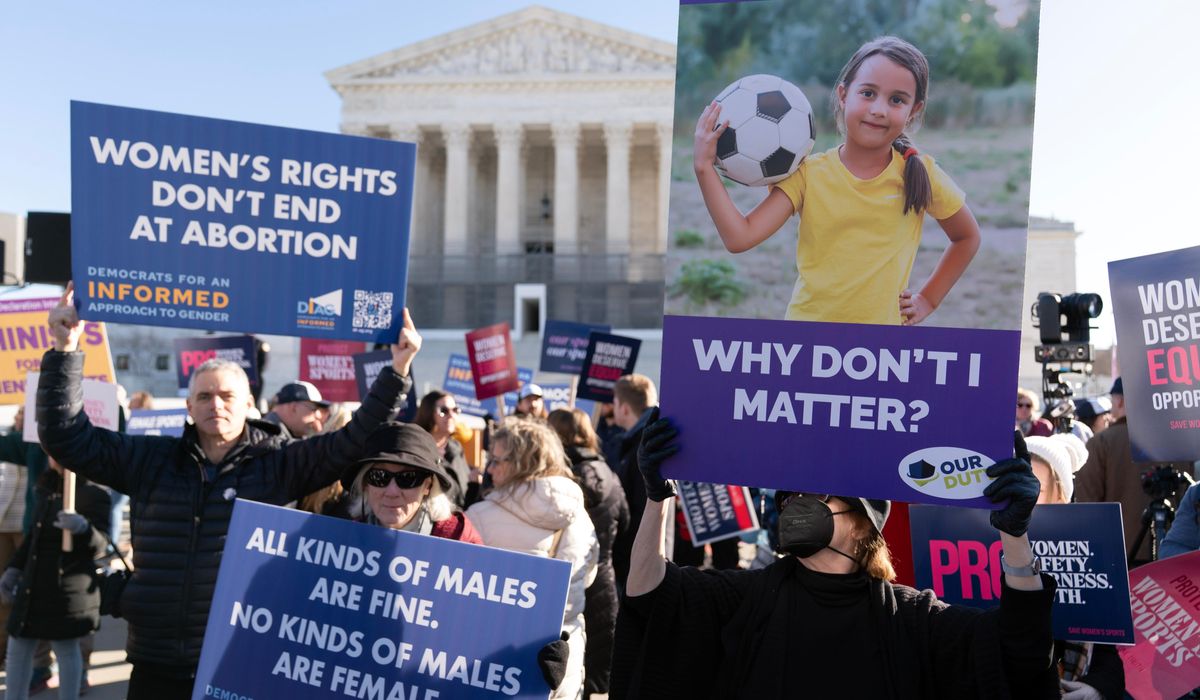
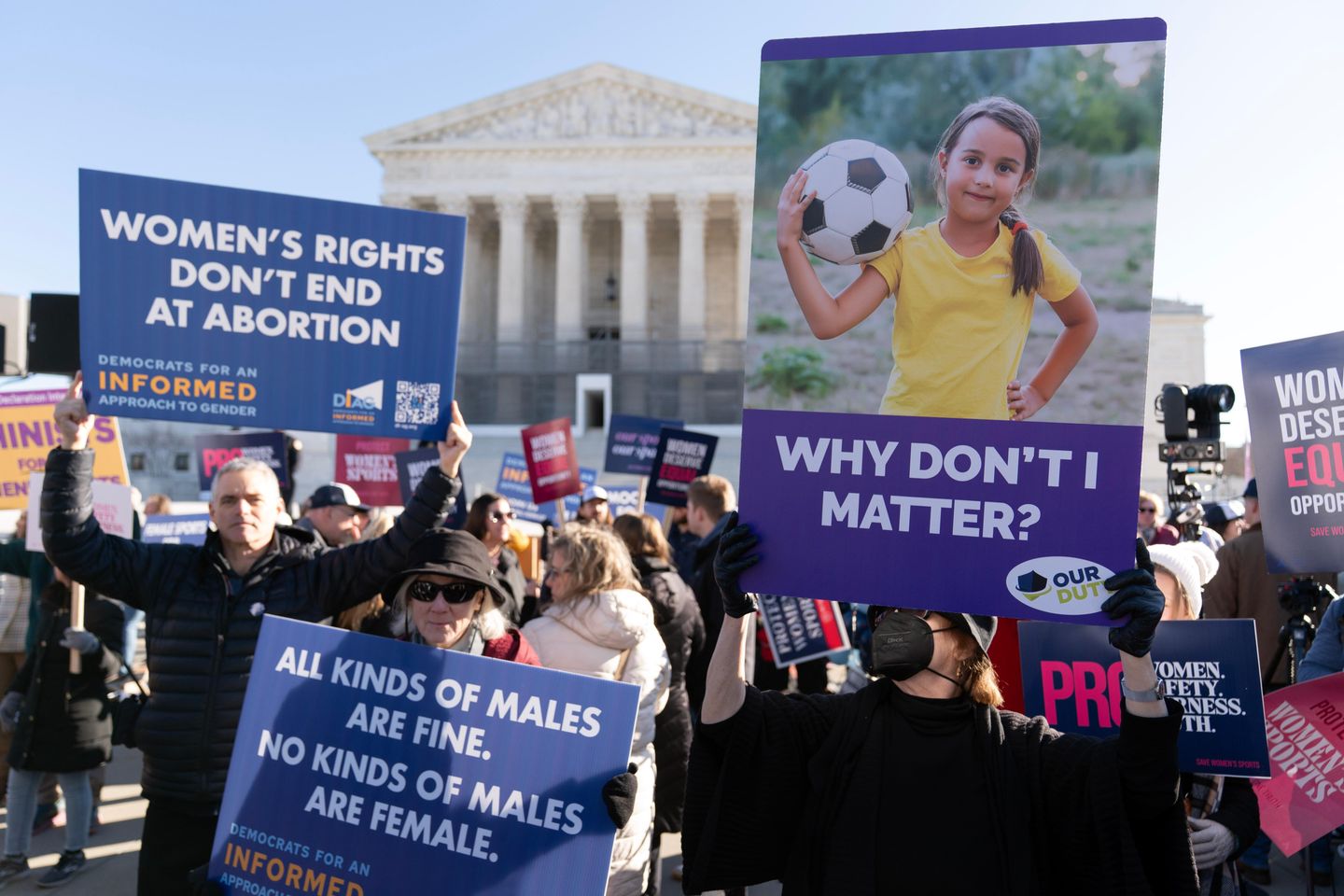
Republican-led states asked the Supreme Court on Tuesday to bless their laws that generally bar biological males from female sports, saying women and girls deserve leagues of their own.
The majority of the justices appeared open to that argument, though they wrestled with the implications, wondering whether it would mean opening the door to segregated chess teams and academic classes on the one hand, or doing away with same-sex locker rooms and separate teams for males and females on the other.
But the court’s liberal wing worried about the implications of leaving out some biological boys who identify as girls and cannot compete effectively on boys’ teams but also would be excluded from girls’ teams.
“The numbers don’t talk about the human beings,” said Justice Sonia Sotomayor, an Obama appointee.
But GOP court appointees said the girls and women being pushed off teams, missing the medal stand and losing scholarships must be considered, too.
“What do you say about them? Are they bigots? Are they deluded into thinking they are subjected to unfair competition?” asked Justice Samuel A. Alito Jr., a George W. Bush appointee.
The justices heard more than three hours of oral arguments in cases out of Idaho and West Virginia, where state laws restrict the participation of transgender girls and women in girls’ sports. Twenty-five other states have similar laws.
Idaho and West Virginia both suffered losses in lower courts.
At issue are the Equal Protection Clause of the Constitution and Title IX, a civil rights law passed in 1972 to bar sex discrimination in education. It was updated in 1974 to specifically urge for more opportunity for girls’ and women’s sports.
As they have in other contexts such as congressional hearings, the advocates for transgender athletes struggled to define what sex means.
Joshua Block, lawyer for Becky Pepper-Jackson, the girl who challenged West Virginia’s law, resisted the need for a definition. He said civil rights law doesn’t need to define what race is to bar discrimination based on race.
He suggested the court should look to outcomes rather than definitions.
“Our argument is that there’s a group of people who are assigned male at birth for whom being placed on the boys’ team is harmful. We happen to have a word for those people. It’s transgender girls,” Mr. Block said. “But I don’t think it means we’re elevating the gender identity to be the new definition of sex.”
Chief Justice John G. Roberts Jr. said he thought the law demanded more.
“You don’t think we should have an operating definition of sex?” said the chief justice, a George W. Bush appointee.
Justice Alito said knowing what sex means is crucial to deciding whether state laws are discriminating on that basis — which is the standard in Title IX.
“How can we decide that question without knowing what sex means in Title IX?” he said.
The sides clashed over how many people are actually affected by the laws — and how many people would need to be affected in order to rise to the level of discrimination that would undermine the laws.
Kathleen Hartnett, lawyer for Lindsay Hecox, the college athlete who challenged Idaho’s law, said the treatments that her client has undergone have reduced her testosterone levels to the point where she’s competitive with girls.
“This is an important moment to just take a step back and say is this law actually responding to a problem in a rational manner or is it actually overreacting on the presumption that transgender women are are categorically going to be strong athletes, when that’s not the case,” Ms. Hartnett said.
Justice Brett M. Kavanaugh, a Trump appointee, countered that a number of major organizations, from the Olympic Committee to the National Collegiate Athletic Association, have concluded that allowing transgender women and girls to participate will “create unfairness” and undermine the growth of women’s sports.
“For the individual girl who does not make the team, or doesn’t get on the stand for the medal or doesn’t make all-league, there’s a harm there, and I think we can’t sweep that aside,” said Justice Kavanaugh, also known as “Coach K” who famously coached his daughter’s Catholic Youth Organization basketball team at Blessed Sacrament Parish.
Idaho Solicitor General Alan Hurst said a U.N. report found that 600 women have been denied 890 medals in 29 different sports in international competitions due to participation of transgender athletes.
“That’s what we’re talking about. It’s a real threat,” Mr. Hurst said.
The Trump administration sided with the GOP-led states in the arguments on Tuesday.
“Denying a special accommodation to trans-identifying individuals does not discriminate on the basis of sex or gender identity or deny equal protection,” said Principal Deputy Solicitor General Hashim M. Mooppan. “All of that remains true even assuming a man could take drugs that eliminate his sex-based physiological advantages.”
The arguments were the latest in a string of cases that have come to the court testing the limits of the law and how it applies to the growth in the number of people who identify as transgender.
In a 2020 case, the Bostock ruling, the high court ruled that job discrimination against a transgender employee counted as sex discrimination under the law.
But last June the high court, in the Skrmetti case, allowed states to move ahead with laws that restrict medical treatments aimed at children seeking to transition their sex.
Several GOP-appointed justices prodded the lawyers about how they can square the West Virginia and Idaho laws with the Bostock ruling. Among them was the chief justice, who was part of the majority in Bostock but seemed to tilt toward the states in Tuesday’s argument.
The author of the Bostock ruling was Justice Neil M. Gorsuch, a Trump appointee, who seemed somewhat sympathetic to the transgender athletes. He raised issues of past discrimination against transgender persons, such as laws against cross-dressing.